

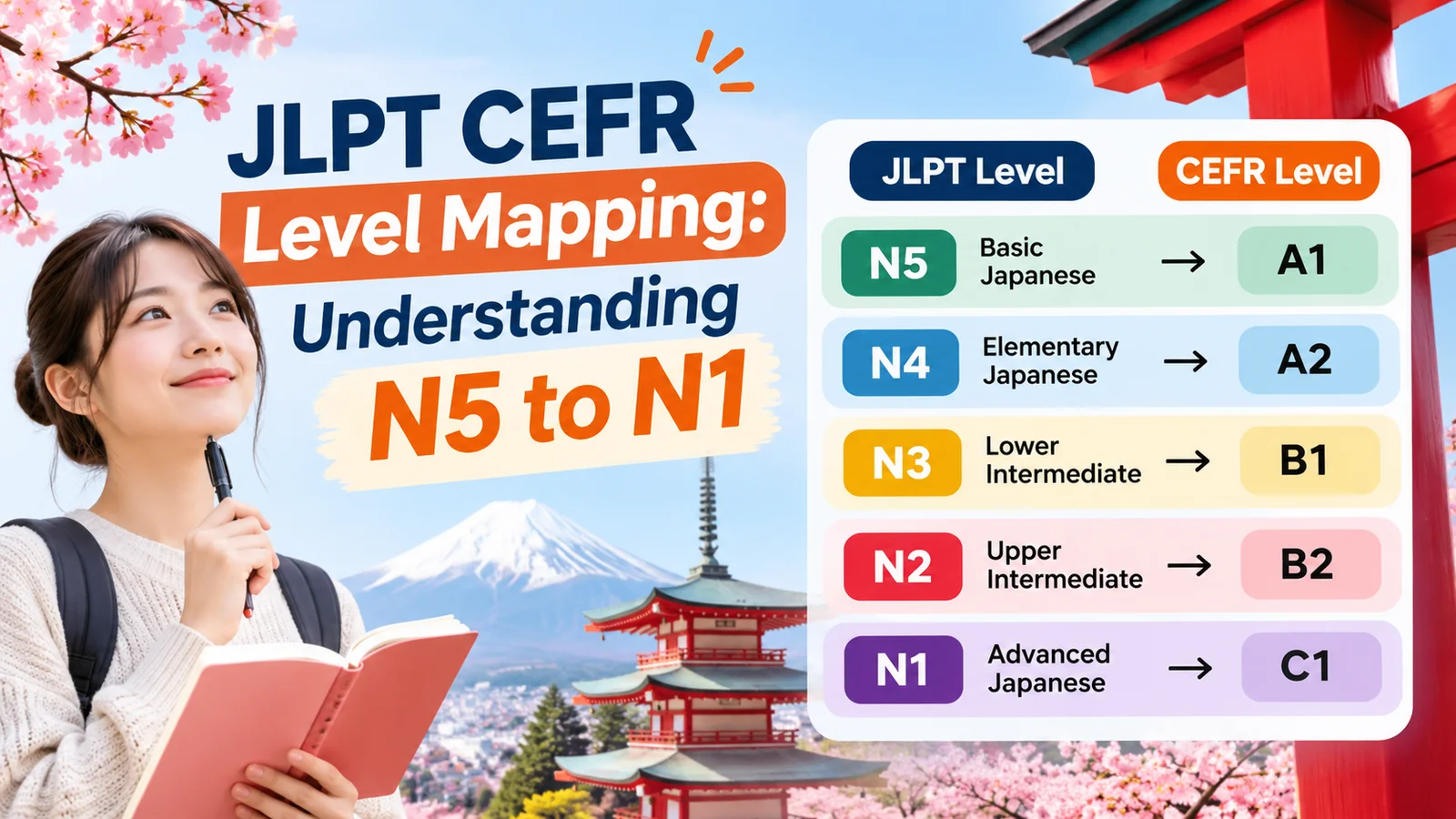
JLPT CEFR Level Mapping: Understanding N5 to N1
Published: 2026-11-14 12:56:19
If you have ever wondered how your JLPT N3 or N2 compares with an IELTS-style "B2" or "C1", you are asking the right question. Since the December 2025 JLPT, the Japan Foundation and Japan Educational Exchanges and Services (JEES) print a CEFR reference level on the score report of successful candidates. That one line changes how universities, employers and visa officers can read your result.
This guide explains the official JLPT–CEFR mapping in plain language: the exact score cut-offs, who gets a CEFR level and who does not, what the CEFR level does not measure, and how to plan your preparation level by level.
Quick answer: N5 = A1 · N4 = A2 · N3 = A2 or B1 · N2 = B1 or B2 · N1 = B2 or C1, depending on your total score.
JLPT vs CEFR at a glance
The Japanese-Language Proficiency Test (JLPT) and the Common European Framework of Reference for Languages (CEFR) measure language ability in different ways. Since the December 2025 sitting, however, official JLPT score reports include a CEFR reference level for candidates who pass, so the two scales can now be read side by side.
Key differences at a glance
- Nature of the standard
- JLPT: A standardised, multiple-choice test (N5 to N1) run officially to certify Japanese proficiency.
- CEFR: A broad international framework (A1 to C2) that describes what a learner can do in any language.
- Skills covered
- JLPT: Measures receptive skills only: Language Knowledge (vocabulary and grammar), Reading and Listening. It does not test speaking or writing (production and interaction).
- CEFR: Covers all the main skills, including Listening, Reading, Speaking and Writing.
- Maximum level
- JLPT: Tops out at N1, which maps up to CEFR C1. The JLPT does not map to C2.
JLPT to CEFR level correspondence
From the December 2025 score reports onwards, the JLPT maps total scores (out of 180) to CEFR reference levels as follows:
| JLPT level | Total score range | CEFR reference level | CEFR proficiency category |
| N5 | 80 – 180 (pass mark and above) | A1 | Basic User |
| N4 | 90 – 180 (pass mark and above) | A2 | Basic User |
| N3 | 95 – 103 | A2 | Basic User |
| N3 | 104 – 180 | B1 | Independent User |
| N2 | 90 – 111 | B1 | Independent User |
| N2 | 112 – 180 | B2 | Independent User |
| N1 | 100 – 141 | B2 | Independent User |
| N1 | 142 – 180 | C1 | Proficient User |
Note: A CEFR level is shown only to candidates who pass. N5 and N4 each map to a single level, while N3, N2 and N1 are split into two bands based on your total score.
Who each level is for
| JLPT level | CEFR reference | Who it is for |
| N5 | A1 | Absolute beginners who know basic hiragana, katakana and simple kanji |
| N4 | A2 | Learners who handle everyday topics in slow, simple Japanese |
| N3 | A2 / B1 | The bridge between classroom Japanese and real-life Japanese |
| N2 | B1 / B2 | Learners using Japanese in many everyday, academic and professional settings |
| N1 | B2 / C1 | Learners who can follow complex, abstract and specialised material |
Learn more about each level in our complete guide to Japanese language levels and the overall JLPT syllabus.
What is the CEFR?
The Common European Framework of Reference for Languages (CEFR) was published by the Council of Europe in 2001 as a shared framework for learning, teaching and assessing languages. It divides proficiency into six levels:
- A1, A2 – basic user
- B1, B2 – independent user
- C1, C2 – proficient user
Each level is described through "can-do" statements, such as what a learner can understand, say or write. The framework has been translated into dozens of languages, which is why a CEFR label is easy to read for institutions in Europe and across the world.
For Japanese, two CEFR-based frameworks matter: the Reference Framework for Japanese-Language Education from Japan's Agency for Cultural Affairs and the JF Standard for Japanese-Language Education from the Japan Foundation. The JLPT organisers used these as the basis for adding CEFR information to score reports.
How the JLPT was linked to the CEFR
The mapping is not a guess. According to the official JLPT website, the process worked like this:
- Standard setting (October 2024). Experts from Japan and abroad who know the CEFR, language testing and how Japanese learners develop judged the CEFR level (A1 to C1) of the Reading and Listening questions at each JLPT level (N5 to N1).
- Cut scores. Analysis of those judgements produced the cut scores that connect JLPT total scores to CEFR levels.
- Publication. The detailed procedure was released in a February 2024 report, and the CEFR reference indication began on score reports from the December 2025 JLPT (the original July 2025 start was postponed to give users time to prepare).
Because the JLPT only tests language knowledge (vocabulary and grammar), reading and listening, the official link stops at C1. The JLPT does not show a C2 level.
You can read the primary source on the official JLPT CEFR reference page.
Official score-to-CEFR table (N5 to N1)
The total score for every JLPT level is out of 180. Here is the official correspondence:
| JLPT level | Total score | CEFR level (for reference) |
| N5 | 80 or higher | A1 |
| N4 | 90 or higher | A2 |
| N3 | 95 – 103 | A2 |
| N3 | 104 or higher | B1 |
| N2 | 90 – 111 | B1 |
| N2 | 112 or higher | B2 |
| N1 | 100 – 141 | B2 |
| N1 | 142 or higher | C1 |
Key takeaway: N5 and N4 each map to a single CEFR level, while N3, N2 and N1 are split into two bands. Two candidates who pass N2 can therefore receive different CEFR labels.
Both the B1 shown for N3 and the B1 shown for N2 count as the same CEFR B1, according to the official JLPT FAQ.
Rules you must know before reading your result
The official page sets out three rules that many blogs skip.
1. A CEFR level appears only if you pass
If any single scoring section falls below its sectional pass mark, you fail the level, even if your total score is high. In that case the CEFR field shows an asterisk (*) instead of a level.
2. The CEFR level is based on your total score
- N1, N2 and N3 total scores combine three sections: Language Knowledge (Vocabulary/Grammar), Reading and Listening.
- N4 and N5 total scores combine two sections: Language Knowledge (Vocabulary/Grammar) plus Reading, and Listening.
3. It covers only what the JLPT tests
The JLPT maps to the CEFR's linguistic and reception (reading and listening) competences. It does not assess speaking, writing or spoken and written interaction. We come back to this in the limitations section.
Level-by-level breakdown: N5 to N1
The descriptions below paraphrase the official JLPT "Summary of Linguistic Competence" for each level and add practical context from TLS classrooms.
JLPT N5 = CEFR A1 (understanding some basic Japanese)
What the JLPT expects: You can read typical expressions and sentences in hiragana, katakana and basic kanji, and follow slow, short conversations about daily life and classroom situations.
Score for A1: 80 or above.
Where to start:
- Master hiragana and katakana first.
- Build your first kanji with our JLPT N5 kanji list.
- Use the N5 exam pattern and N5 preparation strategy for beginners to plan your weeks.
TLS course: Basic Japanese (N5)
JLPT N4 = CEFR A2 (understanding basic Japanese)
What the JLPT expects: You can read short passages on familiar topics written with basic vocabulary and kanji, and follow everyday conversations when they are spoken slowly.
Score for A2: 90 or above.
Where to go next:
- Review the N4 exam pattern.
- Follow our JLPT N4 preparation guide.
- Strengthen your verbs with Japanese transitive vs intransitive verbs.
TLS course: Intermediate Japanese (N4)
JLPT N3 = CEFR A2 or B1 (the bridge level)
What the JLPT expects: You can read concrete material on everyday topics, grasp the gist of items such as headlines, and follow coherent everyday conversations at near-natural speed. Slightly harder text becomes manageable when alternative phrasing is available.
Scores: 95–103 = A2 · 104 or above = B1.
Why this level matters: N3 is the point where many learners move from "textbook Japanese" to real-world Japanese. If you are aiming for B1, target 104 , not just the pass mark.
Where to go next:
- Understand the N3 exam pattern.
- Practise with the JLPT N3 kanji list.
- Compare adjective types in i-adjectives vs na-adjectives.
TLS course: Pre-Advance Japanese (N3)
JLPT N2 = CEFR B1 or B2 (everyday and professional Japanese)
What the JLPT expects: You can read clearly written newspaper and magazine articles, commentaries and simple critiques, and follow conversations and news at nearly natural speed.
Scores: 90–111 = B1 · 112 or above = B2.
Why it is popular: N2 is the level most often requested for jobs with Japanese companies and for many university and visa pathways. Aim for 112 if you want your report to show B2.
Where to go next:
- Study the JLPT N2 syllabus and N2 exam pattern.
- Explore career outcomes in salary after JLPT N2 in India and Japan and jobs in India for Japanese language speakers.
TLS course: Advance Japanese (N2)
JLPT N1 = CEFR B2 or C1 (advanced comprehension)
What the JLPT expects: You can read logically complex and abstract writing, such as editorials and critiques, understand both structure and content, and follow lectures, news reports and conversations at natural speed, including the relationships between speakers and the logic of their arguments.
Scores: 100–141 = B2 · 142 or above = C1.
Reality check: Passing N1 does not automatically mean C1. A candidate at 100–141 receives a B2 reference. Even with C1, remember the label covers reading and listening only.
TLS course: Super Advance Japanese (N1)
How your score report looks now
From the December 2025 JLPT, the score report includes a Reference Information section. For a candidate who passed, it shows:
- Percentage of correct responses per category (vocabulary, grammar, reading), rated A (67% or higher), B (34% to 66%) or C (below 34%)
- Percentile rank (shown for candidates who pass overseas, not for candidates in Japan)
- CEFR level for linguistic and reception competence
For candidates who do not pass, the percentile rank and the CEFR level both show an asterisk (*).
Check how and when results are released in our JLPT result guide.
What the CEFR level on your JLPT result does not tell you
- No speaking or writing. The JLPT does not test production or interaction, so a CEFR level on the score report describes your reading and listening, not your all-round ability.
- Labels are for reference. The CEFR level is supplementary information. The official result is still your pass or fail at N5, N4, N3, N2 or N1.
- Same JLPT level, different CEFR. Within N3, N2 and N1, your total score decides which CEFR label you see.
This is why serious learners combine exam preparation with real conversation practice. TLS builds this into its Japanese conversation (Kaiwa) classes and our Kaiwa guide.
Why unofficial charts disagree
Search results show many different tables, for example N3 = B1, N2 = B1–B2 and N1 = B2–C1. Older tables from universities and language-learning websites were approximate and unofficial, created before the JLPT organisers completed standard setting. Some institutions also use their own placement scales.
Use the official table in this article (and on the JLPT website) whenever you submit a result to a university, employer or visa office. If an institution quotes a different mapping, ask which scale it follows.
How to use your CEFR level for study, work and visas
- Universities and language schools: A CEFR label makes your Japanese easier to compare with other language qualifications. Read the Japan student visa language requirements and the April 2027 intake guide.
- Jobs and skilled worker pathways: Many employers still ask for "N2" or "N3", but a CEFR label helps international HR teams. For workers, see Japan Specified Skilled Worker visa and JFT-Basic 2026 for SSW Japan.
- Choosing the right test: Compare options in JLPT vs JFT-Basic, J-Test vs JLPT and JLPT vs NAT.
How TLS helps you move up the levels
TLS – The Japanese Language School teaches the full JLPT ladder, from absolute beginner to advanced, so you can move from A1 to B2 and beyond without changing institutes.
| Your goal | TLS programme |
| Start from zero | Basic Japanese (N5) |
| Reach everyday fluency | Intermediate Japanese (N4) and Pre-Advance Japanese (N3) |
| Target jobs and higher education | Advance Japanese (N2) |
| Reach expert-level comprehension | Super Advance Japanese (N1) |
| Speak with confidence | Conversation (Kaiwa) classes |
| Learn from anywhere | Online Japanese classes |
| Learn in Hindi or English | Hindi-English courses for Japanese |
| Study in Japan | Japan visa assistance and COE support |
Why learners choose TLS
- A complete N5 to N1 pathway with a dedicated focus on the JLPT exam pattern
- Kaiwa (conversation) training that covers the speaking skills the JLPT does not test
- Flexible online and classroom options
- Guidance for learners planning to study or work in Japan, including visa and COE assistance
- Classes across Delhi NCR, including Delhi, Noida, Gurugram, Ghaziabad, Faridabad and Greater Noida
Not sure which level to begin with? Take the free Japanese quiz or request a call back. You can also review course fees.
Your next JLPT date
The official JLPT website lists the second 2026 test on Sunday, December 6, 2026. Outside Japan, some cities hold the test only in July or December, so confirm your city before planning.
- JLPT December 2026 details
- JLPT December 2026 exam centres in India
- JLPT registration help
- Overseas test centres
- JLPT practice tests
- JLPT exam format
FAQs
What is the CEFR equivalent of JLPT N5 to N1?
Officially, N5 maps to A1 and N4 to A2. N3 maps to A2 or B1, N2 to B1 or B2, and N1 to B2 or C1, depending on your total score.
Is JLPT N2 equal to B2?
Not always. A passing N2 score of 90–111 is shown as B1, and a score of 112 or higher is shown as B2.
Does passing JLPT N1 mean I am C1?
Not automatically. N1 scores of 100–141 are shown as B2. You need 142 or more to see C1.
Is JLPT N3 equal to B1?
Only if your total score is 104 or higher. A score of 95–103 is shown as A2.
Does the JLPT show CEFR C2?
No. The official linking covers A1 to C1 only.
Which JLPT results show a CEFR level?
Results from the December 2025 JLPT onwards, and only for candidates who pass. Anyone who fails, including someone who misses a sectional pass mark, sees an asterisk instead.
Can I find my CEFR level if I took the JLPT earlier?
Candidates who tested between 2010 and July 2025 can use the official score-to-CEFR chart as a learning reference, even though it was not printed on their score report.
Does the CEFR level include speaking and writing?
No. It reflects the competences the JLPT tests, which are language knowledge, reading and listening.
Are N3 B1 and N2 B1 the same level?
According to the official JLPT FAQ, both are considered CEFR B1.
What total score should I aim for?
Aim above the pass mark if you need a higher CEFR label: 104 in N3 for B1, 112 in N2 for B2, and 142 in N1 for C1.
How long does it take to move between levels?
It depends on your starting point, weekly study hours and practice quality. Read our Japanese course duration guide and Japanese learning roadmap for realistic planning.
Does TLS teach all JLPT levels from N5 to N1?
Yes. TLS offers N5, N4, N3, N2 and N1, plus Kaiwa classes and online batches. More answers are on our FAQ page.
Can TLS help me move to Japan to study?
TLS provides Japan visa assistance, including documentation, COE assistance and timeline guidance.
Start your JLPT journey with TLS
Whether you are aiming for A1 with N5 or C1 with N1, the right guidance saves months of trial and error.
- 🎓 Join a batch: Apply for admission
- 📞 Talk to a counsellor: Call or WhatsApp 91 8700956038, or write to tls@teamlanguages.com (contact page)
- 📝 Find your level: Take the free Japanese quiz
- 💻 Prefer online? Explore online Japanese classes
- 🇯🇵 Planning to study in Japan? Submit a study-abroad enquiry