
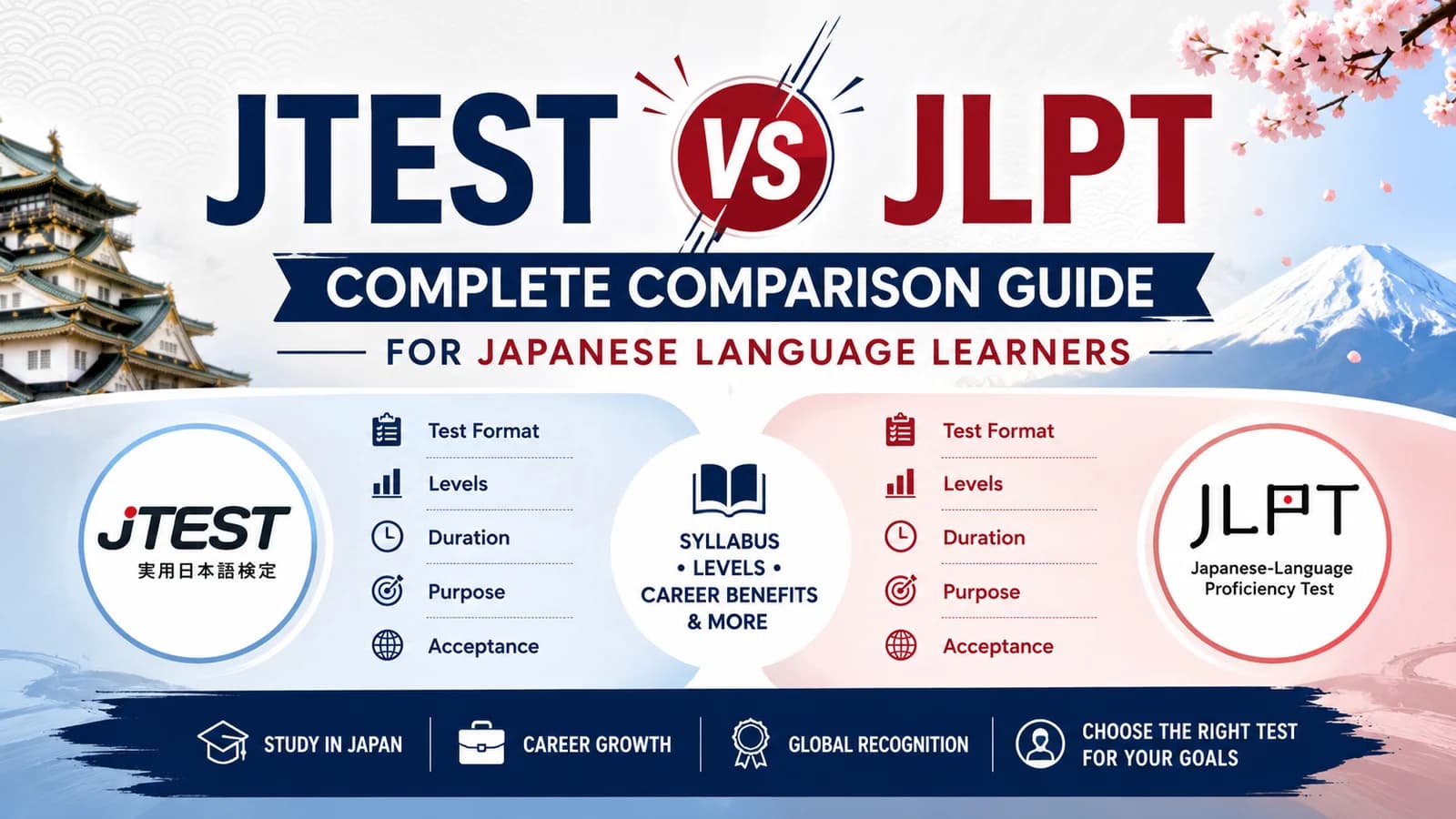
JTest vs JLPT: Complete Comparison Guide for Japanese Language Learners
Published: 2026-06-04 12:00:06
Choosing between JTest and JLPT? Both are recognized Japanese language proficiency exams, but they differ significantly in format, recognition, exam frequency, certification value, and career impact. JTest is a computer-based test held monthly in India, while JLPT is a paper-based international exam held twice a year. Understanding which exam suits your goals jobs, study in Japan, or visa purposes is critical before you invest your time and money in preparation.
Looking for complete Japan study support? Explore our guide on Japanese Language Institute in Delhi with Study in Japan Guidance.
What Is the Difference Between JTest and JLPT?
JTest (Japanese Language Test) and JLPT (Japanese Language Proficiency Test) are both standardized Japanese language certification exams, but they serve different purposes and audiences. JLPT is globally recognized and managed jointly by the Japan Foundation and Japan Educational Exchanges and Services (JEES). JTest, formally known as the J.TEST Practical Japanese Proficiency Test, is administered by the J.TEST Office in Japan and is particularly popular for business and employment contexts.
| Feature | JTest | JLPT |
| Full Name | J.TEST Practical Japanese Proficiency Test | Japanese Language Proficiency Test |
| Organizer | J.TEST Office, Japan | Japan Foundation & JEES |
| Exam Frequency | Up to 6–8 times/year | Twice a year (July & December) |
| Format | Paper Listening (some CBT) | Paper-based |
| Levels | A–F (6 levels) | N1–N5 (5 levels) |
| Skills Tested | Reading, Listening | Reading, Listening (no Speaking/Writing) |
| Global Acceptance | Moderate (Japan-focused) | High (worldwide) |
| Recognition for Study Visa | Limited | High |
| Recognition for Work in Japan | Moderate–High | Very High |
| Official Website | www.jtest.jp | www.jlpt.jp |
JTest vs JLPT: Which Exam Should You Take?
If your goal is to work in Japan in sectors like manufacturing, caregiving, or IT — both JTest and JLPT are accepted, but JLPT N4/N3 is more universally demanded by Japanese employers. JTest is particularly valued in industries that hire through Japanese recruitment agencies and SSW (Specified Skilled Worker) visa channels, where JTest A-C level is often accepted alongside JLPT.
For studying in Japan, JLPT N2 or N1 is almost always required by Japanese universities and language schools. JTest does not have the same traction in academic visa applications.
Planning to work in Japan? Learn everything about the JFT Basic Exam, including eligibility, syllabus, and registration process.
What Is JTest? A Detailed Overview
JTest (J.TEST) is a practical proficiency exam designed to assess real-world Japanese communication skills, especially for the workplace. It was developed by the J.TEST Office in Japan and is widely used by Japanese companies when hiring non-native speakers.
JTest Levels Explained:
- Level A–B: Equivalent to advanced Japanese (JLPT N1–N2 range)
- Level C–D: Equivalent to intermediate Japanese (JLPT N3–N4 range)
- Level E–F: Equivalent to beginner Japanese (JLPT N5 range)
JTest Exam Pattern:
- Reading Section: Vocabulary, grammar, reading comprehension
- Listening Section: Audio-based comprehension questions
- Duration: Approximately 2 hours
- Scoring: 0–1000 points (combined reading listening)
JTest Official Website: https://www.jtest.jp
Learn everything about JLPT registration in India, including exam schedules and city-wise test centers.
What Is JLPT? A Detailed Overview
JLPT (Japanese Language Proficiency Test) is the world's most widely recognized Japanese language certification exam. Established in 1984 and revised in 2010, it tests reading and listening comprehension across five levels.
JLPT Levels Explained:
- N1: Mastery-level; required for most professional roles in Japan
- N2: Business proficiency; accepted for most SSW and technical visas
- N3: Intermediate; accepted for basic employment and some visa categories
- N4: Elementary; foundation for entry-level roles in Japan
- N5: Beginner; certification of basic understanding
JLPT Exam Pattern:
- Reading Comprehension: Grammar, vocabulary, text reading
- Listening Comprehension: Audio passages and Q&A
- No speaking or writing assessment
- Duration: 1 hour 45 minutes (N5) to 3 hours 10 minutes (N1)
- Scoring: Scaled score system with passing threshold per section
JLPT Official Website: https://www.jlpt.jp
JLPT India Registration: https://www.jlpt.jp
Looking for flexible Japanese learning? Explore our Online Japanese Language Course in India designed for students and working professionals.
JTest vs JLPT: Exam Frequency and Availability in India
JLPT is held only twice a year in India — in July and December — making it crucial to plan your preparation timeline carefully. Missing a registration window means waiting six more months.
JTest is held approximately 6–8 times per year, with exam centers in major Indian cities. This makes JTest more accessible for candidates who need certification quickly for job placements or visa applications.
For candidates in Delhi, Noida, Gurgaon, and the NCR region, both exams have registered centers. JLPT centers in India include New Delhi, Mumbai, Chennai, Kolkata, Hyderabad, Bengaluru, and Pune. JTest centers are also expanding across India.
Key takeaway: If you missed the JLPT registration window, JTest offers more frequent opportunities and may still satisfy your employer's language requirement.
JTest vs JLPT: Exam Difficulty Level Comparison
JLPT is generally considered more structured and standardized, while JTest is considered more practical and business-oriented.
- JTest Level A = JLPT N1 (approximately)
- JTest Level C = JLPT N3 (approximately)
- JTest Level E–F = JLPT N5 (approximately)
Many candidates find JTest slightly more flexible because its scoring is continuous (point-based) rather than pass/fail by level sections. In JLPT, you must meet the minimum threshold in each section separately — failing one section fails the entire test even if your total score is high.
For beginners in India, JLPT N5 and N4 are recommended as starting points due to their worldwide recognition and clear syllabus. JTest Level E–F is a good parallel option for those preparing for Japanese job placements quickly.
Learn everything about MEXT Scholarship 2027, including application dates, required documents, and selection criteria.
JTest vs JLPT: Certification Value and Recognition
JLPT certification is recognized globally and is the gold standard for Japanese language proficiency. It is accepted by:
- Japanese universities and language schools for student visa applications
- Most Japanese employers across all sectors
- Government bodies in Japan for visa and work permit evaluations
- Multinational companies in India hiring Japanese-speaking professionals
JTest is recognized primarily within Japan's employment ecosystem, especially through Japanese staffing agencies, manufacturing companies, and some SSW visa pathways. JTest is gaining traction but is not yet as universally accepted for academic or immigration purposes.
Verdict on recognition: If you're targeting a global career or academic route in Japan, choose JLPT. If you're pursuing a specific job in Japan through a recruitment agency, JTest may suffice.
Wondering about visa approval chances? Read our complete guide on Is Japan Student Visa Easy to Get for Indian Students? for eligibility, requirements, and expert tips.
JTest vs JLPT: Which Is Better for Jobs in Japan?
For working in Japan, JLPT N3 or N2 remains the most demanded certification by Japanese employers in 2026. However, JTest is increasingly accepted in specific industries:
- Manufacturing & Factory jobs: JTest Level C–D is often accepted alongside JLPT N4–N3
- Caregiving (Tokutei Gino / SSW Visa): JLPT N4 or JFT-Basic is typically required; JTest is not a standard substitute here
- IT and Engineering: JLPT N2 is preferred; JTest Level B is sometimes accepted
- Translation and Interpretation: JLPT N1 is the industry standard
For Indian professionals targeting Japan jobs through agencies in Delhi, Noida, or Gurgaon, it's advisable to hold both certifications if possible — JLPT for visa and formal recognition, JTest as a supplementary credential to showcase practical proficiency.
JTest vs JLPT for SSW Visa (Specified Skilled Worker Visa Japan)
For the SSW (Specified Skilled Worker) visa from India to Japan, the Japanese government primarily recognizes JLPT N4 or the JFT-Basic (Japan Foundation Test for Basic Japanese) — not JTest. This is a critical distinction for Indian workers targeting SSW visa categories in industries like food service, agriculture, hospitality, and construction.
JTest is not an officially listed language requirement for SSW visa applications as of 2026. Candidates should confirm directly with the Japan Embassy in New Delhi or their sponsoring organization about accepted certifications.
Reference links:
Starting your Japanese language journey? Read our complete JLPT N5 Study Guide for Indian Students for syllabus, study plans, and exam preparation tips.
JTest vs JLPT: Syllabus and Preparation Differences
JLPT preparation requires a structured study plan covering:
- Vocabulary (Moji/Goi)
- Grammar patterns
- Reading comprehension passages
- Listening comprehension (audio-based)
JTest preparation requires:
- Business Japanese vocabulary
- Grammar in context
- Listening to practical conversation scenarios
- Reading practical documents (reports, emails, signs)
JTest leans toward practical, real-world language use. JLPT is more academic in its approach, especially at N2 and N1 levels. Students preparing for JLPT benefit from structured coursework with dedicated JLPT-oriented trainers, while JTest preparation can be self-guided with business Japanese materials.
Completed your 12th and looking for a rewarding career path? Explore our complete guide on Japanese Language Course After 12th.
JTest vs JLPT: Exam Fees Comparison (India, 2026)
| Exam | Approximate Fee in India |
| JLPT N5 | ₹2,000 – ₹2,500 |
| JLPT N4 | ₹2,000 – ₹2,500 |
| JLPT N3 | ₹2,000 – ₹2,500 |
| JLPT N2 | ₹2,000 – ₹2,500 |
| JLPT N1 | ₹2,000 – ₹2,500 |
| JTest (varies by level) | ₹1,500 – ₹3,000 |
Fees are subject to change. Always verify at the official websites before registering.
JTest vs JLPT: Validity of Certification
Both JTest and JLPT certificates do not expire — they are issued as permanent records of achievement at the time of testing. However, many Japanese employers and universities may prefer recent certifications (within the last 2–3 years) as evidence of current proficiency.
Which Japanese Exam Is Easier — JTest or JLPT?
Neither exam is universally easier — it depends on your goals and study style. JLPT has a clearly defined syllabus and extensive preparation materials globally. JTest is more practical and conversational but has fewer prep resources available outside Japan.
For absolute beginners in India learning Japanese from scratch, JLPT N5 is the recommended starting point due to abundant study materials, a clear curriculum, and global recognition. Candidates can then progress through N4, N3, N2, and N1 with structured coaching.
Planning to study in Japan with financial support? Explore our guide on Japanese Government MEXT Scholarship Types & Eligibility.
JTest and JLPT: N-Level Comparison Breakdown
JTest vs JLPT N5 Comparison
JLPT N5 tests basic vocabulary (~800 words), hiragana, katakana, and simple kanji (about 100). JTest Level E–F tests similar beginner content but with more emphasis on listening to natural conversation.
JTest vs JLPT N4 Comparison
JLPT N4 requires ~1,500 vocabulary words and ~300 kanji. JTest Level D is comparable in scope but includes workplace scenarios.
JTest vs JLPT N3 Comparison
JLPT N3 is the intermediate bridge level requiring ~3,750 vocabulary words and ~650 kanji. JTest Level C covers similar territory with a practical business slant.
JTest vs JLPT N2 Comparison
JLPT N2 is the most demanded level for employment in Japan. Approximately 10,000 vocabulary words and 1,000 kanji. JTest Level B is roughly equivalent but not always substitutable for employers who specifically list "JLPT N2."
JTest vs JLPT N1 Comparison
JLPT N1 is mastery level. JTest Level A is comparable in difficulty. Both are respected at the highest tier, but JLPT N1 is more universally valued in academia and professional settings globally.
Looking for the best place to learn Japanese? Explore our guide on Japanese Institute Near Me – Best Japanese Language Institute in Delhi
Why Indian Students and Professionals Should Start with JLPT
For Indian learners — whether in Delhi, Mumbai, Bangalore, Hyderabad, Pune, or Jaipur — JLPT remains the more strategic first choice because:
- It is accepted for student visa applications to Japan
- It is the standard listed in most Japanese job requirements from India
- It has a rich ecosystem of study resources in Hindi and English
- JLPT N3 and above are recognized for SSW visa-adjacent pathways
- Indian universities and corporate HR departments recognize JLPT more readily than JTest
Start Your Japanese Language Journey with TLS — The Japanese Language School, Delhi
If you're preparing for JLPT or JTest in India, TLS (Team Language School) in Laxmi Nagar, New Delhi is one of the most trusted Japanese language institutes in Delhi NCR. With courses ranging from Basic Japanese (N5) to Super Advanced (N1), TLS offers:
- Basic Japanese N5 Course
- Intermediate Japanese N4 Course
- Pre-Advance Japanese N3 Course
- Advance Japanese N2 Course
- Super Advance Japanese N1 Course
- Online Japanese Language Course
- Conversation Classes in Japanese (Kaiwa)
- JLPT Coaching and Preparation
- Japan Visa Assistance
TLS provides JLPT-oriented structured training, experienced Japanese-certified faculty, and end-to-end Japan visa support — making it a one-stop solution for learners across Delhi, Noida, Gurgaon, Faridabad, and across India via online classes.
Related Reading from TLS Blog:
- JLPT July 2026 Complete Guide
- JLPT vs NAT Test Comparison
- JLPT vs JFT-Basic
- Jobs in India for Japanese Language Speakers
- Career After Learning Japanese Language
- Salary After JLPT N2 in India and Japan
- SSW Visa Japan from India
- Study in Japan Guide
- Work in Japan from India
- JLPT Exam Registration 2026
Frequently Asked Questions (FAQs): JTest vs JLPT
Is JTest accepted like JLPT in Japan?
JTest is accepted by many Japanese companies, especially in manufacturing, construction, and service industries. However, it is not universally accepted for student visas, SSW visas, or academic programs, where JLPT remains the standard. Always check with your specific employer or institution.
Which is harder — JTest or JLPT?
Both exams are comparable in difficulty at equivalent levels. JLPT is more standardized with a defined vocabulary and kanji list per level. JTest is more practical and may feel harder for those without business Japanese exposure. Neither is categorically harder — it depends on your training and goals.
Can I use JTest for Japan work visa?
JTest is accepted by some Japanese employers for hiring purposes. However, the SSW (Specified Skilled Worker) visa officially recognizes JLPT N4 or JFT-Basic — not JTest. For technical intern training (TITP), language requirements vary by industry.
How many times is JLPT held in India?
JLPT is held twice a year in India — in July and December. Registration typically opens 3–4 months before the exam. Check jlptsaa.com for India-specific dates.
How many times is JTest held in India?
JTest is held approximately 6–8 times a year in India, making it more accessible for candidates who need certification urgently. Check jtest.jp for the current schedule.
Which exam is better for getting a job in Japan — JTest or JLPT?
For most job categories in Japan, JLPT N3 or N2 is the most demanded certification. JTest is a useful supplementary credential but does not replace JLPT in formal job requirement listings by most Japanese companies.
Is JLPT N2 equivalent to JTest Level B?
Yes, broadly speaking, JTest Level B is considered roughly equivalent to JLPT N2 in terms of proficiency. However, they are scored differently and not directly interchangeable for official purposes.
Which Japanese exam should I take first as a beginner in India?
Start with JLPT N5 for globally recognized entry-level certification. It has the widest availability of study materials, clear syllabus, and sets a strong foundation for advancing to N4, N3, N2, and N1.
Does TLS prepare students for both JTest and JLPT?
Yes. TLS — The Japanese Language School in Laxmi Nagar, New Delhi — offers structured coaching for JLPT at all levels (N5 to N1) and provides guidance for JTest preparation as part of its advanced courses. Contact TLS at 91-8700956038 or tls@teamlanguages.com for a free counseling session.
Final Verdict: JTest vs JLPT — Which Should You Choose?
Choose JLPT if:
- You want universally recognized Japanese certification
- You plan to study in Japan (student visa requires JLPT)
- You're targeting jobs that specifically list JLPT requirements
- You're applying for SSW or engineer visas to Japan
- You want to work in India with Japanese-speaking roles at MNCs
Choose JTest if:
- You need certification more frequently (more exam dates)
- Your specific Japanese employer accepts JTest
- You want to supplement your JLPT certificate with a practical proficiency score
- You're in a time-sensitive job placement process
The best approach for serious learners in 2026: Pursue JLPT as your primary certification and consider JTest as a complementary credential for specific employment contexts.
Visit TLS — The Japanese Language School
Ready to begin your Japanese language journey? Whether you're aiming for JLPT N5 or N1, preparing for jobs in Japan, or seeking study-in-Japan guidance — TLS is here to guide you every step of the way.
📍 Visit Us: 2/81-82, 2nd Floor, Lalita Park, Gali No - 2, Laxmi Nagar, New Delhi - 110092
📞 Call Us: 91-8700956038
📧 Email Us: tls@teamlanguages.com
🌐 Website: www.teamlanguages.com
Enroll Now | View All Courses | Free Japanese Quiz | Contact Us