

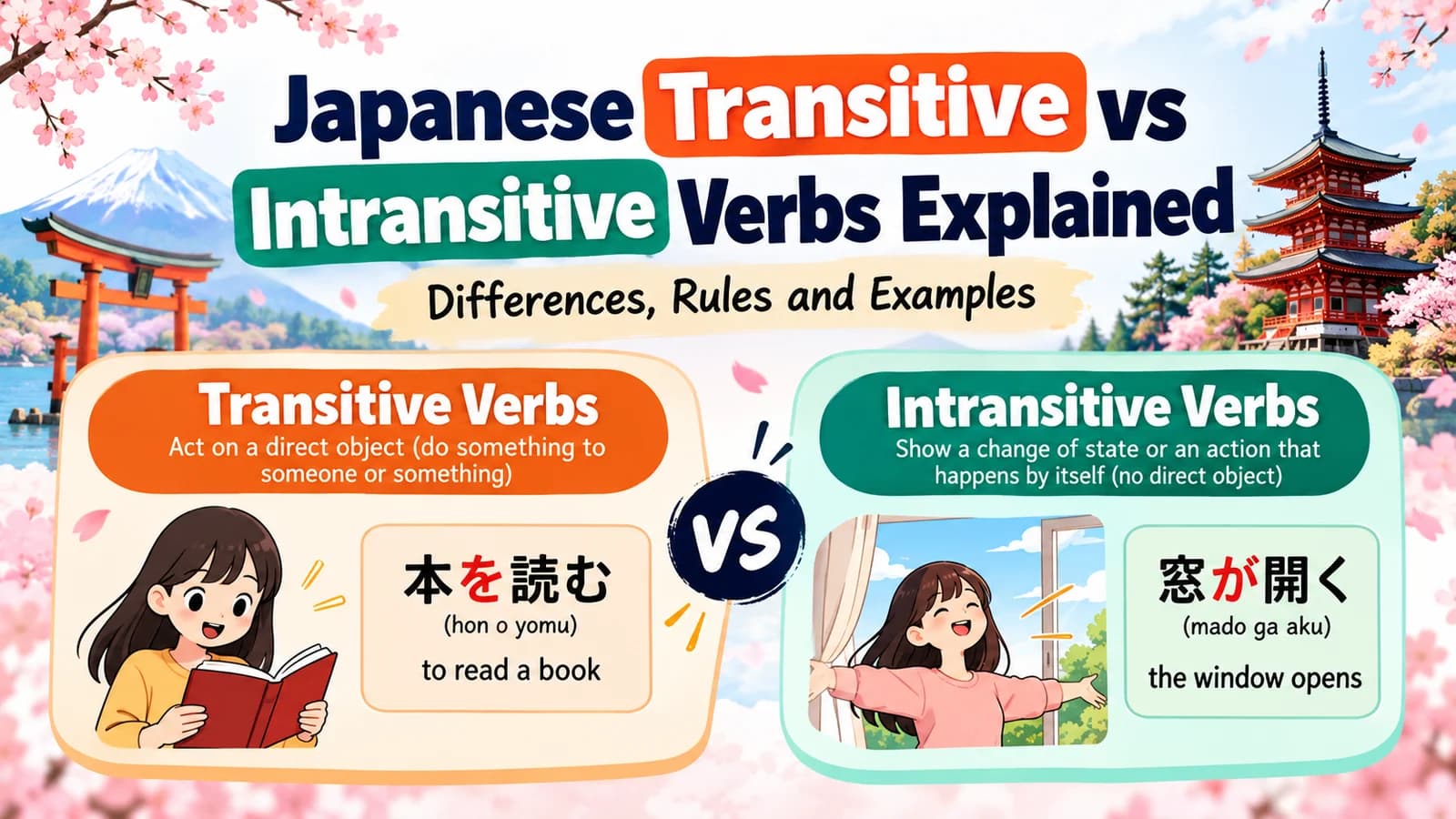
Japanese Transitive vs Intransitive Verbs Explained: Differences, Rules and Examples
Published: 2026-10-14 13:23:56
Almost every beginner makes the same mistake sooner or later. You want to say "The door opened," but you say "Doa o akemashita" and your teacher smiles and corrects you to "Doa ga akimashita." One tiny particle and one tiny verb ending change the whole meaning. This is the world of Japanese transitive and intransitive verbs.
Japanese has many verb pairs where one verb means "someone does something to a thing" and its partner means "something happens by itself." English usually uses a single verb for both ("open", "break", "change"), which is why this topic feels confusing at first. It becomes much easier once you see the logic.
In this guide you will learn:
- what transitive and intransitive verbs are in Japanese, in plain English
- the key difference between transitive and intransitive verbs in Japanese
- how the particles を (o) and が (ga) help you decide
- a Japanese transitive verb list, a Japanese intransitive verb list and a Japanese verb pairs with meanings table
- conjugation, everyday conversations, common mistakes and JLPT N5/N4 tips
Every example includes Japanese, romaji and English translation, so this works as Japanese grammar explained in English even if you are just starting out.
Quick answer: A transitive verb (他動詞, tadōshi) acts on an object and usually takes を. An intransitive verb (自動詞, jidōshi) has no object, usually takes が with its subject, and describes something that happens or someone who moves or exists. Example: ドアを開ける (doa o akeru), "open the door" → ドアが開く (doa ga aku), “the door opens.”
You can learn essential Japanese greetings and phrases for beginners to improve your basic Japanese vocabulary and everyday conversations.
What Are Transitive and Intransitive Verbs in Japanese?
Every verb falls broadly into one of two groups, depending on whether the action is done to something else or just happens or is done by the subject alone.
The Japanese names make this easy to remember:
| Term | Japanese | Literal meaning | Memory hook |
| Transitive verb | 他動詞 (たどうし, tadōshi) | "other" verb | The action goes to an other thing |
| Intransitive verb | 自動詞 (じどうし, jidōshi) | "self" verb | The action stays with the self (the subject) |
In dictionaries you will often see 他 or 自 marked next to a verb. Now you know what they mean.
What Is a Transitive Verb in Japanese? Meaning and Examples
A transitive verb is a verb that does something to something else. There is a person (or force) acting and a thing being acted upon. Ask "what?" after the verb. If you get a sensible answer, the verb is probably transitive.
How to use transitive verbs in Japanese sentences:
[Subject] が/は [Object] を [Transitive verb]
| Japanese | Romaji | English |
| コーヒーを飲みます。 | Kōhī o nomimasu. | I drink coffee. |
| 本を読みました。 | Hon o yomimashita. | I read a book. |
| パンを食べませんでした。 | Pan o tabemasen deshita. | I didn't eat the bread. |
| 新しいセーターを買いました。 | Atarashii sētā o kaimashita. | I bought a new sweater. |
| 母がドアを開けました。 | Haha ga doa o akemashita. | Mother opened the door. |
What do you drink? Coffee. What did you read? A book. Because there is an object receiving the action, these are transitive verbs.
Learn the difference between Japanese I-adjectives and Na-adjectives to improve your Japanese grammar and sentence formation.
What Is an Intransitive Verb in Japanese? Meaning and Examples
An intransitive verb has no object. The action simply happens, or the subject itself moves, exists or changes. Asking "what?" after the verb sounds strange ("What did I go?"), which is a good sign you are dealing with an intransitive verb.
How to use intransitive verbs in Japanese sentences:
[Subject] が/は [Intransitive verb]
| Japanese | Romaji | English |
| ドアが開きました。 | Doa ga akimashita. | The door opened. |
| 学校に行きます。 | Gakkō ni ikimasu. | I go to school. |
| 東京で働きます。 | Tōkyō de hatarakimasu. | I work in Tokyo. |
| 赤ちゃんが泣いています。 | Akachan ga naite imasu. | The baby is crying. |
| 雨が降っています。 | Ame ga futte imasu. | It is raining. |
Notice the difference: ドアを開けました (someone opened the door) vs ドアが開きました (the door opened). The first tells us a person acted. The second tells us only that the door changed state, so we don't know who or what caused it.
If you are planning to learn Japanese, read our guide on how to choose a Japanese language institute in Delhi to make an informed decision.
Difference Between Japanese Transitive and Intransitive Verbs
Here is a side-by-side comparison. It answers the question learners search most: what is the difference between transitive and intransitive verbs in Japanese?
| Feature | Transitive (他動詞) | Intransitive (自動詞) |
| Meaning | Someone does something to something | Something happens / someone moves or exists |
| Takes an object? | Yes | No |
| Usual particle | Object を | Subject が |
| "What?" test | Makes sense ("drink what?") | Doesn't make sense ("go what?") |
| English example | I opened the door | The door opened |
| Japanese example | ドアを開ける (akeru) | ドアが開く (aku) |
| Focus | The person or cause doing the action | The result or change itself |
| Tone | Shows intention and responsibility | Neutral, spontaneous, or "it just happened" |
Why does this matter in real life? Choosing the right verb changes whether you sound like you caused something or it just happened.
- 窓を割りました。 (Mado o warimashita.) "I broke the window." (You did it.)
- 窓が割れました。 (Mado ga waremashita.) "The window broke." (It broke, so you are not necessarily to blame.)
Japanese speakers often use intransitive verbs to describe accidents or natural changes, because they sound softer and less accusing.
A key difference from English. In English, "understand French" has a direct object, so it counts as transitive. In Japanese grammar, the French language isn't being affected, so verbs like わかる (wakaru, to understand) are intransitive and usually take が: フランス語がわかります (Furansugo ga wakarimasu). Always think "is something being acted upon?" instead of translating word-for-word from English.
Not the same as active vs passive. Transitive/intransitive and active/passive are different ideas. 開ける is transitive. The passive form 開けられる ("be opened") is built on top of a transitive verb. Learn passive later at a higher level.
Explore common Japanese phrases used in anime to learn popular expressions and understand everyday Japanese dialogue.
Japanese Transitive vs Intransitive Verbs with Examples and English Meanings
Now let's build vocabulary. These lists will help you with Japanese verbs for beginners and give you ready-to-use Japanese verb usage examples.
Common Japanese Transitive Verbs for Beginners
This Japanese transitive verb list covers the verbs you will meet in the first weeks of study.
| Verb | Romaji | Meaning | Example sentence | Romaji | English |
| 食べる | taberu | eat | ごはんを食べる。 | Gohan o taberu. | I eat a meal. |
| 飲む | nomu | drink | 水を飲む。 | Mizu o nomu. | I drink water. |
| 読む | yomu | read | 新聞を読む。 | Shinbun o yomu. | I read the newspaper. |
| 書く | kaku | write | 名前を書く。 | Namae o kaku. | I write my name. |
| 見る | miru | watch / see | テレビを見る。 | Terebi o miru. | I watch TV. |
| 聞く | kiku | listen / ask | 音楽を聞く。 | Ongaku o kiku. | I listen to music. |
| 買う | kau | buy | かばんを買う。 | Kaban o kau. | I buy a bag. |
| 作る | tsukuru | make | 料理を作る。 | Ryōri o tsukuru. | I make food. |
| 使う | tsukau | use | 辞書を使う。 | Jisho o tsukau. | I use a dictionary. |
| 洗う | arau | wash | 手を洗う。 | Te o arau. | I wash my hands. |
| 待つ | matsu | wait for | バスを待つ。 | Basu o matsu. | I wait for the bus. |
| 勉強する | benkyō suru | study | 日本語を勉強する。 | Nihongo o benkyō suru. | I study Japanese. |
Common Japanese Intransitive Verbs for Beginners
This Japanese intransitive verb list covers movement, existence and natural events.
| Verb | Romaji | Meaning | Example sentence | Romaji | English |
| 行く | iku | go | 駅へ行く。 | Eki e iku. | I go to the station. |
| 来る | kuru | come | 友達が来る。 | Tomodachi ga kuru. | A friend comes. |
| 帰る | kaeru | return home | 家に帰る。 | Ie ni kaeru. | I go home. |
| 起きる | okiru | wake up / get up | 六時に起きる。 | Rokuji ni okiru. | I get up at six. |
| 寝る | neru | sleep / go to bed | 十一時に寝る。 | Jūichiji ni neru. | I go to bed at eleven. |
| 働く | hataraku | work | 会社で働く。 | Kaisha de hataraku. | I work at a company. |
| 泣く | naku | cry | 子供が泣く。 | Kodomo ga naku. | The child cries. |
| 笑う | warau | laugh | 彼が笑う。 | Kare ga warau. | He laughs. |
| 泳ぐ | oyogu | swim | 海で泳ぐ。 | Umi de oyogu. | I swim in the sea. |
| 走る | hashiru | run | 公園で走る。 | Kōen de hashiru. | I run in the park. |
| 住む | sumu | live (reside) | 東京に住む。 | Tōkyō ni sumu. | I live in Tokyo. |
| 降る | furu | fall (rain/snow) | 雪が降る。 | Yuki ga furu. | Snow falls. |
Japanese Verb Pairs You Should Learn Together
This is where Japanese is special. Many verbs come in pairs that share the same kanji and a similar sound, but differ in transitivity. Different sources count a few hundred such pairs in modern Japanese, so they are worth learning together.
| Transitive (someone does it) | Intransitive (it happens) | Meaning |
| 開ける (akeru) | 開く (aku) | open |
| 閉める (shimeru) | 閉まる (shimaru) | close |
| つける (tsukeru) | つく (tsuku) | turn on |
| 消す (kesu) | 消える (kieru) | turn off / disappear |
| 始める (hajimeru) | 始まる (hajimaru) | start |
| 止める (tomeru) | 止まる (tomaru) | stop |
Tip: Never memorise just one half. When you learn 開ける, learn 開く in the same breath. That is the easy way to learn Japanese verb pairs.
Prepare for the JLPT with our guide to the JLPT preparation course in Delhi and improve your Japanese language skills for the exam.
How to Identify Transitive and Intransitive Verbs in Japanese
Here is a practical, step-by-step method for how to identify transitive and intransitive verbs in Japanese.
Step 1: Ask the "what?" question. Put "what?" after the English verb. "I drink what?" works → transitive. "I go what?" doesn't → intransitive.
Step 2: Look for を. If an object marked with を directly follows, the verb is almost certainly transitive: コーヒーを飲む.
Step 3: Look for が marking the thing that changes. If the noun with が is the one that opens, breaks, stops or appears, the verb is intransitive: ドアが開く.
Step 4: Check the pair. If the verb has a twin (開ける/開く), decide which twin matches your meaning: "someone did it" (transitive) or "it happened" (intransitive).
Step 5: Use the dictionary. Good dictionaries mark verbs as 他 or 自, or as "transitive verb" and "intransitive verb". Always check example sentences too, not just the label.
Step 6: Use the ending as a hint, not a rule.
| Common pattern | Transitive | Intransitive | Example |
| -eru ↔ -aru | -eru | -aru | 閉める ↔ 閉まる, 始める ↔ 始まる |
| -su ↔ -eru / -ru | -su | -eru / -ru | 消す ↔ 消える, 出す ↔ 出る |
| -eru ↔ -u | -eru | -u | 開ける ↔ 開く, 入れる ↔ 入る |
Endings are helpful hints, but there are many exceptions. 入れる (ireru, put in) ends in -eru like 閉める, yet its partner is 入る (hairu, enter), not -aru. If a pattern fails, trust the dictionary and the sentence.
Quick checklist:
- Object を → transitive
- Subject が change/movement/existence → intransitive
- Place に/へ/で verb of movement or being → intransitive
- When unsure, check the pair.
Explore the best Japanese language courses in Delhi and their fees to compare course options and plan your Japanese learning journey.
Japanese Transitive and Intransitive Verbs: How to Use Particles
Particles are your best friends here. This section covers Japanese verb particles を and が, which are also essential for Japanese verb particles for JLPT preparation.
How to Use the Japanese Particle を (O) with Transitive Verbs
を marks the direct object, the thing that receives the action.
Object を Transitive verb
| Japanese | Romaji | English |
| 電気をつけます。 | Denki o tsukemasu. | I turn on the light. |
| 窓を閉めます。 | Mado o shimemasu. | I close the window. |
| 水を出します。 | Mizu o dashimasu. | I let the water out (turn the water on). |
| 荷物を落としました。 | Nimotsu o otoshimashita. | I dropped my luggage. |
| 授業を始めます。 | Jugyō o hajimemasu. | I will start the class. |
Remember the pronunciation: を is pronounced "o", not "wo", in modern Japanese.
How to Use the Japanese Particle が (Ga) with Intransitive Verbs
が marks the subject, the thing that changes, moves or exists. With an intransitive verb, が often points to the thing that "just happens".
Subject が Intransitive verb
| Japanese | Romaji | English |
| 電気がつきました。 | Denki ga tsukimashita. | The light came on. |
| 窓が閉まります。 | Mado ga shimarimasu. | The window closes. |
| 水が出ます。 | Mizu ga demasu. | Water comes out. |
| 荷物が落ちました。 | Nimotsu ga ochimashita. | The luggage fell. |
| 授業が始まります。 | Jugyō ga hajimarimasu. | Class begins. |
Compare the pairs: 電気をつける (I turn on the light) vs 電気がつく (the light comes on). Same event, different viewpoint.
Start your Japanese learning journey with this guide to learning Japanese as a complete beginner and build a strong foundation in the language.
Common Particle Mistakes in Japanese Grammar
Particles are a great clue, but they are not a perfect rule. Watch out for these situations:
- Particles are often dropped in conversation. Japanese speakers omit objects and subjects when the context is clear. A short sentence like 始まる前に行きなさい ("Go before it starts") has no visible particle. The verb type still stands.
- Some intransitive verbs take に or で, not が or を. 学校に行く (go to school), お風呂に入る (take a bath), 電車に乗る (ride a train). These are intransitive. The に marks a destination, not an object.
- Some intransitive verbs of movement use を for a path.
- 公園を歩く (kōen o aruku): walk through the park
- 川を泳ぐ (kawa o oyogu): swim across the river
- 橋を渡る (hashi o wataru): cross the bridge
- 家を出る (ie o deru): leave the house
- These verbs are still intransitive. In these sentences を shows a route or starting point, not an object being affected.
- Existence and ability verbs usually take が. ある, いる, わかる, できる and 見える take が: 友達がいる (I have friends), 日本語がわかる (I understand Japanese).
- Desire verbs can take が or を. With ~たい, both are common: すしが食べたい / すしを食べたい ("I want to eat sushi"). が feels like a spontaneous craving. を feels more like an intention to eat it.
- Don't assume が means intransitive. A transitive verb can have a が-marked subject: 私が本を読みました ("I read the book"). Check what the verb does, not only which particle you see.
Japanese Transitive and Intransitive Verb Conjugation Rules
Good news: transitivity doesn't change how a verb conjugates. A transitive and an intransitive verb follow the same Japanese grammar rules for verbs. What matters is the verb's group:
| Group | Also called | How to spot it | Example |
| Group 1 | Godan / u-verbs | Ends in う, く, ぐ, す, つ, ぬ, ぶ, む, る (not -iru/-eru) | 飲む, 書く, 開く |
| Group 2 | Ichidan / ru-verbs | Ends in -iru or -eru (most) | 食べる, 開ける, 起きる |
| Group 3 | Irregular | する and 来る | する, 来る |
How to Conjugate Japanese Transitive Verbs
| Verb | Dictionary | Polite (-masu) | Te-form | Past (-ta) | Negative (-nai) |
| 食べる (eat) | taberu | tabemasu | tabete | tabeta | tabenai |
| 飲む (drink) | nomu | nomimasu | nonde | nonda | nomanai |
| 開ける (open sth) | akeru | akemasu | akete | aketa | akenai |
| 消す (turn off) | kesu | keshimasu | keshite | keshita | kesanai |
| 閉める (close sth) | shimeru | shimemasu | shimete | shimeta | shimenai |
Tip: 食べる, 開ける and 閉める are Group 2 (ru-verbs), so they simply drop る. 飲む and 消す are Group 1 (u-verbs), so their endings change (飲む → 飲んで, 消す → 消して).
Practice for your upcoming JLPT exam with these JLPT practice tests to assess your Japanese language skills and improve your exam preparation.
How to Conjugate Japanese Intransitive Verbs
| Verb | Dictionary | Polite (-masu) | Te-form | Past (-ta) | Negative (-nai) |
| 開く (open itself) | aku | akimasu | aite | aita | akanai |
| 閉まる (close itself) | shimaru | shimarimasu | shimatte | shimatta | shimaranai |
| 消える (go out) | kieru | kiemasu | kiete | kieta | kienai |
| 行く (go) | iku | ikimasu | itte | itta | ikanai |
| 泣く (cry) | naku | nakimasu | naite | naita | nakanai |
| 来る (come) | kuru | kimasu | kite | kita | konai |
Watch the irregular te-form of 行く (行って, not 行いて).
Japanese Verb Forms with Simple Sentence Examples
1. Polite present and past
- ドアを開けます。 / ドアが開きます。 Doa o akemasu. / Doa ga akimasu. "I open the door. / The door opens."
- 窓を閉めました。 / 窓が閉まりました。 Mado o shimemashita. / Mado ga shimarimashita. "I closed the window. / The window closed."
2. Te-form requests (transitive verbs are common here)
- 電気を消してください。 Denki o keshite kudasai. "Please turn off the light."
- ドアを閉めてください。 Doa o shimete kudasai. "Please close the door."
You cannot politely ask someone to make something happen "by itself" with an intransitive verb, so requests normally use the transitive twin.
3. Negative
- 窓を開けません。 Mado o akemasen. "I don't open the window."
- ドアが開きません。 Doa ga akimasen. "The door won't open."
4. ~ている with each type (an important contrast)
| Type | Meaning of ~ている | Example | English |
| Transitive | Action in progress | 本を読んでいます。 Hon o yonde imasu. | I am reading a book. |
| Intransitive (change-of-state) | Resulting state | ドアが開いています。 Doa ga aite imasu. | The door is open. |
5. ~てある (transitive verb ある, usually an N4 grammar point)
- 窓が開けてあります。 Mado ga akete arimasu. "The window has been opened (by someone, on purpose, and is still open)."
- 窓が開いています。 Mado ga aite imasu. "The window is open." (Just a description of the state.)
6. ~てしまう (finished, or regretted)
- お皿を落としてしまいました。 Osara o otoshite shimaimashita. "I (accidentally) dropped the plate."
- お皿が落ちてしまいました。 Osara ga ochite shimaimashita. “The plate fell (unfortunately).”
Explore job opportunities in India for Japanese language speakers to discover career paths where Japanese language skills can be valuable.
Common Japanese Transitive and Intransitive Verb Pairs with Meanings
Use this master table as your Japanese verb pairs with meanings reference. Study it in groups of five.
Daily-action pairs
| # | Transitive | Romaji | Intransitive | Romaji | Meaning |
| 1 | 開ける | akeru | 開く | aku | open |
| 2 | 閉める | shimeru | 閉まる | shimaru | close |
| 3 | つける | tsukeru | つく | tsuku | turn on / be on |
| 4 | 消す | kesu | 消える | kieru | turn off / go out |
| 5 | 出す | dasu | 出る | deru | take out / come out |
| 6 | 入れる | ireru | 入る | hairu | put in / enter |
| 7 | 始める | hajimeru | 始まる | hajimaru | start (something) / begin |
| 8 | 止める | tomeru | 止まる | tomaru | stop (something) / stop |
| 9 | 並べる | naraberu | 並ぶ | narabu | line up (things) / queue |
| 10 | 集める | atsumeru | 集まる | atsumaru | collect / gather |
Change-of-state pairs
| # | Transitive | Romaji | Intransitive | Romaji | Meaning |
| 11 | 変える | kaeru | 変わる | kawaru | change (something) / change |
| 12 | 壊す | kowasu | 壊れる | kowareru | break (something) / get broken |
| 13 | 直す | naosu | 直る | naoru | fix / be fixed |
| 14 | 割る | waru | 割れる | wareru | crack, split / get cracked |
| 15 | 汚す | yogosu | 汚れる | yogoreru | make dirty / get dirty |
| 16 | 増やす | fuyasu | 増える | fueru | increase (something) / increase |
| 17 | 減らす | herasu | 減る | heru | reduce (something) / decrease |
| 18 | 決める | kimeru | 決まる | kimaru | decide / be decided |
| 19 | 乾かす | kawakasu | 乾く | kawaku | dry (something) / dry |
| 20 | 沸かす | wakasu | 沸く | waku | boil (water) / come to a boil |
Movement and position pairs
| # | Transitive | Romaji | Intransitive | Romaji | Meaning |
| 21 | 落とす | otosu | 落ちる | ochiru | drop / fall |
| 22 | 上げる | ageru | 上がる | agaru | raise / go up |
| 23 | 下げる | sageru | 下がる | sagaru | lower / go down |
| 24 | 動かす | ugokasu | 動く | ugoku | move (something) / move |
| 25 | 回す | mawasu | 回る | mawaru | turn (something) / rotate |
| 26 | 倒す | taosu | 倒れる | taoreru | knock down / fall over |
| 27 | 起こす | okosu | 起きる | okiru | wake (someone) / wake up |
| 28 | 立てる | tateru | 立つ | tatsu | stand (something) up / stand |
| 29 | 戻す | modosu | 戻る | modoru | put back / return |
| 30 | 見つける | mitsukeru | 見つかる | mitsukaru | find / be found |
Growth and creation pairs
| # | Transitive | Romaji | Intransitive | Romaji | Meaning |
| 31 | 育てる | sodateru | 育つ | sodatsu | raise / grow up |
| 32 | 建てる | tateru | 建つ | tatsu | build / be built |
| 33 | 伝える | tsutaeru | 伝わる | tsutawaru | convey / be conveyed |
| 34 | 残す | nokosu | 残る | nokoru | leave behind / remain |
| 35 | 隠す | kakusu | 隠れる | kakureru | hide (something) / hide (oneself) |
Sentence pairs to practise:
| Transitive sentence | Intransitive sentence |
| 先生がドアを開けた。 Sensei ga doa o aketa. The teacher opened the door. | ドアが開いた。 Doa ga aita. The door opened. |
| 弟がコップを割った。 Otōto ga koppu o watta. My brother broke the glass. | コップが割れた。 Koppu ga wareta. The glass broke. |
| 子供を育てるのは大変です。 Kodomo o sodateru no wa taihen desu. Raising children is hard. | 子供がのびのび育つ。 Kodomo ga nobinobi sodatsu. Children grow up carefree. |
| 母が電気を消した。 Haha ga denki o keshita. Mother turned off the light. | 電気が消えた。 Denki ga kieta. The light went out. |
A warning about patterns. Pair endings follow trends, but there is no rule that works every time. Treat pairs as vocabulary: learn both halves together, with a sentence.
Explore our guide to a Japanese language institute in New Delhi to learn about Japanese language learning opportunities in the capital.
Japanese Transitive vs Intransitive Verbs: Everyday Conversation Examples
Practising in context helps you choose the right verb automatically.
1. At home: lights and doors
A: 電気をつけるね。 Denki o tsukeru ne. I'll turn on the light.
B: あ、もうついているよ。 A, mō tsuite iru yo. Oh, it's already on.
2. In the classroom
先生: 教科書を出してください。 Kyōkasho o dashite kudasai. Please take out your textbook.
学生: 先生、ドアが開いています。 Sensei, doa ga aite imasu. Teacher, the door is open.
先生: ありがとう。閉めてください。 Arigatō. Shimete kudasai. Thank you. Please close it.
3. In the office
A: パソコンが動きません。 Pasokon ga ugokimasen. The computer won't work/move.
B: 電源を入れましたか。 Dengen o iremashita ka. Did you turn the power on?
A: はい。でも画面が消えました。 Hai. Demo gamen ga kiemashita. Yes. But the screen went blank.
4. In the kitchen
A: 水を出してください。 Mizu o dashite kudasai. Please turn the water on.
B: お湯が沸きましたよ。 Oyu ga wakimashita yo. The water has boiled.
5. On the road
A: 車を止めるよ。 Kuruma o tomeru yo. I'll stop the car.
B: もう止まっているよ。 Mō tomatte iru yo. It's already stopped.
Want more speaking practice like this? Join our conversation classes in Japanese or read our guide to improving Japanese speaking skills fast.
Common Mistakes When Using Japanese Transitive and Intransitive Verbs
Avoid these frequent errors:
- Using the wrong twin. ❌ ドアを開きました。 → ✅ ドアを開けました。 (You opened it, so use the transitive verb.) ❌ ドアが開けました。 → ✅ ドアが開きました。 (The door opened by itself.)
- Translating word-for-word from English. English says "I understand French" and "I have a friend," which feel transitive. Japanese uses が: フランス語がわかる, 友達がいる.
- Assuming を always means transitive. Verbs like 歩く, 泳ぐ, 渡る and 出る use を for a path or starting point, but are still intransitive.
- Assuming が always means intransitive. が can mark the subject of a transitive verb too: 私が作りました ("I made it").
- Forgetting に with certain intransitive verbs. ❌ 電車を乗る → ✅ 電車に乗る. ❌ お風呂を入る → ✅ お風呂に入る.
- Memorising only one half of a pair. If you know 閉める but not 閉まる, you can't say "The door is closed."
- Relying only on endings. -eru, -aru and -su help, but exceptions are many (入れる ↔ 入る). Check the dictionary.
- Mixing ~ている and ~てある. 窓が開いている describes a state. 窓が開けてある describes a state resulting from someone's intentional action.
- Mixing transitivity with passive voice. 開けられる ("be opened by someone") is a passive of a transitive verb, while 開く is a separate intransitive verb. They are different things.
- Using a transitive verb when you want to avoid blame. Saying 壊しました ("I broke it") takes responsibility, while 壊れました ("it broke") sounds neutral. Choose with the situation in mind.
Learn Japanese from anywhere with a Japanese language course online in India and build your language skills with flexible learning options.
Japanese Transitive and Intransitive Verbs for JLPT N5 and N4 Preparation
If you are preparing for the JLPT, this topic is valuable. Many common pairs appear in everyday vocabulary at the early levels, and N4 questions often test whether you can choose the correct verb to fit the sentence. These are useful JLPT N4 grammar points and vocabulary targets.
Useful for JLPT N5 (build the base):
- Particles を (object), が (subject), に (direction/time), で (place of action)
- Core verbs: 食べる, 飲む, 見る, 読む, 書く, 行く, 来る, 帰る, 起きる, 寝る
- First pairs: 開ける/開く, 閉める/閉まる, つける/つく, 消す/消える, 出す/出る, 入れる/入る
- Simple patterns: ~ます, ~ません, ~ました, ~ています, ~てください
Useful for JLPT N4 (add pairs and patterns):
- More pairs: 始める/始まる, 止める/止まる, 変える/変わる, 壊す/壊れる, 直す/直る, 落とす/落ちる, 集める/集まる, 見つける/見つかる
- ~ている for states: ドアが開いている, 電気がついている
- ~てある: 窓が開けてある (intentional state)
- ~てしまう: お皿が割れてしまった
- ~ておく: 先に窓を開けておきます ("I'll open the window in advance")
- Passive and causative forms (introduced around N4–N3)
Typical JLPT-style question:
窓が( )います。
- 開けて 2. 開いて
Answer: 2. 開いて. The subject is 窓 with が, and the sentence describes a state, so we need the intransitive 開く in the ~ている form.
母は窓を( )。
- 閉めました 2. 閉まりました
Answer: 1. 閉めました. 窓を (object with を) needs a transitive verb.
N4 study tips:
- Learn pairs together on two-sided flashcards.
- Always study verbs with their particles, as in 電気をつける, 電気がつく.
- Do particle fill-in drills daily.
- Practise ~ている / ~てある contrasts out loud.
- Take timed mock questions so choosing verbs becomes automatic.
Helpful resources:
- JLPT N5 study guide for Indian students
- JLPT N5 exam pattern
- JLPT N4 preparation guide
- JLPT N4 exam pattern
- JLPT syllabus overview
- Understanding the te-form and its many uses
How to Practise Japanese Grammar and Improve Sentence Formation
Knowing the rule is step one. Using it without thinking is step two. This simple Japanese grammar practice for beginners routine works.
1. Learn verbs in pairs, with a picture or situation. Imagine a door. Someone opens it (開ける) and then it is open (開いている). Picture the scene so the verbs stay attached to meaning.
2. Build "particle verb" chunks. Learn ドアを開ける, ドアが開く, 電気をつける, 電気がつく as whole chunks, not as separate words.
3. Do daily particle drills. Write ten sentences with blanks: ドア_開けてください / 電気_つきました. Choose を or が.
4. Describe your room. Look around and say what is open, closed, on, off, broken, or stopped. This uses intransitive verbs naturally: 窓が開いています。
5. Narrate your actions. As you move through your day, say the transitive verbs: 窓を閉めます。電気を消します。
6. Try mini self-quizzes. Cover the answers in the exercises below, write your own, then check.
7. Say the pair aloud. 開ける・開く, 閉める・閉まる. Speaking builds fast recall.
8. Use spaced repetition. Review difficult pairs at growing intervals.
9. Get a teacher to correct you. A trainer will catch particle errors instantly. This is the biggest advantage of classroom learning.
Quick Practice Exercise
A. Choose を or が
- ドア__開けてください。
- 電気__つきました。
- 母がコップ__壊しました。
- 洗濯物__乾きました。
- 弟が車__止めました。
B. Choose the correct verb
- 窓を(開ける/開く)。
- 電気が(消す/消える)。
- 子供を(育てる/育つ)。
- 時計が(止める/止まる)。
- 財布を(落とす/落ちる)しまいました。
C. Label each verb: T (transitive) or I (intransitive)
- 食べる 2. 行く 3. 閉まる 4. 出す 5. 泣く 6. 壊れる
Answers
- A: 1. を 2. が 3. を 4. が 5. を
- B: 1. 開ける 2. 消える 3. 育てる 4. 止まる 5. 落として(落とす)
- C: 1. T 2. I 3. I 4. T 5. I 6. I
For extra practice, try our free Japanese quiz. You can also read our simple sentences in Japanese guide and the Japanese language learning roadmap.
Learn Japanese Grammar at TLS – The Japanese Language School in Delhi
Grammar topics like transitive and intransitive verbs are much easier with a trainer who explains them step by step, gives you examples, and corrects your sentences in real time. That is what TLS – The Japanese Language School does.
If you are looking for a Japanese language institute in Delhi, a Japanese language course in Delhi or Japanese grammar classes in Delhi, TLS is a trusted option for beginners, JLPT aspirants and working professionals.
Why learners choose TLS:
- Level-wise JLPT courses: Basic Japanese N5, Intermediate N4, Pre-Advance N3, Advance N2 and Super Advance N1. See all Japanese language courses.
- Clear grammar teaching: Particles, verb forms, pairs and sentence building are taught with examples and practice, not just rules.
- Japanese language course for beginners in Delhi: No prior knowledge needed. Start from hiragana, greetings and simple verbs.
- Speaking practice: Regular conversation (Kaiwa) practice turns grammar into confident speech.
- Online and offline learning: Attend classroom batches at our Laxmi Nagar centre or learn through the online Japanese language course.
- Exam-focused preparation: Practice material and guidance aligned to JLPT requirements.
- Study-in-Japan support: Help through Japan visa assistance for students planning to study or work in Japan.
- Convenient East Delhi location: TLS is a popular Japanese language institute in Laxmi Nagar. See our Laxmi Nagar centre page and our guides to Japanese language courses in Laxmi Nagar and the best Japanese institute in Laxmi Nagar.
Searching for Japanese classes in Delhi or Japanese coaching near me? Explore our Japanese language classes in Delhi, the Japanese language course near me page, and our article on Japanese coaching centres near me.
📍 Ready to Master Japanese Grammar? Visit TLS Today
Visit Us 2/81-82, 2nd Floor, Lalita Park, Gali No - 2, Laxmi Nagar, New Delhi - 110092
Call Us 91 87009 56038
Email Us tls@teamlanguages.com
👉 Book a Free Demo Class | Contact Us | Explore Courses
Frequently Asked Questions About Japanese Transitive and Intransitive Verbs
What Is the Difference Between Transitive and Intransitive Verbs in Japanese?
A transitive verb (他動詞) acts on a direct object, usually marked with を: ドアを開ける ("open the door"). An intransitive verb (自動詞) has no object and describes something that happens or someone who moves or exists, usually with が: ドアが開く ("the door opens"). Many Japanese verbs come in pairs for the two meanings, while English often uses one verb for both.
How Can You Identify Transitive Verbs in Japanese?
Ask "what?" after the verb. If it makes sense ("drink what?"), the verb is likely transitive. Also look for an object marked with を, check a dictionary for the 他 label, and see whether the verb has a partner verb. Treat verb endings as hints only, because exceptions are common.
Which Japanese Particles Are Used with Transitive and Intransitive Verbs?
Transitive verbs mostly use を for the object. Intransitive verbs mostly use が for the subject. Intransitive verbs of movement also use に/へ for destinations, で for the place of action, and sometimes を for a path or starting point (公園を歩く, 家を出る). Particles are strong clues but not absolute rules, especially because Japanese often drops them in conversation.
Are Japanese Transitive and Intransitive Verbs Difficult to Learn?
They feel tricky at first because English doesn't have separate verb pairs. But the logic is simple: "someone does it" vs "it happens." Learn pairs together, with particles and example sentences, and practise daily. Within a few weeks, most learners start choosing the right verb naturally. A teacher who corrects your sentences speeds this up a lot.
Do I Need to Learn Transitive and Intransitive Verb Pairs for JLPT N4?
Yes, it is a good idea. Many common pairs appear in vocabulary and grammar questions at the early levels, and N4 patterns such as ~ている and ~てある depend on understanding transitivity. Learning the most common pairs (開ける/開く, 閉める/閉まる, つける/つく, 消す/消える, 始める/始まる, 止める/止まる, 壊す/壊れる, 落とす/落ちる) is a solid foundation for JLPT N4.
What Are Some Common Japanese Transitive and Intransitive Verb Examples?
- 開ける (open sth) / 開く (open): ドアを開ける / ドアが開く
- 閉める (close sth) / 閉まる (close): 窓を閉める / 窓が閉まる
- つける (turn on) / つく (be on): 電気をつける / 電気がつく
- 消す (turn off) / 消える (go out): 火を消す / 火が消える
- 始める (start sth) / 始まる (begin): 授業を始める / 授業が始まる
- 止める (stop sth) / 止まる (stop): 車を止める / 車が止まる
- 壊す (break sth) / 壊れる (break): 時計を壊す / 時計が壊れる
- 落とす (drop) / 落ちる (fall): 財布を落とす / 財布が落ちる
Final Thoughts
Japanese transitive and intransitive verbs are one of those topics that feel confusing until a single idea makes everything click: either someone does something to something (transitive, を), or something happens (intransitive, が).
Start small. Learn five pairs this week (開ける/開く, 閉める/閉まる, つける/つく, 消す/消える, 始める/始まる), say each one in a sentence with its particle, and test yourself daily. Add five new pairs every week, and within two months you will handle most everyday situations with ease.
For clear explanations, structured JLPT preparation and real speaking practice, join TLS – The Japanese Language School in Laxmi Nagar, Delhi.
📞 Call: 91 87009 56038 | ✉️ Email: tls@teamlanguages.com
Related Reading
- Learning Japanese as a Complete Beginner
- Simple Sentences in Japanese
- How to Ask Questions in Japanese
- Understanding the Te-Form and Its Many Uses
- JLPT N4 Preparation Guide
- JLPT N5 Study Guide for Indian Students
- Japanese Language Course in Delhi
- Japanese Language Institute in Delhi