

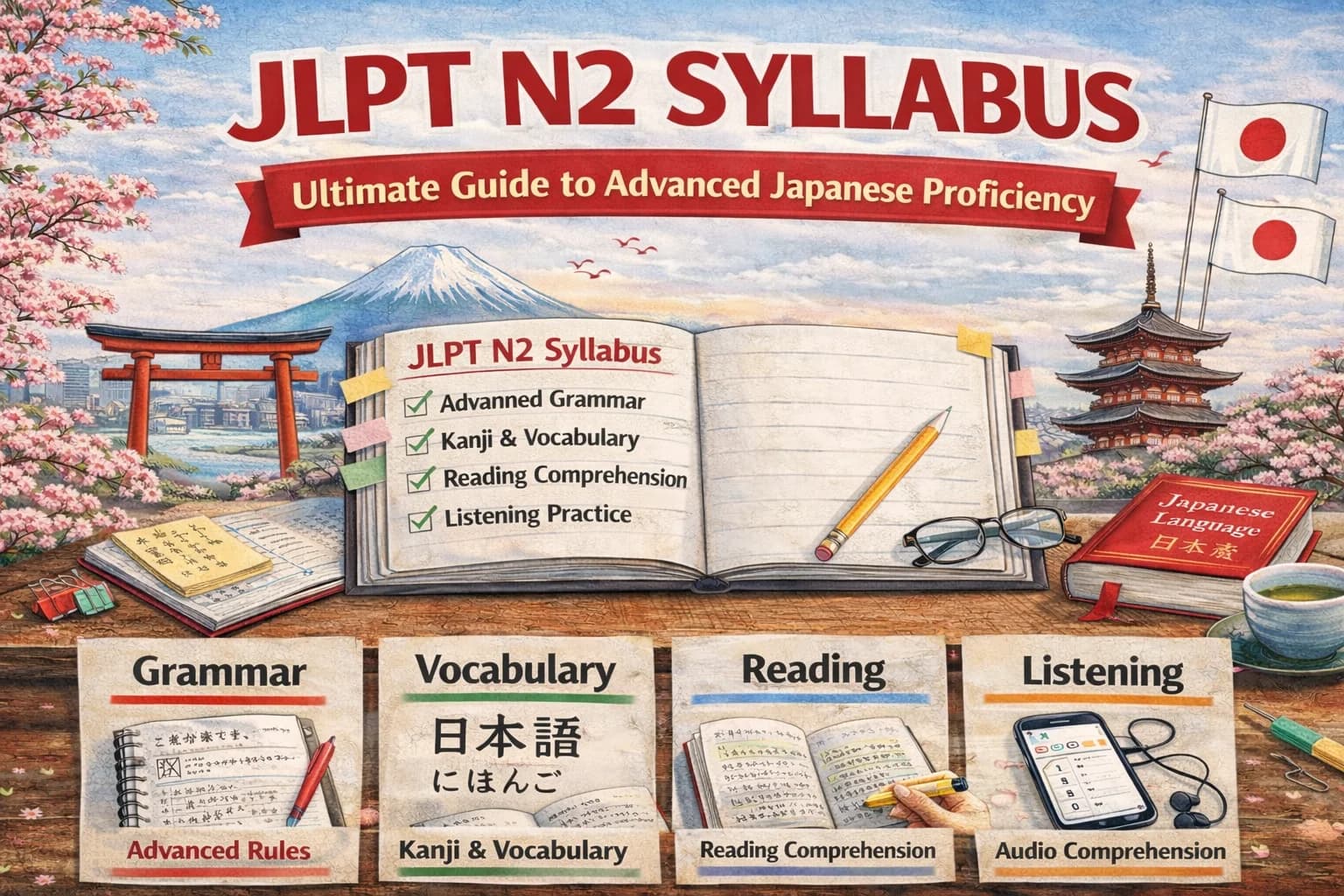
JLPT N2 Syllabus: Ultimate Guide to Advanced Japanese Proficiency
Published: 2026-04-20 08:56:48
The JLPT N2 syllabus represents upper-intermediate mastery, enabling you to thrive in business, academia, or daily life in Japan. Official JLPT data (jlpt.jp) outlines 1,000 kanji, 6,000 vocab, complex grammar, nuanced reading (500 char passages), and fast-paced listening. This level demands 600-900 prep hours post-N3. Whether for visas, jobs, or certification, N2 unlocks opportunities.
At TLS-The Japanese Language School in Laxmi Nagar, Delhi, our N2 program featuring live mocks and native speakers delivers 85% pass rates.
Start your N2 journey today!
Visit Us: 2/81-82, 2nd Floor, Lalita Park, Gali No - 2, Laxmi Nagar, New Delhi - 110092
Call Us: 918700956038
Email Us: tls@teamlanguages.com
JLPT N2 preparation course → https://www.teamlanguages.com/courses/advance-japanese-n2
JLPT N2 Syllabus Overview
JLPT N2 syllabus covers advanced communication: debating ideas, reading newspapers, understanding lectures. Key stats: 1,000 kanji, 6,000 vocab, 150 grammar points. Divided into Language Knowledge (Vocab/Grammar/Reading) and Listening.
Understanding the JLPT N2 Exam Structure
The JLPT N2 exam is an upper-intermediate test that focuses on your ability to understand Japanese in a wide range of everyday and professional situations. It is designed to assess how well you can read, interpret, and respond to real-world Japanese. The exam is conducted twice a year (July and December 2026) and consists of a total of 155 minutes of active testing time.
join JLPT N2 course → https://www.teamlanguages.com/courses/advance-japanese-n2
1. Test Sections and Timing
Unlike lower levels, where vocabulary and grammar may be separated, N2 combines all written components into one comprehensive section:
| Test Section | Components | Time Allotted |
| Language Knowledge & Reading | Vocabulary, Grammar, Reading Comprehension | 105 minutes |
| Listening | Task-based, Key Point, General Comprehension | 50 minutes |
2. Detailed Breakdown of Sections
Language Knowledge (Vocabulary & Grammar):
- Vocabulary: Tests kanji readings, word formation, and contextual usage (approx. 1,000 kanji and 6,000 words).
- Grammar: Around 200 grammar patterns, focusing on sentence structure and real-life usage.
Reading Comprehension:
- Includes short (≈200 characters), medium (≈500 characters), and long passages (up to 1,000 characters).
- Questions test your ability to extract key information, compare texts, and understand the author’s intent.
Listening Comprehension:
- Task-Based: Solve problems based on spoken instructions.
- Key Point: Identify specific details from audio.
- Quick Response: Choose appropriate replies in conversational situations.
advanced Japanese N2 training → https://www.teamlanguages.com/courses/advance-japanese-n2
3. Scoring and Passing Criteria
The JLPT uses a scaled scoring system to ensure fairness across different test versions.
- Total Score: 0–180 points
- Passing Marks: 90 overall
- Sectional Cut-off: Minimum 19 points in each section:
- Language Knowledge (Vocabulary/Grammar)
- Reading
- Listening
To pass, you must meet both the overall score and the sectional minimums—balance is key.
Key Components of the JLPT N2 Syllabus
The JLPT N2 syllabus is built around practical language application, focusing on upper-intermediate Japanese used in real-life and professional contexts. To succeed, you need balanced proficiency across all core skill areas:
- Vocabulary & Kanji (30%)
Emphasis on understanding around 1,000 kanji and 6,000 vocabulary words, including nuanced meanings and context-based usage. - Grammar (25%)
Covers approximately 200 upper-intermediate grammar patterns, with a strong focus on sentence structure and natural expression. - Reading Comprehension (30%)
Involves interpreting short to long passages, identifying key ideas, comparing information, and understanding tone and intent. - Listening Comprehension (15%)
Tests your ability to follow conversations, grasp key points, and respond accurately in everyday and workplace scenarios.
Overall, the exam prioritizes your ability to apply Japanese effectively in practical, real-world situations rather than just theoretical knowledge.
- JLPT N2 exam pattern → https://www.teamlanguages.com/blogs/jlpt-n2-exam-pattern
How to Access Official JLPT N2 Study Materials
- jlpt.jp: Free summaries, samples.
- Bonjinsha Shin Kanzen Master N2 series.
- Apps: Anki, Wanikani. Download past papers from official site.
Changes in the JLPT N2 Syllabus Over the Years
While the core JLPT N2 syllabus including kanji (≈1,000), vocabulary, and grammar—has remained relatively stable over time, the exam format, structure, and scoring system have evolved significantly to better assess real-world communication skills.
Major Historical Change (2010 Reform)
The most significant update came in 2010, when the JLPT shifted from a 4-level system to the current 5-level structure (N1–N5).
- Level Alignment: N2 is roughly equivalent to the old Level 2
- Focus Shift: From memorization to communicative competence (practical usage of Japanese)
- New Question Types: Introduction of scrambled sentence questions to test sentence construction
- Scaled Scoring: Replaced raw scores with a fair, difficulty-adjusted scoring system
Looking for the best Japanese classes? Check out our guide on finding the right institute near you: https://www.teamlanguages.com/blogs/japanese-institute-near-me
Recent Updates & Trends
More recent changes focus on improving evaluation standards and administration:
- CEFR Reference (from Dec 2025): Score reports now include a CEFR level for global comparison
- Sectional Passing Rule: Candidates must pass each section (Language Knowledge, Reading, Listening), not just the total score
- Administrative Updates (2026): Test eligibility rules tightened in Japan (e.g., residency requirements)
Overall Evolution (In Short)
- Then: Knowledge-based, simpler structure, total-score passing
- Now: Skill-based, real-life scenarios, section-wise total score requirement
- Exam Speed & Context: More natural, practical, and closer to real Japanese usage (e.g., emails, workplace communication)
Current Status (2026)
There are no major syllabus changes for 2026. However, the exam continues to emphasize integrated skills, realistic contexts, and natural language usage, making it more aligned with actual communication needs rather than rote learning.
- Want to understand the exam in detail? Read our complete guide on the Japanese Language Proficiency Test (JLPT): https://www.teamlanguages.com/blogs/japanese-language-proficiency-test
Tips for Navigating the JLPT N2 Syllabus
Preparing for JLPT N2 isn’t just about studying harder—it’s about studying smarter. With a vast syllabus, a strategic approach will help you stay consistent and improve faster:
- Identify Weak Areas First
Take a diagnostic test to pinpoint gaps in vocabulary, grammar, or listening. Focus your energy where it matters most instead of revising everything equally. - Build a Daily Immersion Habit
Spend at least 1 hour daily engaging with Japanese—read news articles, short essays, or even blogs. This strengthens both reading speed and comprehension naturally. - Track Your Progress
Use a simple spreadsheet or tracker to log new words, grammar points, and mock test scores. Seeing your improvement keeps you motivated and accountable. - Review Weekly for Retention
Regular revision is key. Structured weekly reviews can significantly improve memory and recall, helping you retain what you study long-term.
Vocabulary Required for JLPT N2
JLPT N2 requires a working knowledge of approximately 6,000 vocabulary words, moving beyond basics into more abstract and nuanced language.
- Abstract Terms: Words like 経済 (keizai – economy), 政策 (policy), and 環境 (environment)
- Idiomatic Expressions: Common phrases used in real conversations and written texts
- Synonyms & Nuance: Understanding subtle differences between similar words
- Context-Based Usage: Knowing not just meanings, but how words are used in sentences
At this level, vocabulary isn’t just about memorization it’s about understanding meaning in context and using words naturally in both written and spoken Japanese.
Confused between exams? Read our detailed comparison of JLPT vs JFT-Basic to choose the right one: https://www.teamlanguages.com/blogs/jlpt-vs-jft-basic
Essential Vocabulary List for JLPT N2
At the N2 level, vocabulary expands into real-world themes that reflect daily life, business, and modern society. Instead of isolated words, focus on learning kanji compounds in context:
- Business & Work: 契約 (keiyaku – contract), 取引 (transaction), 企業 (company)
- Society & Culture: 文化 (bunka – culture), 制度 (system), 政府 (government)
- Technology & Development: 開発 (kaihatsu – development), 技術 (technology), 情報 (information)
A smart approach is to focus on high-frequency kanji compounds daily and revise them consistently to build long-term retention.
Strategies for Memorizing JLPT N2 Vocabulary
- Use Spaced Repetition (e.g., Anki)
Review words at optimized intervals to move them into long-term memory efficiently. - Learn Through Context Sentences
Instead of memorizing meanings, study how words are used in real sentences—this improves both understanding and usage. - Apply Mnemonics for Kanji
Break complex kanji into memorable visuals or stories. For example: 環境 (kankyou – environment) can be remembered by associating its parts with surroundings and conditions. - Active Recall Practice
Test yourself regularly instead of just rereading notes—this strengthens memory faster.
Common Mistakes in N2 Vocabulary Usage
- Confusing Near-Synonyms
Words like 影響 (eikyou – influence) and 結果 (kekka – result) may seem similar but are used differently in context. - Ignoring Readings (Onyomi/Kunyomi)
Many learners know meanings but struggle with correct pronunciation—practice reading aloud daily. - Lack of Practical Usage
Memorizing without application leads to quick forgetting. Use quizzes, mock tests, or interactive methods like vocabulary battles to reinforce learning.
Mastering N2 vocabulary isn’t about cramming thousands of words—it’s about consistent exposure, smart revision, and real-life application.
Looking to learn Japanese in Delhi? Explore our complete guide on the Japan language course in Delhi: https://www.teamlanguages.com/blogs/japan-language-course-in-delhi
Resources for Expanding N2 Vocabulary
Building strong N2 vocabulary becomes much easier when you use the right mix of structured material and real-world exposure:
- Shin Kanzen Master N2 Vocabulary
One of the most trusted books for systematic vocabulary building, with categorized lessons and practice questions. - NHK News Web Easy
Perfect for daily reading practice using simplified news articles—great for learning vocabulary in context. - TLS Flashcards
Curated vocabulary decks designed specifically for JLPT preparation, ideal for quick revision and spaced repetition.
Combining textbooks with real-world content ensures both accuracy and practical understanding.
Practice Exercises for JLPT N2 Vocabulary
Consistent practice is key to retention. Try incorporating these into your daily routine:
- Fill-in-the-Blank Practice
Example: 「この__は重要です。」(This ___ is important.)
→ Helps reinforce contextual usage of words - Daily Drills
Aim for at least 50 vocabulary questions per day to build speed and accuracy - Active Recall & Self-Testing
Cover meanings and test yourself—this strengthens memory far more than passive reading
Planning to take the exam? Check out all details about JLPT July 2026 registration, dates & fees: https://www.teamlanguages.com/blogs/jlpt-july-2026
Grammar Points in JLPT N2 Syllabus
JLPT N2 grammar focuses on around 150–200 patterns, moving beyond basics into more nuanced and natural Japanese:
- Honorific & Humble Forms (Keigo)
Essential for formal and professional communication - Hypothetical & Conditional Expressions
Used to express assumptions, conditions, and possibilities - Nuanced Grammar Patterns
Subtle differences in tone, intention, and emphasis—critical for sounding natural
At this level, grammar is less about rules and more about how meaning changes with context, making it essential for both reading and listening sections.
Introduction to Grammar Required for N2
At the JLPT N2 level, grammar shifts from basic sentence construction to expressing subtle meanings and intentions. You’ll encounter patterns ranging from everyday connectors like 〜のに (although) to more formal and purpose-driven structures like 〜べく (in order to). The focus is on using grammar naturally and appropriately in context.
Detailed Breakdown of JLPT N2 Grammar Points
- Causative-Passive Forms
Example: 食べさせられる (to be made to eat)
→ Combines causation and passivity, often expressing obligation or lack of control - 〜かねる (kaneru)
Used to express difficulty or inability to do something (often politely) - Conditional Forms
〜ば / 〜たら / 〜なら
→ Each has a slightly different nuance and usage depending on the situation - Nuanced Expressions
Many N2 patterns focus on tone, intention, and formality rather than direct meaning
Want to know the cost before enrolling? Check our detailed guide on Japanese language course fees in Delhi: https://www.teamlanguages.com/blogs/japanese-language-course-fees-in-delhi
Common Grammar Pitfalls in JLPT N2
- Overusing Basic Forms
Relying too much on N4–N3 grammar instead of applying advanced patterns - Ignoring Politeness & Context
Using incorrect levels of formality can change the meaning or sound unnatural
Fix: Use structured grammar charts and practice applying patterns in different contexts rather than memorizing them in isolation.
Comparing N2 to Other JLPT Levels
- N2 vs N3: Nearly double the complexity with deeper nuance and real-world usage
- N2 vs N1: N2 focuses on practical communication, while N1 includes highly abstract expressions and idiomatic usage
N2 is often sufficient for job opportunities and professional communication, whereas N1 is more suited for academic or research-level fluency.
Grammar Exercise Drills for N2 Preparation
Practice is essential to master grammar at this level:
- Transformation Exercises
Example: 食べる → causative form → 食べさせる - Daily Drill Practice
Regular exercises help reinforce patterns and improve speed - Mock Tests & Application
Applying grammar in real sentences ensures better retention
Want fast results? Learn how to learn Japanese in 2 months with expert trainers: https://www.teamlanguages.com/blogs/learn-japanese-in-2-months-with-expert-trainers
Reading Comprehension for JLPT N2
Reading at the N2 level involves medium to long passages (approximately 500–800 characters), including articles, essays, and practical texts.
Understanding Reading Comprehension in N2
To succeed in this section, focus on:
- Inferring the Author’s Opinion
Understanding tone and implied meaning, not just direct statements - Learning Vocabulary in Context
Guessing meanings based on surrounding words and sentences - Following Logical Structure
Identifying introductions, arguments, comparisons, and conclusions
N2 reading isn’t just about translation it’s about grasping the full meaning, flow, and intent of the text.
Techniques for Skimming and Scanning Texts
To handle N2 reading efficiently, speed and strategy matter just as much as comprehension:
- Focus on Keywords First
Identify nouns, verbs, and transition words to quickly grasp the main idea - Match Question Types
Read the questions before the passage so you know exactly what to look for - Daily Practice Routine
Aim to practice at least 3 passages per day to improve speed and accuracy
Want complete exam details? Check out our guide on JLPT exam dates, registration & full schedule: https://www.teamlanguages.com/blogs/jlpt-exam-dates-registration-results-full-schedule
Practicing N2 Level Reading Passages
- Use simplified articles from sources like Asahi Shimbun and Yomiuri Shimbun
- Set a timer: 20 minutes for 3 passages
- Gradually increase difficulty to build stamina and comprehension
Developing Critical Thinking for N2 Questions
N2 reading goes beyond basic understanding—it tests interpretation:
- Analyze Author Bias & Intent
Understand not just what is said, but why - Identify Implications
Read between the lines to catch indirect meanings - Structured Practice
Guided sessions and discussions can sharpen these analytical skills
Reading Resources for JLPT N2 Preparation
- Shin Kanzen Master N2 Reading – Structured and exam-focused practice
- Mainichi Shimbun – Great for real-world reading exposure
Listening Skills for JLPT N2
JLPT N2 listening tests your ability to understand natural-speed Japanese (3–5 minute audio clips), including conversations, announcements, and short talks.
Overview of Listening Section in N2
- Around 30 questions
- Includes both long passages and quick-response items
- Tests real-life listening ability rather than memorization
Improve your word power with our detailed Japanese vocabulary list and learning guide: https://www.teamlanguages.com/blogs/japanese-vocabulary
Improving Listening Comprehension at N2 Level
- Shadowing Practice
Listen and repeat simultaneously using audio from NHK - Transcription Exercises
Write down what you hear from podcasts or news clips to improve accuracy - Consistent Exposure
Daily listening builds familiarity with speed, tone, and pronunciation
Types of Listening Questions in N2
- Summary-Based Questions
Choose the best overall meaning of the conversation - Detail-Oriented Questions
Identify specific facts or information - Attitude & Intention Questions
Understand the speaker’s feelings or purpose
Effective Listening Practice Methods for N2
- Active Recall After Listening
Pause and summarize what you understood without looking at notes - Simulated Practice
Practice under timed conditions to match real exam pressure - Audio-Based Drills
Regular exposure to structured listening exercises improves both speed and comprehension
Mastering N2 requires combining smart reading strategies with consistent listening practice, ensuring you can understand Japanese in both written and spoken real-world contexts.
Looking for flexible learning? Explore our guide on Japanese language course in Delhi & online with fees and certification: https://www.teamlanguages.com/blogs/japanese-language-course-delhi-online-fees-certificate
Recommended Audio Resources for N2 Preparation
- NHK World Japanese Lessons.
- JapanesePod101 N2 podcasts.
Power Up with TLS N2 Mastery Program—Limited Seats!
Visit Us: 2/81-82, 2nd Floor, Lalita Park, Gali No - 2, Laxmi Nagar, New Delhi - 110092
Call Us: 918700956038
Email Us: tls@teamlanguages.com
FAQs on JLPT N2 Syllabus
What is JLPT N2 syllabus overview?
1,000 kanji, 6,000 vocab, advanced grammar/reading/listening for business/daily fluency.
How many kanji in JLPT N2 syllabus?
1,000 cumulative; focus on compounds/nuances.
JLPT N2 vs N3 syllabus differences?
N2 doubles vocab/kanji, adds idioms/honorifics, longer/faster content.
Official JLPT N2 study materials?
jlpt.jp samples Shin Kanzen series.
Prep time for JLPT N2 syllabus?
600-900 hrs post-N3; TLS cuts to 4-6 months.
Changes in JLPT N2 syllabus?
2010 update: More practical contexts, no major recent shifts.
Master N2 at TLS—Free Trial Class Now!
Visit Us: 2/81-82, 2nd Floor, Lalita Park, Gali No - 2, Laxmi Nagar, New Delhi - 110092
Call Us: 918700956038
Email Us: tls@teamlanguages.com