
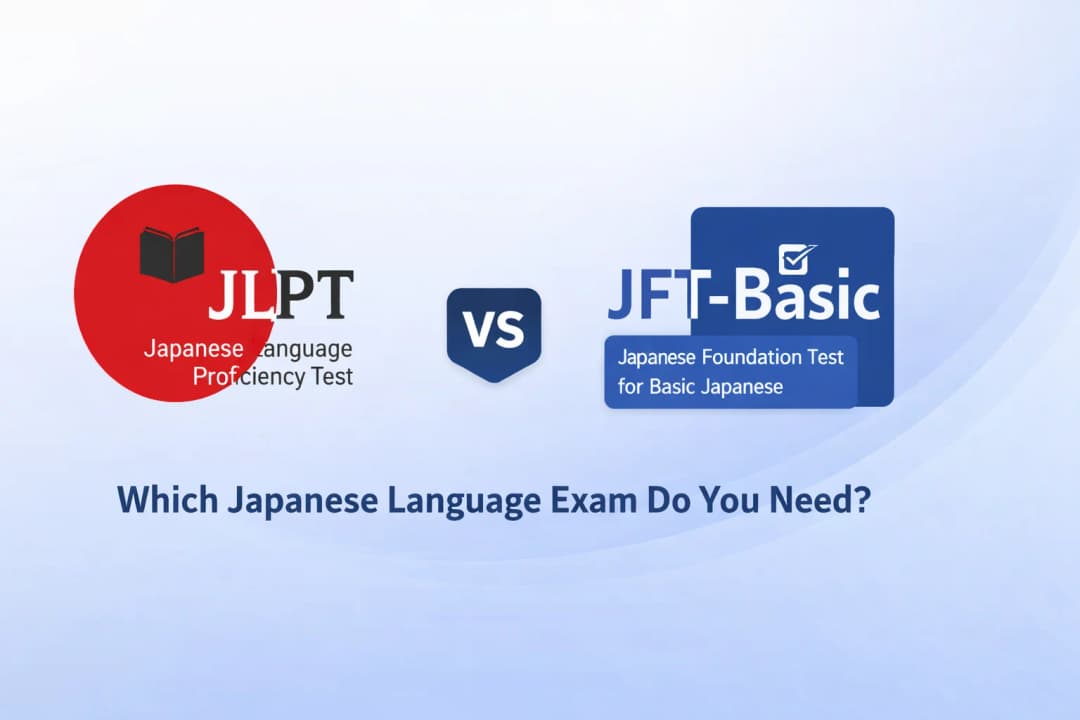
JLPT vs JFT-Basic — Which Japanese Language Exam Do You Need?
Published: 2026-03-25 05:53:48
Planning to study in Japan, apply for a Japanese work visa, or just want to prove your Japanese proficiency? You have likely come across two major exams: JLPT (Japanese Language Proficiency Test) and JFT-Basic (Japan Foundation Test for Basic Japanese). While both are administered by the Japan Foundation, they serve entirely different purposes — and choosing the wrong one can waste months of preparation.
This guide breaks down every important difference between JLPT and JFT-Basic so you can pick the right path for your goals.
Japanese language courses
📚 Preparing for JLPT? TLS Can Help! The Japanese Language School (TLS) offers structured JLPT coaching from N5 to N1 — online and offline — at centres across Delhi NCR. 📞 Call: 91 8700956038 | 🌐 www.teamlanguages.com |
What is the JLPT? (Japanese Language Proficiency Test)
The JLPT is the world's most widely recognised Japanese language certification. It was developed jointly by the Japan Foundation and Japan Educational Exchanges and Services (JEES) and has been running since 1984.
Key facts about the JLPT:
• Five levels: N5 (beginner) to N1 (advanced/near-native)
• Tests vocabulary, grammar, reading comprehension, and listening
• No speaking or writing section
• Conducted twice a year — July and December
• Paper-based test using optical mark recognition (OMR) answer sheets
• Results available approximately 2–3 months after the exam
• Certificate is valid for lifetime — it never expires
• Held in over 80 countries and regions worldwide, including India
Who is JLPT for? The JLPT is the go-to exam for students seeking admission to Japanese universities, professionals applying for jobs at Japanese companies in India or Japan, and anyone who wants a globally recognised, career-level proof of Japanese proficiency. N2 and N1 are the most valued by employers.
Japanese language proficiency test
Join the Best Language Institute in Delhi Today!
91 87009 56038
What is the JFT-Basic? (Japan Foundation Test for Basic Japanese)
The JFT-Basic is a relatively newer exam, launched by the Japan Foundation in April 2019. It was specifically designed to assess the basic Japanese communication skills needed for daily life in Japan — primarily for foreign nationals seeking to work in Japan under the Specified Skilled Worker (SSW) visa program.
Key facts about the JFT-Basic:
• Single level only — equivalent to CEFR A2 (elementary)
• Tests script and vocabulary, conversation and expression, listening comprehension, and reading comprehension
• Computer-Based Testing (CBT) — conducted at authorised test centres via computer
• Duration: 60 minutes
• Results are displayed on screen on the same day
• Official results certificate issued within 5 business days
• Available multiple times per year (more flexible scheduling than JLPT)
• There is a 45-day waiting period between attempts
• Passing score: 200 out of 250
Who is JFT-Basic for? JFT-Basic is primarily for individuals applying for the Specified Skilled Worker (i) visa to work in Japan in fields such as hospitality, agriculture, construction, food service, and manufacturing. It is not typically required for academic study or white-collar professional roles.
- Learn more about the Japan language course in Delhi: https://www.teamlanguages.com/blogs/japan-language-course-in-delhi
JLPT vs JFT-Basic: Side-by-Side Comparison
| Feature | JLPT | JFT-Basic |
| Levels | N5 to N1 (5 levels) | Single level (A2 equivalent) |
| Purpose | Academic, professional, visa | Specified Skilled Worker (SSW) visa |
| Format | Paper-based (OMR sheet) | Computer-Based Testing (CBT) |
| Duration | Approx. 170 min (varies by level) | 60 minutes |
| Sections | Vocabulary, Grammar, Reading, Listening | Script/Vocab, Conversation, Listening, Reading |
| Speaking | Not tested | Not tested |
| Writing | Not tested | Not tested |
| Results | 2-3 months after test | Same day (on screen) |
| Held | Twice a year (July & December) | Multiple times a year (CBT slots) |
| Certificate validity | Lifetime | Data stored 5 years; used for SSW visa |
| Conducted by | Japan Foundation JEES | Japan Foundation (via Prometric) |
| India availability | Yes (major cities) | Yes (select centers) |
| Best for | Study, jobs, PR, career growth | SSW work visa to Japan |
Key Differences Between JLPT and JFT-Basic
Before choosing the right exam, it’s important to understand the key differences between JLPT and JFT-Basic.
- Learn more about learn Japanese language in Delhi: https://www.teamlanguages.com/blogs/learn-japanese-language-in-delhi
1. Purpose: Academic & Career vs. Skilled Worker Visa
The JLPT is a comprehensive proficiency benchmark used for university entry, job applications at Japanese firms, Japan work visa (Engineer/Specialist in Humanities), and long-term career credentialing. The JFT-Basic was purpose-built for the Specified Skilled Worker (SSW) visa — meaning its use case is narrower and more specific.
2. Difficulty & Level: Broad vs. Basic
JLPT spans five levels, from total beginners (N5) to near-native speakers (N1). The JFT-Basic has only one level, calibrated at A2 on the CEFR scale — roughly equivalent to JLPT N4. If you already have JLPT N4 or above, you are eligible to apply for the SSW visa using your JLPT certificate instead of the JFT-Basic.
3. Test Format: Paper vs. Computer
JLPT is conducted on paper with OMR sheets, simultaneously in multiple countries on fixed dates. JFT-Basic uses Computer-Based Testing (CBT) — you sit at a computer, answer questions displayed on screen, and listen via headphones. This makes JFT-Basic feel more interactive and allows for more flexible scheduling.
4. Results Speed: Months vs. Same Day
One of the biggest practical differences: JLPT results take 2–3 months. JFT-Basic shows your score on the day you take the test, with an official result certificate issued within 5 business days. If you are on a deadline for visa processing, JFT-Basic has a clear advantage.
5. Scheduling Flexibility
JLPT is held only twice a year (July and December). If you miss one window, you wait six months. JFT-Basic is offered multiple times a year with more flexible slots, giving you much greater scheduling freedom.
6. Certificate Use & Recognition
JLPT certificates are recognised globally by universities, corporations, and immigration authorities — and they never expire. JFT-Basic results are stored for five years on the Prometric website and are primarily used for the SSW visa application. The JFT-Basic is not accepted as a substitute for JLPT in academic or most professional settings.
- Learn more about Japanese language course fees in Delhi: https://www.teamlanguages.com/blogs/japanese-language-course-fees-in-delhi
🎯 Not Sure Which Exam to Prepare For? TLS offers expert counselling to help you choose the right exam path — and personalised JLPT coaching from N5 to N1. 📞 Call us at 91 8700956038 or visit us at Laxmi Nagar, New Delhi. 🌐 Enroll online: www.teamlanguages.com |
Is JFT-Basic Equivalent to JLPT?
This is one of the most common questions asked by learners, and the answer is: no, they are not equivalent — but there is a useful overlap.
The JFT-Basic assesses Japanese at the A2/CEFR level — broadly equivalent to JLPT N4. However, a JLPT N4 or N5 certificate cannot automatically replace a JFT-Basic result for the SSW visa, unless you have JLPT N4 or above — in that case, you may use your JLPT certificate instead of taking the JFT-Basic at all.
In short: JLPT N4 and above can be used for the SSW visa. JFT-Basic cannot be used for university admissions or most professional job applications that require JLPT.
- Learn more about the Japan student visa process in India: https://www.teamlanguages.com/blogs/japan-student-visa-process-india
Is JLPT a Japanese National Qualification?
The JLPT is not a national qualification in the sense of a government license, but it is the most official and globally recognised standardised test of Japanese language proficiency. It is jointly administered by the Japan Foundation (a government-affiliated organisation) and Japan Educational Exchanges and Services (JEES). Many Japanese employers and universities treat JLPT N2 or N1 as an industry-standard minimum requirement.
For Indian students and professionals, JLPT certification is widely respected and accepted by Japanese embassies, multinational corporations with Japanese operations, and academic institutions in Japan.
- Learn more about Mitsui Scholarship 2026 for Indian students: https://www.teamlanguages.com/blogs/mitsui-scholarship-2026-indian-students
Which Exam Should You Choose?
Now that you understand the differences, the next step is deciding which exam is right for you.
Choose JLPT if you want to:
• Apply to a Japanese university or graduate school
• Work in Japan in a professional capacity (engineer, IT specialist, interpreter, teacher)
• Apply for Japan's highly skilled professional visa (points-based)
• Get a job at a Japanese company in India (Sony, Toyota, Suzuki, Toshiba, etc.)
• Build a long-term, internationally recognised Japanese language credential
• Take your language skills from beginner (N5) to advanced (N1)
- Learn more about the best Japanese language classes near me: https://www.teamlanguages.com/blogs/best-japanese-language-classes-near-me
Choose JFT-Basic if you want to:
• Apply for the Specified Skilled Worker (SSW) visa to work in Japan
• Work in industries like hospitality, food service, construction, agriculture, or care work in Japan
• Get results quickly — ideal when visa deadlines are approaching
• Take an exam with more flexible scheduling throughout the year
• Demonstrate A2-level functional Japanese for daily life
Pro tip: If you are serious about building a career linked to Japan — in India or Japan — the JLPT is the stronger long-term investment. JFT-Basic is faster and more accessible, but its use is limited to the SSW visa pathway.
How TLS — The Japanese Language School — Helps You Prepare
TLS (The Japanese Language School) is one of Delhi NCR's most trusted Japanese language institutes, with students across Delhi, Noida, Gurgaon, Faridabad, Ghaziabad, Vaishali, and Greater Noida. Whether you are preparing for JLPT N5 as a beginner or pushing for N1 as an advanced learner, TLS offers structured, exam-focused coaching with experienced faculty.
Why Choose TLS for Your JLPT Preparation?
• Complete course ladder: N5, N4, N3, N2, N1 — and Conversation Classes
• Online and offline batch options — study from anywhere in India
• Experienced faculty with proven JLPT results
• Dedicated JLPT registration guidance and result tracking
• Japan Visa Assistance — a unique service no other Delhi institute offers
• 7 centres across Delhi NCR to choose from
• Flexible batch timings — morning, evening, and weekend options
Start Your Japanese Journey with TLS Today Whether you need JLPT coaching or Japan visa assistance, The Japanese Language School (TLS) has got you covered. 📍 Visit Us: 2/81-82, 2nd Floor, Lalita Park, Gali No. 2, Laxmi Nagar, New Delhi – 110092 📞 Call Us: 91 8700956038 ✉️ Email Us: tls@teamlanguages.com |
Frequently Asked Questions (FAQs)
Q1. Is JFT-Basic equivalent to JLPT?
No, JFT-Basic and JLPT are not equivalent, though the JFT-Basic is calibrated at roughly the JLPT N4 level (CEFR A2). A JLPT N4 or above certificate can be used instead of JFT-Basic for the Specified Skilled Worker visa, but JFT-Basic cannot replace JLPT for university admissions, most jobs, or other professional uses.
Q2. Is JFT-Basic better than JLPT?
Neither is universally 'better' — they serve different purposes. JFT-Basic is faster, more flexibly scheduled, and results come the same day, making it ideal for SSW visa applicants. JLPT is more comprehensive, internationally recognised, and useful for a much wider range of academic and professional goals. If your goal is a long-term career linked to Japan, JLPT is the stronger choice.
Q3. Who needs to take the JFT-Basic exam?
JFT-Basic is required for foreign nationals applying for Japan's Specified Skilled Worker (i) visa, unless they already hold a JLPT N4 or higher certificate. It is aimed at individuals seeking to work in Japan in designated industries such as nursing care, building cleaning, food manufacturing, restaurant industry, agriculture, hospitality, construction, and more.
Q4. Is JLPT a Japanese national qualification?
The JLPT is not a government-issued national license but is jointly administered by the Japan Foundation (a government-affiliated body) and Japan Educational Exchanges and Services (JEES). It is the most widely recognised and respected Japanese language proficiency certification globally, treated as a standard benchmark by universities, employers, and immigration authorities.
Q5. Can I use JFT-Basic to apply for a student visa to Japan?
No. JFT-Basic is currently accepted only for the Specified Skilled Worker (i) visa. For a student visa or academic study in Japan, you will need a JLPT certificate (usually N4 or above for language schools, N2 for universities).
Q6. How many times can I take the JFT-Basic in a year?
You can take JFT-Basic multiple times a year. However, you must wait at least 45 days between each attempt. This is far more flexible than JLPT, which is only offered twice a year.
Q7. Do JLPT certificates expire?
No, JLPT certificates are valid for life. JFT-Basic results are stored on the Prometric website for five years — you should print your certificate while the data is available.
Q8. I already have JLPT N4 — do I still need to take JFT-Basic for the SSW visa?
No. If you hold JLPT N4 or above, you can use it to satisfy the Japanese language requirement for the Specified Skilled Worker (i) visa and do not need to take the JFT-Basic.
Q9. Which JLPT level is needed to work in Japan as an engineer?
Most IT and engineering companies in Japan require JLPT N2 as a minimum. For highly technical roles or customer-facing positions, N1 may be preferred. TLS offers N2 and N1 coaching at its Delhi NCR centres and online.
Q10. Where can I prepare for JLPT in Delhi NCR?
TLS — The Japanese Language School — offers JLPT preparation classes for all levels (N5 to N1) across Delhi, Noida, Gurgaon, Faridabad, Ghaziabad, Vaishali, and Greater Noida. Online classes are also available. Contact TLS at 91 8700956038 or visit www.teamlanguages.com.
Conclusion: JLPT or JFT-Basic — Make the Right Call
The choice between JLPT and JFT-Basic ultimately comes down to what you want to achieve. If your goal is a career, academic journey, or long-term connection with Japan, JLPT is your foundation. If you are specifically pursuing the Specified Skilled Worker visa and need a practical, quick-result exam, JFT-Basic is the efficient route.
Either way, structured preparation makes all the difference. Starting from the right level, studying with the right materials, and having expert guidance can cut your preparation time significantly and dramatically improve your pass rate.
Ready to Start? Join TLS — Delhi NCR's Trusted Japanese Language School JLPT Coaching: N5, N4, N3, N2, N1 Conversation Classes in Japanese Online & Offline Batches Available Japan Visa Assistance 7 Centres Across Delhi NCR 2/81-82, 2nd Floor, Lalita Park, Gali No. 2, Laxmi Nagar, New Delhi – 110092 91 8700956038 tls@teamlanguages.com |