

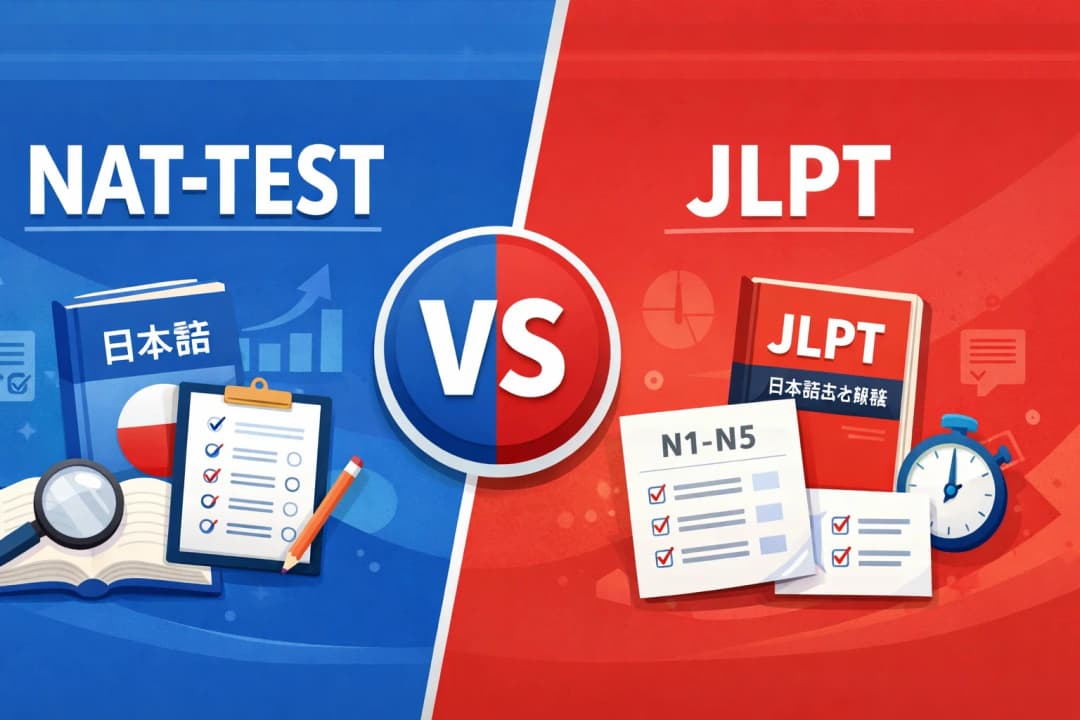
NAT-TEST vs JLPT: Which Japanese Exam Should You Take?
Published: 2026-03-27 05:37:50
The NAT-TEST and the JLPT are the two leading Japanese-language proficiency tests for non-native speakers. They share an almost identical syllabus, but differ in key ways: the JLPT is held only twice a year and is the globally recognised gold standard for visas and employment, while the NAT-TEST is held six or more times annually, returns results in roughly three weeks, and is ideal for practice runs or urgent certification needs.
Whether you are a student dreaming of studying at a Japanese university, a professional eyeing a corporate role in Tokyo, or a language enthusiast tracking your own progress, one question will eventually confront you: Should I take the NAT-TEST or the JLPT?
Both exams test Japanese reading, vocabulary, grammar, and listening comprehension for non-native speakers. Both use nearly identical level structures and share the same syllabus. Yet the choice between them can significantly affect your visa application timeline, your study strategy, and your certification credibility. This guide breaks down every meaningful difference so you can make the right call the first time.
What Are the NAT-TEST and the JLPT?
The JLPT (Japanese-Language Proficiency Test) is the world's most widely recognised Japanese language certification. Administered in Japan by Japan Educational Exchanges and Services (JEES) and internationally by The Japan Foundation, it is accepted by employers, immigration authorities, and universities as the definitive proof of Japanese language ability.
The NAT-TEST (Nihongo Achievement Test) is administered by Senmon Kyouiku Publishing Co., Ltd. through its NAT-TEST Administration Committee in Tokyo. It was specifically engineered so that the same textbooks, vocabulary lists, and practice questions used for the JLPT are directly applicable to NAT-TEST preparation — a huge advantage for learners who do not want to maintain two separate study tracks.
Compare NAT Test and JLPT: http://www.nat-test.com/en/comparison.html
NAT-TEST vs JLPT: At-a-Glance Comparison
The table below summarises the most important differences between the two exams:
| Feature | JLPT | NAT-TEST |
| Sponsor | Japan Foundation / JEES | Senmon Kyouiku Publishing Co., Ltd. |
| Frequency | 2 times per year (July & December) | 6 times per year (every 2 months) |
| Levels | N1 (hardest) → N5 (easiest) | 1Q (hardest) → 5Q (easiest) |
| Result Speed | Approx. 2 months | Approx. 3 weeks |
| Recognition | Gold standard — visas, jobs, universities | Growing; strong in Asia (India, Vietnam) |
| Vocabulary | Not publicly disclosed (since 2010) | Fully disclosed by level |
| Kanji | Not publicly disclosed | Fully disclosed by level |
| Study Hours | Not publicly disclosed | Disclosed: 200–1,000 hrs by level |
| Pass Criteria | Sectional Overall marks required | Sectional Overall marks required |
| Best For | Visa / career / university in Japan | Practice, progress tracking, urgent needs |
Exam Format: Identical Structure, Different Sponsors
One of the most reassuring facts for learners is that both exams use the same format. For Levels 1 and 2 (JLPT N1/N2), the exam consists of:
1. Language Knowledge (reading, vocabulary, grammar) Reading Comprehension — 120 points
2. Listening Comprehension — 60 points
For Levels 3, 4, and 5 (N3/N4/N5), the exam splits into three sections:
3. Language Knowledge (reading, vocabulary) — 60 points
4. Language Knowledge (grammar) — 60 points
5. Listening Comprehension — 60 points
Get complete JLPT exam details here: https://www.teamlanguages.com/jlpt
Visit Us:
👉 Drop by our office at 2/81-82, 2nd Floor, Lalita Park, Gali No - 2, Laxmi Nagar, New Delhi - 110092
| Katakana Note: The NAT-TEST places special emphasis on katakana vocabulary common in daily Japanese life — words derived from foreign languages. These loanwords may carry different nuances in Japanese than in their source language, so context-specific meaning matters when preparing. |
Vocabulary & Kanji Requirements by Level
The NAT-TEST is the only one of the two exams to publish transparent, official vocabulary and kanji counts. Since JLPT stopped disclosing this data in 2010, these NAT-TEST figures are widely used as the de facto benchmark for both exams.
| Vocabulary Count — NAT-TEST | |
| Level 5 (Beginner) | ~750 words |
| Level 4 | ~1,700 words |
| Level 3 | ~3,350 words |
| Level 2 | ~5,900 words |
| Level 1 (Advanced) | ~10,000 words |
| Kanji Count — NAT-TEST | |
| Level 5 (Beginner) | ~100 characters |
| Level 4 | ~300 characters |
| Level 3 | ~650 characters |
| Level 2 | ~1,100 characters |
| Level 1 (Advanced) | ~1,850 characters |
Recommended Study Hours
The NAT-TEST publishes official study-hour estimates — something the JLPT no longer provides. These figures serve as a reliable planning benchmark for both exams:
| Level | Study Hours (NAT-TEST Official Guide) |
| Level 5 | ███ 200 hours |
| Level 4 | ██████ 400 hours |
| Level 3 | ██████████ 600 hours |
| Level 2 | █████████████ 800 hours |
| Level 1 | ████████████████ 1,000 hours |
Pass Criteria: Two Hurdles, Not One
Both exams require candidates to clear two separate benchmarks: a sectional pass mark for each individual scoring section, and an overall pass mark for the complete exam. Passing one section does not compensate for failing another.
Strategic implication: Do not neglect the Listening Comprehension section by focusing solely on grammar and vocabulary drills. Both exams will mark you as failed if your listening score falls below the sectional cut-off, regardless of your total score. Compare JLPT vs JFT Basic here: https://www.teamlanguages.com/blogs/jlpt-vs-jft-basic |
Listening Comprehension: A Subtle Difference
Seasoned test-takers often note a subtle distinction in the listening audio between the two exams. The NAT-TEST follows standard native Japanese pronunciation guidelines but also includes speakers who replicate natural, colloquial speech patterns used by younger Japanese — where the final syllable of a word and the following particle receive a slight pitch raise.
Examples: グラフ (graph) and ドラマ (drama). The JLPT listening audio tends to be more formally standardised throughout. Candidates who have primarily trained on JLPT audio may occasionally notice a slightly more conversational tone in NAT-TEST listening passages. Using both sets of practice materials is the most comprehensive preparation strategy.
Check NAT Test April exam details: https://www.teamlanguages.com/blogs/nat-test-april
Call Us:
📞 Call 91 87009 56038 to speak with our team today!
Strategic Recommendation: Which Exam Is Right for You?
The choice between the NAT-TEST and JLPT is not about which exam is harder — it is about which one serves your specific goals and timeline. Use the guide below to decide:
Choose the JLPT if… • You need proof of proficiency for a Japanese work visa • Applying to a Japanese university requiring N2 or N1 • A corporate employer demands JLPT certification • You want the most globally portable language credential • Long-term career or academic planning in Japan is your goal | Choose the NAT-TEST if… • You missed the JLPT deadline and need a certificate soon • You want a high-stakes practice run before the JLPT • A language school in India or SE Asia accepts NAT-TEST • You need results within 3 weeks for a time-sensitive need • You want to track progress every 2 months with formal feedback |
Pro tip from TLS faculty: Many students in India register for the NAT-TEST at Level 3 or 4 approximately six months before their intended JLPT attempt. The structured exam environment, real time pressure, and official certificate motivate more consistent study — and the results arrive fast enough to adjust your preparation plan well before JLPT day. Check complete guide for JLPT July 2026: https://www.teamlanguages.com/blogs/jlpt-july-2026 |
Content Depth & Difficulty Nuances
At beginner and intermediate levels (5Q/N5 through 3Q/N3), the reading passages and grammar questions in both exams are nearly indistinguishable in style. At advanced levels, a subtle divergence appears:
• JLPT at N2 and N1 increasingly features formal, academic, and abstract texts — the kind found in Japanese newspapers, academic journals, and corporate documentation. These challenge not just vocabulary size but cultural and contextual comprehension.
• NAT-TEST at Level 2 and Level 1 is considered slightly more grounded in everyday and practical Japanese, though this distinction should not be overstated.
Candidates aiming for JLPT N1 should ensure they include newspaper editorials, academic articles, and formal correspondence in their reading practice — even if they are primarily preparing via NAT-TEST materials.
Check JLPT July registration details in India: https://www.teamlanguages.com/blogs/jlpt-july-registration-india
Orthography: An Overlooked Detail
The NAT-TEST uses orthography drawn from everyday Japanese life and standard dictionaries, favouring expressions that native Japanese speakers actually use in daily communication.
One notable example: both 一所懸命 and 一生懸命 (meaning 'with all one's effort') may appear on the NAT-TEST, but such variant expressions are not tested in the kanji reading section — they serve as reading comprehension vocabulary. Focus on natural, dictionary-standard Japanese in writing practice.
Frequently Asked Questions (FAQ)
| Q: Is the NAT-TEST accepted for Japanese visa applications? |
| A: The JLPT remains the gold standard for visa-related language requirements in Japan. The NAT-TEST is primarily recognised by language schools in India, Vietnam, and other Asian countries. If your visa application specifically requires a JLPT certificate, do not substitute the NAT-TEST without first confirming with the relevant Japanese embassy or immigration authority. |
| Q: Can I use the same study materials for both exams? |
| A: Yes — this is one of the NAT-TEST's defining design principles. All JLPT textbooks, grammar guides, vocabulary lists, and practice question sets are directly applicable to NAT-TEST preparation, and vice versa. Senmon Kyouiku's own 1万語語彙分類集 is particularly recommended. |
| Q: How long does it take to receive results? |
| A: NAT-TEST results are typically released within approximately three weeks of the exam date. JLPT results take around two months. For learners with time-sensitive applications, the NAT-TEST's rapid result turnaround is a significant practical advantage. |
| Q: What is the difference between JLPT N1–N5 and NAT-TEST 1Q–5Q? |
| A: The level structures are directly equivalent in difficulty and content scope. JLPT N1 corresponds to NAT-TEST 1Q (most advanced), and JLPT N5 corresponds to NAT-TEST 5Q (beginner). The different naming conventions are simply branding choices by each administering organisation. |
| Q: How many times a year can I take the NAT-TEST in India? |
| A: The NAT-TEST is held six or more times per year — roughly every two months. Availability in India depends on registered test centres. Contact TLS – The Language School in Laxmi Nagar, New Delhi for local exam registration support and dates for your region. |
| Q: Is the NAT-TEST harder or easier than the JLPT? |
| A: The two exams are designed to be equivalent in difficulty at each corresponding level. The primary differences are practical (frequency, result speed, recognition) rather than academic. Neither exam is consistently rated harder overall. |
| Q: How many kanji do I need to know for JLPT N3 / NAT-TEST Level 3? |
| A: The NAT-TEST officially discloses that Level 3 requires approximately 650 kanji characters and around 3,350 vocabulary words. Since JLPT no longer publishes its own counts, these NAT-TEST figures are widely used as the benchmark for JLPT N3 preparation. |
| Q: I failed the JLPT — should I take the NAT-TEST while I wait? |
| A: Absolutely. Many learners use the NAT-TEST strategically between JLPT sittings to identify weak areas, build exam stamina, and gain a fresh certificate. The shared syllabus means your JLPT preparation is simultaneously NAT-TEST preparation, with no wasted effort. |
Conclusion
The NAT-TEST and the JLPT are not rivals — they are complementary tools in a serious Japanese learner's toolkit. They share the same syllabus, mirror each other's format, and demand the same depth of grammar, vocabulary, kanji, and listening skill. What separates them is purely strategic: the JLPT delivers global prestige and institutional recognition, while the NAT-TEST delivers flexibility, frequency, and speed.
If you are in India and serious about Japanese — whether for study in Japan, employment at a Japanese firm, or personal mastery — the smartest move is to understand both exams thoroughly, use both sets of practice materials, and let your timeline and certification goals determine which one you register for next.
At TLS – The Japanese Language School in Laxmi Nagar, New Delhi, our Japanese language faculty teach to both exam standards simultaneously, ensuring you are never caught unprepared regardless of which exam date arrives first.
ENROLL NOW Prepare for NAT-TEST & JLPT in New Delhi Our expert Japanese faculty offer structured courses aligned to both exam syllabus— guiding you toward whichever exam best fits your timeline and career goals. 📍 2/81-82, 2nd Floor, Lalita Park, Gali No-2, Laxmi Nagar, New Delhi – 110092 |