

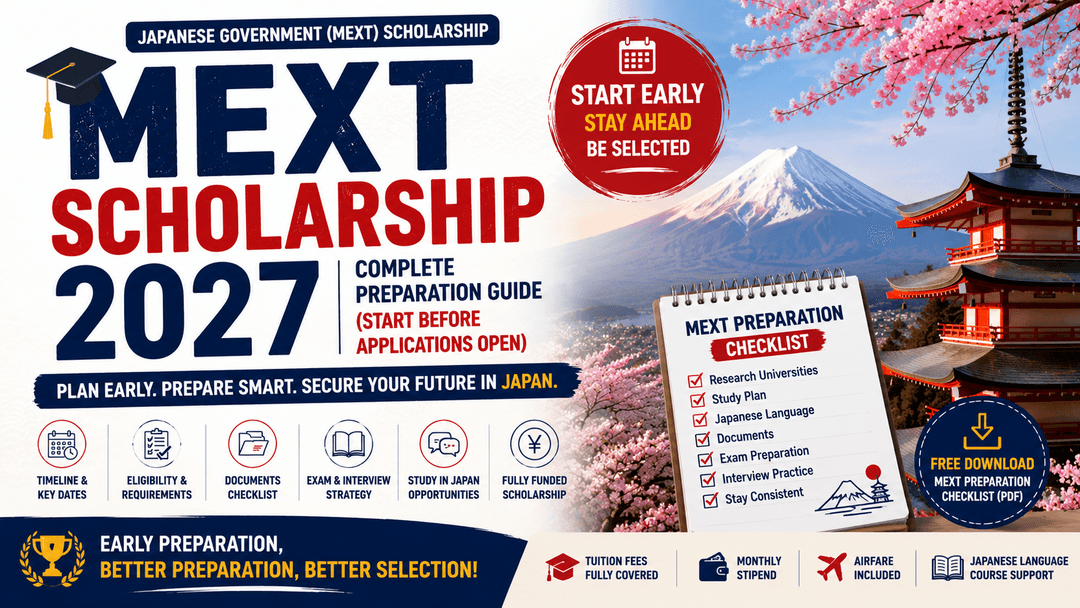
MEXT Scholarship 2027: Complete Preparation Guide (Start Before Applications Open)
Published: 2026-07-30 07:11:23
Quick update: Embassy Recommendation applications for MEXT 2027 (students arriving in Japan in April 2027) already opened in most countries between April and June 2026, and many embassies have completed written exams and interviews, with results expected around November 2026. If you haven't applied yet, check your local Japanese Embassy website immediately — a few countries may still be finalizing screening. If the 2027 window has closed for your country, this guide is your head start for MEXT 2028, and starting early is exactly what separates selected candidates from the rest. Embassy schedules vary by country every year, so always confirm exact dates with your own embassy rather than relying solely on this article.
Every year, thousands of students search for "MEXT Scholarship" only after the application notice is already posted — and by then, they're racing to collect documents, write a Study Plan, and prepare for a Japanese-language interview in a matter of weeks. Selected candidates rarely work this way. Most start preparing 6 to 8 months before applications open, not after.
This guide walks you through exactly what to do — step by step — before the application window opens, so that when it finally does, you're submitting a polished application instead of a rushed one.
In this guide: What MEXT is · When applications open · Embassy vs. University Recommendation · Eligibility · Month-by-month timeline · Documents · Study Plan (with sample outline) · Japanese language prep · Written exam strategy · Interview questions · Building your profile · Common rejection reasons · Checklist · FAQs.
Learn about scholarships for Indian students to study in Japan, including eligibility, application process, and funding options available for international students.
What Is the MEXT Scholarship?
The Japanese Government (MEXT) Scholarship is offered by Japan's Ministry of Education, Culture, Sports, Science and Technology to international students across several categories:
- Undergraduate Students
- Research Students (Master's/PhD track)
- Specialized Training College Students
- College of Technology Students
- Teacher Training Students
It is a fully funded scholarship that generally covers:
- Full tuition fees
- A monthly stipend (varies by category and region, roughly ¥143,000–¥145,000)
- Round-trip economy airfare between your home country and Japan
- A preparatory Japanese language course for many awardees before degree studies begin
There are no repayment or return-service obligations — it's a grant, not a loan.
Explore the MEXT Scholarship 2027 for Indian Students to learn about eligibility, benefits, application process, and important dates.
Planning to Study in Japan?
Get expert guidance from TLS.
Visit: 2/81-82, 2nd Floor, Lalita Park, Gali No - 2, Laxmi Nagar, New Delhi - 110092
Call: 91 8700956038 | Email: tls@teamlanguages.com
MEXT Scholarship Benefits at a Glance
| Benefit | Undergraduate | Research Student (Master's/PhD) |
| Tuition | Fully covered | Fully covered |
| Monthly stipend | ~¥117,000–¥145,000 | ~¥143,000–¥145,000 |
| Airfare | Round-trip, economy | Round-trip, economy |
| Japanese language course | Included (1 year, if needed) | Sometimes included pre-enrollment |
| Repayment | None | None |
| Scholarship duration | Up to 5 years (incl. language year) | 2 years Master's / 3 years PhD, optional research year |
When Do MEXT Applications Actually Open?
This is where a lot of confusion happens, so let's be precise.
MEXT scholarships are named for the year students arrive in Japan, not the year applications open. So "MEXT 2027" means arrival in April 2027 — but the application cycle itself runs almost a full year earlier:
| Stage | Typical Timing |
| Embassy applications open | April – May (prior year) |
| Document screening | May – June |
| Written exam | June – July |
| Interview | June – August |
| Embassy shortlist sent to MEXT | September – October |
| MEXT primary/secondary screening results | November |
| University placement | December – February |
| Arrival in Japan | April |
Exact dates vary significantly by country — some embassies open in April, others in June, and deadlines can differ by several weeks. Always confirm directly with the Japanese Embassy or Consulate in your country of citizenship, since only they can recommend you to MEXT.
Learn how to fill out the MEXT Scholarship Application Form, including the required documents, application steps, and important guidelines.
How to Prepare for MEXT Scholarship:
- Choose your scholarship category (Undergraduate, Research, etc.)
- Verify eligibility for your category and country
- Draft your Study Plan or Research Proposal
- Gather documents (transcripts, certificates, recommendation letter)
- Begin Japanese language study
- Practice for the written exam and interview
- Submit through your local Japanese Embassy before the deadline
Start Your Japan Study Journey Today
Connect with Team Languages for course and scholarship guidance.
Call: 91 8700956038
Email: tls@teamlanguages.com
Visit: Laxmi Nagar, New Delhi - 110092
Embassy Recommendation vs. University Recommendation
MEXT has two separate application routes, and understanding the difference early saves you from applying through the wrong channel.
| Factor | Embassy Recommendation | University Recommendation |
| Where you apply | Your country's Japanese Embassy/Consulate | Directly to a specific Japanese university |
| Who selects you | Embassy screens, MEXT makes final decision | University nominates, MEXT confirms |
| University placement | MEXT assigns you (you may propose a preference) | Fixed — the nominating university |
| Competition | Higher (large applicant pool per country) | Lower per seat, but very limited slots (often 5–25 per university) |
| Timeline | April–August (prior year) | Varies, often September–January |
| Best for | Applicants without an existing Japan contact | Applicants who already have a supervisor or university relationship |
If you already have a professor or university in Japan interested in supervising you, the University Recommendation route can be faster and less competitive. If not, Embassy Recommendation is the standard path.
Explore the MEXT Scholarship 2027 application process to understand the eligibility, required documents, selection process, and application steps.
Why Early Preparation Is the Real Differentiator
The MEXT Scholarship isn't lost or won in the six weeks after applications open. It's lost or won in the months before — in whether you:
- Already have a clear, specific research topic or study plan
- Have approached a potential academic supervisor (for research students)
- Have started Japanese language study, even at a basic level
- Have your documents, transcripts, and certificates ready to request in advance
- Have practiced articulating "why Japan" in a way that isn't generic
None of this can be done well in two weeks. That's the entire premise of preparing early.
Step 1: Understand Which MEXT Category Fits You
Before anything else, confirm which category you actually qualify for and want to pursue:
- Undergraduate — for students who haven't started a bachelor's degree yet
- Research Student — for those pursuing Master's or PhD-track study under a Japanese professor
- College of Technology — technical, vocational-style education
- Specialized Training College — shorter, career-focused programs
- Teacher Training — for practicing teachers seeking further training in Japan
Each category has different age limits, academic prerequisites, and application routes, so this decision shapes everything that follows.
Get the MEXT Scholarship 2027 complete guide covering eligibility, benefits, documents, application process, and important dates.
Need Guidance for MEXT Scholarship?
Speak with our experts for application and scholarship support.
Call: 91 8700956038 | Email: tls@teamlanguages.com
Visit Us: 2/81-82, 2nd Floor, Lalita Park, Gali No - 2, Laxmi Nagar, New Delhi - 110092
Step 2: Check Eligibility Early
Common eligibility factors across categories include:
- Age (varies by category, generally under 24–35 depending on the track)
- Academic background relevant to your intended program
- Nationality — must hold nationality of a country with diplomatic relations with Japan, and must apply through your own country's embassy
- Health — meeting standard health requirements
- Language — Japanese or English proficiency depending on the program
- Scholarship history — not currently receiving another Japanese government scholarship
Requirements vary by category and by country, so pull the official guideline PDF for your specific track and country as your first task, not your last.
Step 3: Build Your MEXT Preparation Timeline
Here's a practical month-by-month structure you can adapt, starting roughly 8 months before your embassy's expected opening date:
| Month | Action | Goal |
| Month 1 (e.g., August) | Research universities and potential supervisors | Shortlist 3–5 programs/professors |
| Month 2 (September) | Start basic Japanese study (JLPT N5 level) | Build a language foundation |
| Month 3 (October) | Draft Study Plan / Research Proposal | Get mentor or instructor feedback |
| Month 4 (November) | Request recommendation letters | Secure referees early, before they get busy |
| Month 5 (December) | Begin collecting transcripts and certificates | Avoid last-minute processing delays |
| Month 6 (January) | Continue Japanese study, start exam practice | Build toward written exam readiness |
| Month 7 (February) | Practice mock interviews | Build confidence and clarity |
| Month 8 (March) | Final document review, certified translations | Have a complete, error-free file ready |
| Application month (April/May) | Submit to your local Japanese Embassy | On-time, complete submission |
Print this out or turn it into a wall calendar — the biggest risk in this process isn't difficulty, it's disorganization.
Explore the Japanese Government MEXT Scholarship types and eligibility to find the right scholarship category and understand its requirements.
Step 4: Start Preparing Required Documents Early
Typical documents requested for MEXT applications include:
- Completed application form
- Passport-size photographs
- Academic transcripts
- Degree certificates or graduation-in-progress certificates
- Recommendation letter (from a professor, academic advisor, or employer)
- Study Plan / Research Proposal
- Medical certificate (on the official MEXT format)
- Language certificates, if available (JLPT, TOEFL, IELTS)
- Passport copy
Requirements differ slightly by country and category, so always download the current document checklist from your embassy's official page rather than relying on a generic list. Documents like transcripts and certified translations can take weeks to process — this is exactly the kind of task that early preparation solves.
Step 5: Prepare a Strong Study Plan / Research Proposal
Your Study Plan is arguably the single most scrutinized part of your application. A strong one clearly connects:
- Your academic/professional background
- Why this specific field, and why now
- Why Japan specifically (not "a good education system" — be concrete)
- What you intend to research or study, and with which kind of program
- How this connects to your career or research goals afterward
Avoid generic statements like "Japan has advanced technology." Reviewers read hundreds of these — specificity is what stands out.
Explore Japanese Government MEXT Scholarships to learn about scholarship types, eligibility, benefits, and the application process for studying in Japan.
Learn Japanese. Study in Japan. Build Your Future.
Get personalised guidance from TLS today.
Visit: 2/81-82, 2nd Floor, Lalita Park, Gali No - 2, Laxmi Nagar, New Delhi - 110092
Call: 91 8700956038
Sample Study Plan Outline (Research Student Track)
- Introduction — your academic background and current professional/academic status (2–3 sentences)
- Research motivation — the specific problem or question you want to study, and why it matters
- Why Japan — a specific lab, professor, methodology, or research strength unique to Japan (not generic praise)
- Research objectives — what you aim to investigate during your Master's/PhD period, broken into rough phases
- Method/approach — how you plan to conduct the research, briefly
- Future contribution — how this research connects to your career plans or benefits your home country
- Closing — a concise, confident summary tying the above together
Keep it specific and personal — a Study Plan that could be submitted by any applicant to any country is the fastest way to blend into the rejection pile.
Learn about the MEXT Research Student Scholarship, including eligibility, benefits, required documents, and the application process.
Step 6: Improve Your Japanese Language Skills Early
Japanese proficiency isn't mandatory for every MEXT category, but it meaningfully strengthens most applications — particularly for Undergraduate and Research Student tracks — and it matters even more once you're placed at a university in Japan.
Even reaching JLPT N5 or N4 before you apply signals genuine commitment, and it also prepares you for day-to-day life once you arrive. Here's why it specifically helps at each stage:
- In the written exam — some embassies include a basic Japanese-language component
- In the interview — panels often ask a few questions in Japanese, even for applicants who plan to study in English; responding with basic composure builds real credibility
- In your Study Plan — mentioning your current JLPT level or ongoing coursework shows commitment, not just intent
- After arrival — daily life, part-time work eligibility, and integration are all considerably easier with even N4-level ability
This is one of the areas where starting 6–8 months early makes the biggest practical difference, since language ability builds slowly and can't be crammed.
This is exactly where TLS – The Japanese Language School fits in. TLS runs structured JLPT-focused courses from N5 through N1, offered both online and offline, along with visa and study-abroad application guidance. Rather than treating Japanese as a last-minute checklist item, students who train with TLS walk into their interview with genuine conversational ability — which panels notice immediately. TLS also offers a free JLPT counseling session if you're unsure which level to start at based on your MEXT timeline.
Step 7: Prepare for the Written Examination
Depending on your category and embassy, you may be tested on:
- English
- Japanese
- Mathematics
- Basic Science subjects (for some Undergraduate tracks)
Official past examination papers are published on the Study in Japan website, and there's no separate "MEXT syllabus" beyond preparing at a level comparable to standard university entrance exams in your subject area.
Written Exam Strategy
- Start with the most recent 2–3 years of past papers for your category and work backward
- Time yourself under real exam conditions, not open-book
- For Japanese-language sections, focus on reading comprehension and basic grammar rather than advanced kanji
- Identify your two weakest subjects and dedicate extra weekly practice specifically to those
- Redo the same past papers a second time closer to the exam date to check retention, not just first-pass understanding
Practicing with past papers is one of the highest-value things you can do in the months before applications open.
Check the MEXT Scholarship eligibility criteria to understand the age, academic, nationality, and other requirements for applicants.
Your Japan Education Journey Starts Here
Talk to TLS for Japanese language courses, scholarships, and study guidance.
Call: 91 8700956038
Email: tls@teamlanguages.com
Step 8: Prepare for the Interview
Embassy interviews commonly explore:
- Why you want to study in Japan specifically
- Your research topic or study plan, in detail
- Your future goals and how Japan fits into them
- Basic composure and clarity under questioning, sometimes partly in Japanese
Common MEXT Interview Questions
- Why did you choose Japan over other countries for this field?
- Walk me through your Study Plan / Research Proposal.
- What will you do if your preferred university doesn't accept you?
- How do you plan to overcome the language barrier?
- What are your plans after completing this scholarship?
- Why should MEXT select you over other applicants from your country?
Mock interviews — with a mentor, senior, or language instructor — are far more useful than reading interview questions online. If you've been studying Japanese with an institute like TLS, ask your instructor to run a mock interview segment in Japanese; it's a small step that noticeably improves confidence on the actual day, and TLS offers guided mock-interview sessions as part of its study-abroad support track.
Learn about Japanese language requirements for MEXT scholars, including language proficiency expectations and requirements for studying in Japan.
Step 9: Build a Strong Academic Profile
While you can't rebuild your CGPA overnight, in the months before applying you can still strengthen:
- Research experience or academic projects
- Internships relevant to your field
- Publications or conference participation, if applicable
- Volunteer work or leadership roles
- A clear, coherent academic narrative tying these together
Step 10: Prepare Financially and Administratively
Even though tuition, stipend, and airfare are covered, plan ahead for:
- A valid passport with sufficient remaining validity
- Certified copies and official translations of documents
- Medical checkups for the official certificate
- Initial living funds — new scholars are generally advised to bring some money for their first weeks, since the first stipend payment can arrive roughly one to one-and-a-half months after arrival in Japan
Learn about the MEXT Scholarship application process, including eligibility, required documents, selection stages, and application steps.
Common Reasons MEXT Applications Get Rejected
Understanding why applications fail is often more useful than a checklist of what to include:
- A generic Study Plan — vague goals like "I want to experience Japanese culture and technology" without a specific research angle
- A weak or unconvincing "Why Japan?" — reviewers can tell when this section is copy-pasted logic rather than genuine reasoning
- Poor interview performance — not because of language ability alone, but a lack of clarity or preparation
- Incomplete or incorrectly formatted documents — missing signatures, wrong photo specifications, or unnumbered document sets
- Unrealistic research proposals — proposing a scope far too broad (or narrow) for the program duration
- Weak academic record with no compensating strengths — a modest GPA isn't disqualifying on its own, but it needs to be paired with research experience, a strong Study Plan, or relevant work history
- Applying to the wrong category or route — e.g., applying Embassy Recommendation when a University Recommendation route was clearly the better fit
Complete MEXT Preparation Checklist
- [ ] Passport valid and up to date
- [ ] Passport-size photographs ready
- [ ] Academic transcripts requested
- [ ] Degree/graduation certificates arranged
- [ ] Recommendation letter requested
- [ ] Study Plan / Research Proposal drafted
- [ ] Medical certificate scheduled
- [ ] Japanese language study started
- [ ] English proficiency documents ready (if required)
- [ ] Mock interview practiced
- [ ] Written exam past papers reviewed
- [ ] University and supervisor research completed
- [ ] Embassy website bookmarked for updates
Check the MEXT Scholarship eligibility for Indian students to understand the academic, age, nationality, and other requirements for applicants.
Connect With TLS Today
Visit our centre or contact us for expert guidance on studying in Japan.
Visit: 2/81-82, 2nd Floor, Lalita Park, Gali No - 2, Laxmi Nagar, New Delhi - 110092
Call: 91 8700956038 | Email: tls@teamlanguages.com
Final Tips to Increase Your Selection Chances
- Start preparing 6–8 months ahead, not 6–8 weeks
- Keep a physical or digital tracker for every document and deadline
- Research 3–5 target universities and potential supervisors in advance
- Practice your interview answers out loud, not just in your head
- Begin Japanese language study now, even informally
- Read multiple successful Study Plans for structure and tone, then write your own in your own voice
Check the MEXT 2026 results to learn about the result announcement, selection status, and next steps for selected candidates.
Frequently Asked Questions
1. What is the MEXT Scholarship 2027?
It's the Japanese Government Scholarship cycle for students arriving in Japan in April 2027, covering tuition, a monthly stipend, and airfare across Undergraduate, Research, and other categories.
2. When do MEXT 2027 applications open?
Most embassies opened Embassy Recommendation applications for 2027 between April and June 2026, with results generally announced around November 2026. Deadlines vary by country, so always confirm with your local embassy.
3. Is the MEXT Scholarship fully funded?
Yes — it typically covers tuition, a monthly stipend, and round-trip airfare, with no repayment obligation.
4. Is JLPT mandatory to apply?
Not always. Requirements vary by category and embassy, but Japanese proficiency is considered an advantage in many programs, especially for Research and Undergraduate tracks.
5. Is IELTS or TOEFL mandatory?
For English-medium programs, many universities request IELTS/TOEFL scores at the placement stage, though it isn't always mandatory at the initial embassy application stage. Check your target university's specific requirement.
6. How can I prepare before applications open?
Focus on your Study Plan, document collection, recommendation letters, Japanese language study, and mock interview practice — ideally starting 6–8 months in advance.
7. What documents should I start collecting first?
Academic transcripts, degree certificates, and recommendation letters, since these typically take the longest to obtain.
8. What is Embassy Recommendation vs. University Recommendation?
Embassy Recommendation means you apply through your country's Japanese Embassy and MEXT places you at a university; University Recommendation means a specific Japanese university nominates you directly, with its own separate timeline.
9. How long does the whole selection process take?
From application to final placement, the process typically spans 8–10 months, from initial embassy screening through to university placement.
10. Can undergraduate students apply for MEXT?
Yes — MEXT has a dedicated Undergraduate Student category with its own eligibility rules and timeline.
11. Can diploma students apply for MEXT?
Depending on the country and category, diploma holders may be eligible for Research Student or Specialized Training tracks if the diploma meets the academic-equivalency requirement — check your embassy's specific guideline.
12. What CGPA is required for MEXT?
There's no single universal CGPA cutoff — it varies by country and category, though a consistently strong academic record improves competitiveness. A modest GPA can be offset by strong research experience or a compelling Study Plan.
13. Can I work part-time while on the MEXT Scholarship?
Yes, scholars can generally apply for permission to work part-time within the limits set by Japanese immigration rules, though it isn't guaranteed and shouldn't be relied upon as a primary income source.
14. How many students get selected each year?
Numbers vary widely by country and category depending on embassy quotas, which are generally small relative to the applicant pool — competition is significant in most countries.
15. Can I reapply if I was rejected before?
In most cases, yes — you can reapply in a future cycle, though you should address whatever weakened your prior application, such as your Study Plan or exam performance.
16. What happens after passing the embassy interview?
Your file is forwarded to MEXT for a secondary screening and university placement process, with final results typically announced around November for the following April's intake.
17. What are the biggest mistakes applicants make?
Starting too late, submitting a generic Study Plan, and skipping Japanese language preparation are the most common — and most avoidable — mistakes.
Ready to Strengthen Your MEXT Application?
Document checklists and timelines only go so far — the parts of your application that genuinely stand out are your Study Plan, your interview performance, and your Japanese language ability. Of these, language is the one that takes real time to build, which is exactly why starting now matters.
TLS – The Japanese Language School offers structured JLPT preparation (N5–N1), online and offline classes, mock-interview support, and dedicated guidance for students planning to study in Japan — including help with visa documentation. If you're serious about maximizing your MEXT chances, starting your Japanese language journey with TLS today puts you months ahead of applicants who wait until the application window opens.
- 🎯 Book a Free JLPT Counseling Session — find out which level fits your MEXT timeline
- 📋 Ask about Study Plan review support — get feedback before you submit
- 🗣️ Request a mock-interview slot — practice under real interview conditions
📍 Laxmi Nagar, Delhi | 📞 91-8700956038 | ✉️ tls@teamlanguages.com | 🌐 www.teamlanguages.com
