

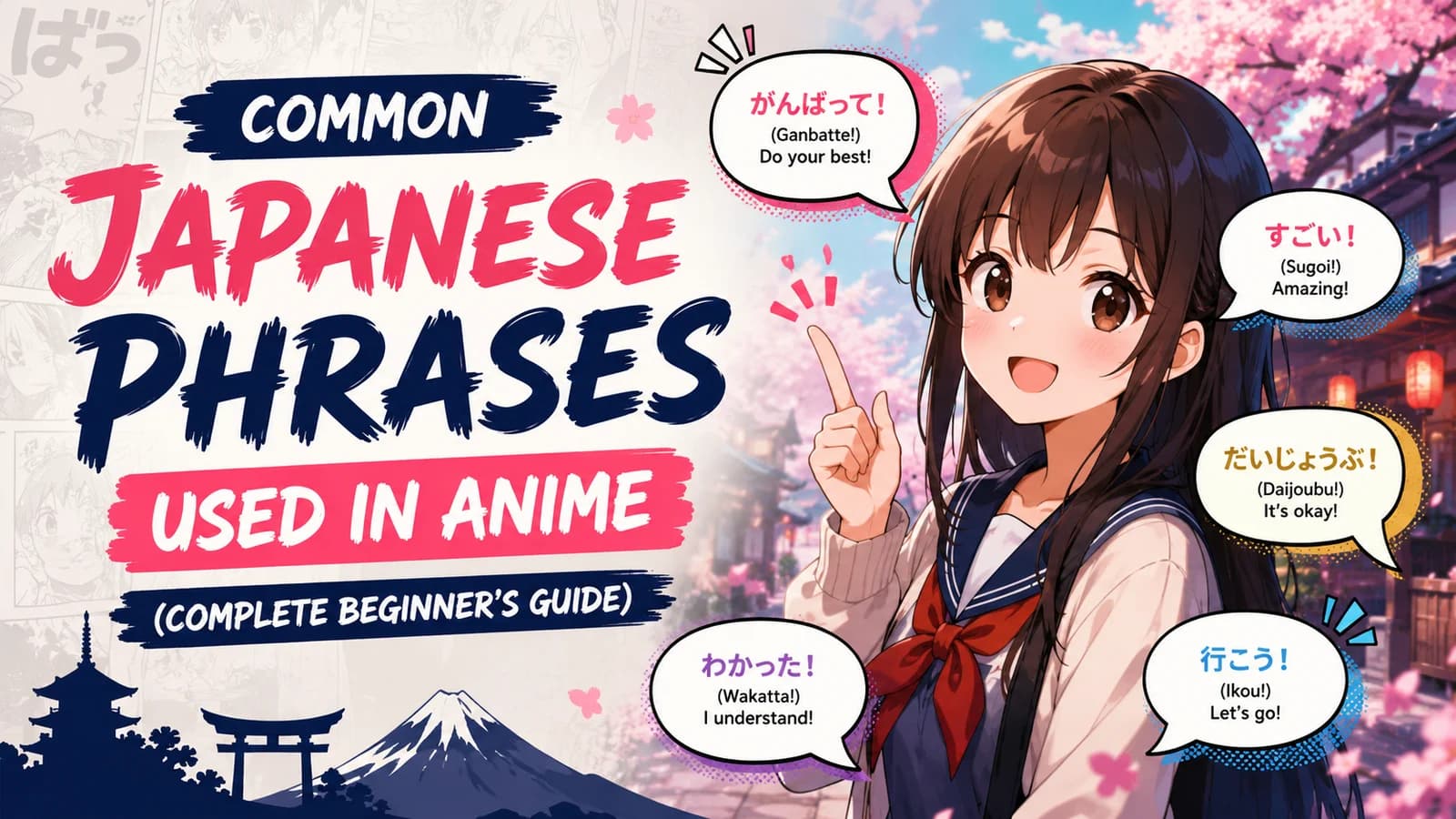
Common Japanese Phrases Used in Anime (Complete Beginner's Guide)
Published: 2026-07-28 09:34:52
If you have ever watched an anime and caught yourself repeating a word like "sugoi" or "baka" without even trying, you already know how powerful anime can be for picking up Japanese. Common Japanese phrases used in anime are often the very first words that hook new fans into the language long before they open a textbook or sign up for a class.
This guide breaks down the most common Japanese phrases used in anime, explains what they actually mean, shows you how they're used in real conversation, and helps you separate "anime Japanese" from the Japanese people speak every day. Whether you're a total beginner, a JLPT aspirant, or simply someone who wants to understand your favorite shows without subtitles, this article is built for you.
By the end, you'll have a practical vocabulary list, pronunciation guidance, example conversations, and a clear roadmap for turning anime-watching into genuine language progress.
Learn everything about the When Will JLPT July Exam Results Be Announced and expected result timeline.
Why Learning Japanese Through Anime Is Effective
Anime isn't just entertainment — for millions of learners worldwide, it's the doorway into the Japanese language. But does it actually work as a study method? Let's look at it honestly.
Benefits of Learning Japanese Through Anime
- Natural pronunciation exposure — you hear real intonation, rhythm, and speed instead of robotic textbook audio.
- Emotional context — phrases stick better when tied to a dramatic or funny scene.
- High repetition — common expressions like sugoi, baka, and ganbatte appear across almost every series, reinforcing memory.
- Cultural insight — you absorb honorifics, politeness levels, and social dynamics alongside vocabulary.
- Motivation boost — studying feels like a hobby, not homework, which helps beginners stay consistent.
Limitations You Should Know
- Anime dialogue often uses exaggerated, dramatic, or masculine/feminine speech patterns that don't reflect everyday conversation.
- Characters frequently skip particles or use rough grammar for stylistic effect.
- Slang and battle phrases may sound odd or even rude if used in real-life situations, such as at work or with strangers.
- Anime alone won't teach you grammar structure, reading, or writing — you still need structured study for that.
Real-Life Usage
Some anime phrases translate directly into daily Japanese life — greetings like ohayou and expressions like arigatou are used exactly as shown. Others, like dramatic battle cries or exaggerated slang, are mostly confined to fiction. Knowing which is which is key to sounding natural rather than "anime-ish" when you actually speak with native speakers.
Beginner Tips
- Treat anime as listening practice, not your only textbook.
- Pause and repeat lines out loud (a technique called shadowing).
- Keep a small notebook of phrases you hear often.
- Cross-check anime phrases with a real course or tutor before using them in conversation.
- Watch shows with Japanese subtitles once you're past the beginner stage — it dramatically improves retention.
Quick Callout: Anime is a fantastic supplement to structured learning, not a replacement for it. Pair it with a proper course, like those offered at TLS – The Japanese Language School, for the fastest and most accurate progress.
Read our Last-Minute Tips for Passing the JLPT Exam to boost your exam-day confidence.
Top 100 Common Japanese Anime Phrases
Below is a comprehensive table of the most common Japanese phrases used in anime, along with romaji, English meaning, when they're typically used, and example context. This is one of the most complete anime Japanese phrases with pronunciation resources you'll find in one place.
| # | Japanese | Romaji | English Meaning | When Used | Anime Example Context |
| 1 | おはよう | Ohayou | Good morning | Casual morning greeting | Characters greeting classmates |
| 2 | こんにちは | Konnichiwa | Hello / Good afternoon | Daytime greeting | Meeting someone during the day |
| 3 | こんばんは | Konbanwa | Good evening | Evening greeting | Arriving at a gathering at night |
| 4 | おやすみ | Oyasumi | Good night | Before sleeping | Roommates saying goodnight |
| 5 | いってきます | Ittekimasu | I'm heading out | Leaving home | Leaving for school |
| 6 | いってらっしゃい | Itterasshai | Take care / See you off | Sending someone off | Parent replying to a child leaving |
| 7 | ただいま | Tadaima | I'm home | Returning home | Walking through the front door |
| 8 | おかえり | Okaeri | Welcome back | Welcoming someone home | Family greeting a returning member |
| 9 | ありがとう | Arigatou | Thank you | Expressing gratitude | After receiving help |
| 10 | ありがとうございます | Arigatou gozaimasu | Thank you (polite) | Formal gratitude | Thanking a teacher or senior |
| 11 | すみません | Sumimasen | Excuse me / Sorry | Apology or getting attention | Bumping into someone |
| 12 | ごめんなさい | Gomen nasai | I'm sorry | Sincere apology | After a mistake |
| 13 | ごめん | Gomen | Sorry (casual) | Apology among friends | Light teasing apology |
| 14 | すごい | Sugoi | Amazing / Incredible | Expressing amazement | Watching a powerful attack |
| 15 | やばい | Yabai | Oh no! / Insane! (context-dependent) | Danger or excitement | Reacting to a shocking twist |
| 16 | かわいい | Kawaii | Cute | Complimenting appearance | Reacting to a mascot character |
| 17 | ばか | Baka | Idiot / Fool | Playful or genuine insult | Tsundere character teasing love interest |
| 18 | がんばって | Ganbatte | Do your best | Encouragement | Cheering for a friend before a match |
| 19 | がんばれ | Ganbare | Go for it! | Cheering | Crowd shouting during a tournament |
| 20 | だいじょうぶ | Daijoubu | It's okay / Are you alright? | Reassurance or checking in | After someone falls or gets hurt |
| 21 | まって | Matte | Wait | Stopping someone | Chasing after a character |
| 22 | だめ | Dame | No good / Don't | Prohibition | Stopping a reckless action |
| 23 | やめて | Yamete | Stop it | Pleading to stop | Comedic or serious scenes |
| 24 | しょうがない | Shouganai | It can't be helped | Accepting a situation | Resigned reaction to bad luck |
| 25 | まじで | Maji de | Seriously? / For real? | Disbelief | Reacting to surprising news |
| 26 | うそ | Uso | Lie / No way | Disbelief | Hearing shocking information |
| 27 | ほんとう | Hontou | Really / True | Confirming truth | Double-checking information |
| 28 | わかった | Wakatta | Got it / Understood | Confirming understanding | Agreeing to a plan |
| 29 | わからない | Wakaranai | I don't understand | Confusion | Lost in a conversation |
| 30 | いただきます | Itadakimasu | Thanks for the meal | Before eating | Sitting down to a meal |
| 31 | ごちそうさま | Gochisousama | Thanks for the meal (after) | After eating | Finishing a meal |
| 32 | だいすき | Daisuki | I really like / love you | Affection | Confession scene |
| 33 | すき | Suki | Like / Love | Romantic or casual liking | Confession or preference |
| 34 | あいしてる | Aishiteru | I love you | Deep romantic love | Serious romantic confession |
| 35 | きにしないで | Ki ni shinaide | Don't worry about it | Reassurance | Comforting a friend |
| 36 | だいじょうぶだよ | Daijoubu da yo | It's alright | Reassurance (casual) | Comforting tone |
| 37 | どういたしまして | Dou itashimashite | You're welcome | Response to thanks | Polite reply |
| 38 | よろしくおねがいします | Yoroshiku onegaishimasu | Please treat me well / Nice to meet you | Introductions | First meeting or new team |
| 39 | はじめまして | Hajimemashite | Nice to meet you | First introduction | Meeting a new classmate |
| 40 | おつかれさま | Otsukaresama | Good work / Thanks for your effort | After work/training | End of practice or mission |
| 41 | がんばります | Ganbarimasu | I'll do my best | Self-motivation | Before a challenge |
| 42 | まかせて | Makasete | Leave it to me | Confidence | Volunteering for a task |
| 43 | やった | Yatta | I did it! / Yay! | Celebration | Winning a battle or exam |
| 44 | くそ | Kuso | Damn it | Frustration | Losing an advantage in battle |
| 45 | ちくしょう | Chikushou | Damn it (stronger) | Frustration/anger | Facing defeat |
| 46 | なにこれ | Nani kore | What is this? | Confusion/surprise | Encountering something strange |
| 47 | なに | Nani | What? | Surprise or question | Classic shocked reaction |
| 48 | なんで | Nande | Why? | Questioning | Confused reaction |
| 49 | どうして | Doushite | Why? (softer) | Genuine question | Asking a friend's reasoning |
| 50 | たすけて | Tasukete | Help me! | Emergency | Danger scene |
| 51 | にげて | Nigete | Run away! | Warning | Danger approaching |
| 52 | きをつけて | Ki wo tsukete | Be careful | Warning/farewell | Before a mission |
| 53 | いくぞ | Ikuzo | Let's go! | Starting action | Beginning a battle |
| 54 | いくよ | Iku yo | Here I go! | Starting an attack | Launching an attack |
| 55 | まけない | Makenai | I won't lose | Determination | Before a fight |
| 56 | まだまだ | Mada mada | Not yet / Still more | Determination | Mid-battle taunt |
| 57 | おわった | Owatta | It's over / Finished | Conclusion | End of a battle |
| 58 | やっと | Yatto | Finally | Relief | Completing a long task |
| 59 | ちょっと | Chotto | A little / Hold on | Mild interruption | Casual conversation |
| 60 | ほんきだ | Honki da | I'm serious | Determination | Before going all-out |
| 61 | しんじられない | Shinjirarenai | Unbelievable | Shock | Witnessing a twist |
| 62 | おめでとう | Omedetou | Congratulations | Celebration | Passing an exam |
| 63 | たんじょうびおめでとう | Tanjoubi omedetou | Happy birthday | Birthday celebration | Birthday episode |
| 64 | げんきです | Genki desu | I'm doing well | Response to "how are you" | Casual check-in |
| 65 | げんき | Genki | Energetic / well | Describing state | Cheerful character trait |
| 66 | つかれた | Tsukareta | I'm tired | Exhaustion | After training |
| 67 | おなかすいた | Onaka suita | I'm hungry | Hunger | Before a meal scene |
| 68 | ねむい | Nemui | Sleepy | Tiredness | Late-night study scene |
| 69 | あつい | Atsui | Hot (weather/passionate) | Weather or intensity | Summer scene or passionate speech |
| 70 | さむい | Samui | Cold | Weather | Winter scene |
| 71 | たのしい | Tanoshii | Fun | Enjoyment | Festival scene |
| 72 | うれしい | Ureshii | Happy | Joy | Good news reaction |
| 73 | かなしい | Kanashii | Sad | Sadness | Emotional scene |
| 74 | こわい | Kowai | Scary | Fear | Horror-themed scene |
| 75 | あぶない | Abunai | Dangerous / Watch out! | Warning | Near-accident scene |
| 76 | だいじ | Daiji | Important | Emphasis | Serious conversation |
| 77 | たいへん | Taihen | Tough / Terrible | Difficulty | Describing hardship |
| 78 | もちろん | Mochiron | Of course | Affirmation | Confident response |
| 79 | ぜったい | Zettai | Absolutely | Emphasis/determination | Strong declaration |
| 80 | どうぞ | Douzo | Please / Go ahead | Offering something | Handing an item over |
| 81 | おねがい | Onegai | Please (request) | Requesting favor | Pleading scene |
| 82 | おねがいします | Onegaishimasu | Please (polite) | Formal request | Asking a teacher |
| 83 | まぁまぁ | Maa maa | So-so / Calm down | Mild reaction | Casual reassurance |
| 84 | いいね | Ii ne | That's nice / Good | Approval | Agreeing with a plan |
| 85 | だめだよ | Dame da yo | That's not okay | Gentle scolding | Correcting behavior |
| 86 | しっかりして | Shikkari shite | Get a grip / Stay strong | Encouragement | Snapping someone out of shock |
| 87 | あきらめない | Akiramenai | I won't give up | Determination | Classic shonen resolve |
| 88 | ぜんりょく | Zenryoku | Full power | Battle intensity | Final attack scene |
| 89 | さあ | Saa | Now then... | Transition phrase | Starting a challenge |
| 90 | いくよ、みんな | Iku yo, minna | Let's go, everyone | Team rally | Group mission start |
| 91 | まってました | Matteimashita | I've been waiting for this | Anticipation | Long-awaited battle |
| 92 | しんぱいしないで | Shinpai shinaide | Don't worry | Reassurance | Comforting scene |
| 93 | だいじょうぶかな | Daijoubu kana | I wonder if it's okay | Concern | Worried thought |
| 94 | よかった | Yokatta | Thank goodness | Relief | Safe outcome |
| 95 | じゃあね | Jaa ne | See you / Bye | Casual farewell | Leaving friends |
| 96 | またね | Mata ne | See you again | Casual farewell | Parting after school |
| 97 | さようなら | Sayounara | Goodbye (formal/final) | Formal farewell | Emotional goodbye scene |
| 98 | おげんきで | O-genki de | Take care | Farewell wish | Long-term goodbye |
| 99 | きいて | Kiite | Listen | Getting attention | Important announcement |
| 100 | わすれない | Wasurenai | I won't forget | Emotional promise | Final episode farewell |
Featured Snippet Answer: The most common Japanese phrases used in anime include greetings like ohayou (good morning), reactions like sugoi (amazing) and yabai (oh no!/insane), and determination phrases like ganbatte (do your best) and makenai (I won't lose).
Read our Learning Japanese as a Complete Beginner guide to build a strong foundation.
Everyday Japanese Words Used in Anime
Beyond dramatic one-liners, anime is full of everyday Japanese words used in daily conversation between characters. These are the phrases you'll hear in almost every slice-of-life or school anime, and they're genuinely useful in real Japanese too.
Common everyday categories include:
- Agreement and confirmation: wakatta (got it), mochiron (of course), sou desu ne (that's right)
- Requests: onegai (please), chotto matte (wait a moment)
- Reactions: maji de (seriously?), uso (no way)
- Politeness markers: sumimasen, arigatou gozaimasu
These everyday Japanese words used in anime form the backbone of natural conversation, which is exactly why beginners should prioritize learning them before diving into flashy battle phrases.
Take our JLPT Practice Tests to assess your exam readiness and improve your score.
Anime Japanese Greetings Explained
Greetings are usually the first common Japanese expressions in anime that beginners pick up, since they appear in almost every episode.
| Greeting | Romaji | Meaning | Usage Note |
| おはよう | Ohayou | Good morning | Casual; add "gozaimasu" for politeness |
| こんにちは | Konnichiwa | Hello/afternoon | Neutral, used with acquaintances |
| こんばんは | Konbanwa | Good evening | Used after sunset |
| おやすみ | Oyasumi | Good night | Said before sleeping |
| いってきます | Ittekimasu | I'm off / heading out | Said when leaving home |
| ただいま | Tadaima | I'm home | Said upon returning |
| おかえり | Okaeri | Welcome back | Response to tadaima |
| ありがとう | Arigatou | Thank you | Casual gratitude |
| すみません | Sumimasen | Excuse me/sorry | Very versatile, polite |
| ごめんなさい | Gomen nasai | I'm sorry | Sincere apology |
Pronunciation Notes
- Ohayou is pronounced "oh-hah-yoh," with a slightly stretched final vowel.
- Konnichiwa has a double "n" sound — kon-nee-chee-wah.
- Ittekimasu / Tadaima are often shortened casually to "itte kimasu" and just "tadaima."
These anime Japanese greetings explained above are essential building blocks — they're used identically in real Japanese homes, schools, and workplaces, making them some of the safest anime phrases to actually use in conversation.
Explore Jobs in India for Japanese Language Speakers and discover high-paying career opportunities.
Japanese Honorifics Used in Anime
Honorifics are attached to names and reveal a lot about relationships between characters. Understanding Japanese honorifics used in anime is essential for following social dynamics in any series.
| Honorific | Used For | Example |
| -san | General respectful default | Tanaka-san |
| -kun | Younger males or close male friends | Kenji-kun |
| -chan | Children, close friends, cute nicknames | Yui-chan |
| -sama | High respect/formality (customers, nobility) | Ojou-sama |
| Sensei | Teachers, doctors, masters | Yamada-sensei |
| Senpai | Upperclassman/senior colleague | Senpai, help me! |
| Kouhai | Underclassman/junior | My kouhai joined the club |
Callout Box: Using the wrong honorific in Japanese can sound rude or overly familiar. In anime, watch how honorifics shift when characters grow closer — dropping "-san" for "-chan" often signals a deepening friendship.
Common Japanese School Anime Phrases
School-life anime is packed with common Japanese school anime phrases that reflect real classroom culture in Japan.
- Sensei, ohayou gozaimasu — "Good morning, teacher"
- Kiritsu, rei, chakuseki — "Stand, bow, sit" (classroom routine)
- Ganbatte, tesuto! — "Good luck on the test!"
- Bukatsu ikou — "Let's go to club activities"
- Housoukagou de aimashou — "Let's meet after school" (informal version: "houkago aou")
These phrases reflect genuine Japanese school customs, including bowing rituals and club activity culture, making school anime one of the most linguistically accurate genres for beginners.
Explore our Japanese Language Institute in Delhi with Study in Japan Guidance to start your journey towards studying in Japan.
Romantic Japanese Anime Phrases
Romance anime introduces some of the most memorable romantic Japanese phrases from anime — often the emotional peak of an entire series.
| Phrase | Romaji | Meaning | Intensity Level |
| すき | Suki | I like you | Casual confession |
| だいすき | Daisuki | I really like you | Stronger affection |
| あいしてる | Aishiteru | I love you | Deep, serious love |
| いっしょにいたい | Issho ni itai | I want to be with you | Emotional closeness |
| たいせつなひと | Taisetsu na hito | An important/precious person | Meaningful description |
Note: In real Japanese, saying "aishiteru" is rare and reserved for serious moments — Japanese speakers often show affection through actions rather than words, unlike the frequent confessions seen in anime.
Funny Japanese Anime Expressions
Comedy anime relies on exaggerated reactions, and these funny Japanese anime expressions are some of the most quoted phrases by fans online.
- Nani?! — "What?!" (classic shocked reaction)
- Maji de? — "Seriously?"
- Are? — "Huh?" (confusion)
- Ee?! — Exaggerated surprised sound
- Baka! — "Idiot!" (often said affectionately by tsundere characters)
- Uwaa — Sound of being overwhelmed or startled
These expressions are heavily stylized for comedic timing and are generally not used the same way in serious real-life conversation.
Explore Japanese Language Institute in New Delhi and discover the best JLPT coaching and expert trainers.
Japanese Battle Phrases in Anime
Shonen and action anime are famous for dramatic Japanese battle phrases in anime shouted before a big attack.
| Phrase | Romaji | Meaning |
| いくぞ | Ikuzo | Here I come / Let's go |
| ぜんりょくで | Zenryoku de | With full power |
| まだまだ | Mada mada | Not done yet |
| おれのかちだ | Ore no kachi da | This is my victory |
| まけない | Makenai | I won't lose |
| つぎはこっちのばんだ | Tsugi wa kocchi no ban da | Now it's my turn |
Fun Fact: Many battle phrases use masculine speech patterns (ore, da, zo) that sound tough and confident — but using this speech style in daily polite conversation would come across as very casual or even rude.
Japanese Slang Used in Anime
Modern anime, especially those set in contemporary Japan, frequently features Japanese slang used in anime that reflects how younger characters actually talk.
- Yabai — Can mean "amazing," "terrible," or "dangerous" depending on tone
- Maji — "Seriously" (shortened from maji de)
- Uzai — "Annoying"
- Kimoi — "Gross/creepy"
- Chou — "Super/very" (used as an intensifier, e.g., chou sugoi)
- Dasai — "Lame/uncool"
Slang changes quickly and varies by region and generation, so while it's fun to recognize in anime, it should be used carefully — and ideally only after confirming context with a native speaker or teacher.
Join our Japanese Language Course Online in India and prepare for JLPT from the comfort of your home.
Anime Japanese Conversation Examples
Here are simple anime Japanese conversation examples to show how these phrases combine naturally.
Example 1: Morning Greeting
- A: Ohayou! Genki?
- B: Un, genki da yo! Ohayou!
(Translation: A: "Morning! How are you?" B: "Yeah, I'm good! Morning!")
Example 2: Before a Match
- A: Ganbatte ne!
- B: Un, zenryoku de ikuzo!
(Translation: A: "Good luck!" B: "Yeah, I'm going all out!")
Example 3: Apology Scene
- A: Gomen, osoku natta.
- B: Daijoubu, ki ni shinaide.
(Translation: A: "Sorry, I'm late." B: "It's fine, don't worry about it.")
Japanese Anime Vocabulary for Beginners
Organizing anime Japanese vocabulary for beginners into categories makes memorization far easier.
Family
Otousan (father), Okaasan (mother), Onii-san (older brother), Onee-san (older sister), Imouto (younger sister), Otouto (younger brother)
School
Gakkou (school), Sensei (teacher), Kyoushitsu (classroom), Shukudai (homework), Bukatsu (club activity)
Food
Gohan (rice/meal), Oishii (delicious), Onaka suita (I'm hungry), Itadakimasu (before eating)
Emotions
Ureshii (happy), Kanashii (sad), Kowai (scared), Okotteiru (angry)
Travel
Ekimae (in front of the station), Densha (train), Chikatetsu (subway)
Shopping
Ikura desu ka (how much is it?), Yasui (cheap), Takai (expensive)
Friendship
Tomodachi (friend), Shinyuu (best friend), Nakama (comrade/companion)
Action
Hashiru (to run), Tatakau (to fight), Nigeru (to run away)
Romance
Suki (like), Koibito (girlfriend/boyfriend), Kokuhaku (confession)
Discover Japanese Language Courses in Delhi for comprehensive training, experienced faculty, and career guidance.
Japanese Anime Phrases with Pronunciation
Getting pronunciation right matters more than most beginners expect. Here's a quick reference for tricky Japanese anime phrases with pronunciation.
| Phrase | Pronunciation Tip |
| Sugoi | soo-goy, not "su-go-eye" |
| Kawaii | kah-wa-ee, three distinct vowel sounds |
| Senpai | sem-pai, not "sen-pay" |
| Arigatou | ah-ree-gah-toh, stretched final "o" |
| Itadakimasu | ee-tah-dah-kee-mahs |
| Ganbatte | gahn-baht-teh, double "t" held briefly |
Voice Search Tip: If you're asking a smart assistant "how do you pronounce sugoi in Japanese," the answer is: soo-goy, meaning "amazing" or “incredible.”
Real Japanese vs Anime Japanese
One of the biggest questions beginners ask is whether anime Japanese is different from normal Japanese. The honest answer: yes, often significantly.
| Aspect | Real-Life Japanese | Anime Japanese |
| Politeness | Frequently polite/formal (desu/masu) | Often casual, even blunt |
| Pronoun use | Watashi is common and neutral | Ore, boku, atashi used for character personality |
| Emotion display | Reserved, subtle | Loud, exaggerated for drama/comedy |
| Speech speed | Moderate, natural pacing | Sometimes fast or stylized for effect |
| Slang | Used carefully, context-dependent | Used heavily for character flavor |
Understanding how anime Japanese differs from real Japanese helps you avoid sounding unintentionally rude or overly dramatic in actual conversations.
Learn more about Japanese Language Courses Fees in Delhi and find an affordable JLPT preparation course.
Famous Anime Phrase Styles
Rather than quoting specific copyrighted lines, it's more useful to understand the style of famous anime phrases: short, punchy declarations of resolve ("I won't lose"), loyalty ("I'll protect my friends"), or motivation ("I'll become the strongest"). These patterns repeat across countless series because they tap into universal themes of determination and friendship — themes that resonate regardless of the specific show.
Japanese Phrases Every Anime Fan Should Know
If you only remember a handful of phrases, make it these Japanese phrases every anime fan should know:
- Sugoi (Amazing)
- Yabai (Oh no! / Insane, context-dependent)
- Ganbatte (Do your best)
- Arigatou (Thank you)
- Gomen nasai (I'm sorry)
- Daijoubu (It's okay / Are you okay?)
- Baka (Idiot, often playful)
- Kawaii (Cute)
- Senpai (Senior/upperclassman)
- Itadakimasu (Said before eating)
Read our JLPT N5 Study Guide for Indian Students to prepare with a structured study plan and expert tips.
How Anime Can Help You Learn Japanese Faster
Used correctly, anime accelerates learning by combining audio, visual context, and emotional memory — three things that plain textbook study lacks. Here's how to make it count:
- Watch actively, not passively. Pause on new words instead of letting them wash over you.
- Repeat lines aloud to train your mouth muscles for Japanese pronunciation.
- Match subtitles to audio — first in English, then switch to Japanese subtitles once you recognize basic grammar.
- Pick genre-appropriate shows — slice-of-life anime for everyday vocabulary, school anime for classroom phrases, shonen for motivational language.
- Combine with formal study so you understand why a sentence is structured the way it is, not just what it sounds like.
Beginner Anime Japanese Language Guide
Here's a simple, practical roadmap for turning your anime hobby into real fluency:
- Weeks 1–4: Learn Hiragana and Katakana thoroughly — don't skip this step.
- Weeks 5–8: Build core vocabulary (greetings, numbers, common verbs) while watching anime for reinforcement.
- Weeks 9–12: Start basic grammar (particles, verb conjugation) and begin shadowing anime dialogue.
- Months 4–6: Introduce Kanji gradually, alongside JLPT N5 vocabulary and grammar points.
- Months 6 : Practice speaking with a tutor or class, watch anime with Japanese subtitles, and start reading simple manga or NHK Easy Japanese articles.
Learning Tips
- Listening practice: Dedicate 15–20 minutes daily to focused anime listening without subtitles.
- Shadowing: Repeat lines immediately after characters speak, matching rhythm and tone.
- Vocabulary notebook: Write down new anime phrases with romaji, meaning, and the episode where you heard them.
- Flashcards: Use spaced repetition apps to review anime vocabulary regularly.
- JLPT preparation: Structure your anime-derived vocabulary around JLPT N5–N4 word lists for exam relevance.
- Speaking practice: Practice using safe, everyday anime phrases (greetings, gratitude) with a tutor or language exchange partner.
Common Mistakes Beginners Make
- Using rough, masculine anime speech (ore, da yo, zo) in polite or professional settings.
- Assuming every anime phrase is appropriate for daily use — some are purely dramatic or comedic.
- Skipping Hiragana/Katakana in favor of memorizing romaji long-term.
- Overusing slang picked up from anime without understanding its social context.
- Relying solely on anime without structured grammar study, which stalls progress at a basic level.
Start learning with the Best Online Japanese Language Course and prepare confidently for the JLPT exam.
Best Resources to Learn Japanese
Books
Genki I & II, Minna no Nihongo, Tobira (for intermediate learners)
Apps
Anki (flashcards), WaniKani (Kanji), Duolingo (basics)
Podcasts
NHK Easy Japanese News audio, Japanese language learning podcasts aimed at beginners
Anime for Beginners
Slice-of-life and school-life series tend to use clearer, more natural pacing than fast-talking action series, making them easier for new learners to follow.
Practice Methods
Language exchange apps, structured classroom courses, and regular speaking practice with native speakers or certified trainers.
Why Choose TLS – The Japanese Language School
While anime is a fantastic way to fall in love with Japanese, real fluency comes from structured, guided learning — and that's exactly what TLS – The Japanese Language School offers.
Here's why learners across Delhi and beyond choose TLS:
- Certified, experienced trainers who understand both traditional grammar and modern conversational Japanese
- JLPT preparation covering N5 through advanced levels, with structured mock tests
- NAT preparation for learners targeting Japan-specific certification pathways
- Spoken Japanese focus, so you can actually hold real conversations, not just pass exams
- Online and offline classes, giving you flexibility whether you're local or studying remotely
- Interactive learning methods that go beyond textbooks — role-plays, listening drills, and real conversation practice
- Small batch sizes ensuring personal attention from instructors
- Flexible timings designed around students' work or school schedules
- Regular mock tests to track your JLPT/NAT readiness
- Placement guidance for learners aiming to use Japanese professionally
Ready to turn your anime obsession into real Japanese fluency? Join TLS – The Japanese Language School and start speaking with confidence.
Contact Information
Visit Us: 2/81-82, 2nd Floor, Lalita Park, Gali No - 2, Laxmi Nagar, New Delhi - 110092
Call Us: 91 8700956038
Email: tls@teamlanguages.com
FAQs
1. What are the most common Japanese phrases used in anime?
The most common Japanese phrases used in anime include greetings like ohayou (good morning) and arigatou (thank you), reaction words like sugoi (amazing) and yabai (oh no/insane), and motivational phrases like ganbatte (do your best). These phrases repeat across nearly every genre because they cover universal emotions — excitement, gratitude, determination — that anime storytelling relies on heavily. Beginners often learn these phrases first simply through repeated exposure, even without actively studying. While some are safe to use in real conversation, others, like exaggerated battle cries, are mostly stylistic and less common in everyday Japanese speech.
2. Can anime help you learn Japanese?
Yes, anime can meaningfully support Japanese learning, especially for listening comprehension, pronunciation, and vocabulary retention. It exposes you to natural speech rhythm and emotional context that textbooks often lack. However, anime alone isn't enough for full fluency — it rarely teaches grammar structure, formal speech, reading, or writing in a systematic way. The most effective approach combines anime as a supplementary listening tool alongside structured lessons, a good textbook, and ideally guided instruction from a qualified teacher or language school.
3. Are anime phrases used in real life?
Some are, some aren't. Greetings (ohayou, arigatou, sumimasen) and basic reactions (sugoi, daijoubu) are used identically in real life. However, dramatic battle phrases, exaggerated slang, and rough masculine speech patterns (like "ore" and "da zo") are largely stylistic choices for characterization and storytelling, and using them in polite or professional settings could come across as overly casual or even rude.
4. What does "Baka" mean?
Baka means "idiot" or "fool" in Japanese. In anime, it's often used affectionately, especially by tsundere characters teasing someone they secretly care about. In real life, baka can range from a light, joking insult among close friends to a genuinely rude remark, depending on tone and context, so it should be used cautiously with people you don't know well.
5. What is "Sugoi"?
Sugoi is one of the most common Japanese anime phrases, meaning "amazing," "incredible," or "wow." It's used constantly across nearly every anime genre to express admiration, whether toward a powerful attack, a skill, or something impressive a character has done. It's considered safe and natural to use in real Japanese conversation as well.
6. What does "Ganbatte" mean?
Ganbatte means "do your best" or "good luck," and it's used to encourage someone before a challenge, exam, competition, or difficult task. It comes from the verb ganbaru (to persevere or try hard). This phrase is completely natural in real-life Japanese and is one of the safest, most versatile anime-derived expressions to use with friends, classmates, or coworkers.
7. Is anime Japanese different from normal Japanese?
Yes, in several ways. Anime often features exaggerated emotional delivery, rougher or more masculine speech patterns for character personality, and heavier slang than typical daily conversation. Real-life Japanese tends to be more reserved, polite, and context-sensitive, especially in professional or unfamiliar social settings. Recognizing these differences helps learners avoid picking up habits that might sound unnatural or overly dramatic outside of fiction.
8. Which anime is best for beginners learning Japanese?
Slice-of-life and school-life anime are generally best for beginners, since they feature clearer pacing, everyday vocabulary, and realistic social situations like greetings, classroom routines, and casual conversations. Fast-paced action or heavily stylized fantasy anime can be harder to follow due to invented terminology, dramatic speech patterns, and rapid dialogue delivery.
9. Can I pass JLPT by watching anime?
Anime alone is unlikely to be enough to pass the JLPT, since the exam tests structured grammar, reading comprehension, and formal vocabulary that anime dialogue doesn't consistently cover. That said, anime can strengthen listening skills and vocabulary recognition as a supplement. For actual exam success, structured JLPT preparation courses, textbooks, and practice tests remain essential.
10. What Japanese greetings are common in anime?
Common anime greetings include ohayou (good morning), konnichiwa (hello/good afternoon), konbanwa (good evening), oyasumi (good night), and the ittekimasu/tadaima pair used when leaving and returning home. These greetings are used identically in real Japanese life, making them some of the most practical anime phrases for beginners to learn early.
11. What does "Yabai" mean in anime?
Yabai is a flexible slang word that can mean "amazing," "terrible," "dangerous," or "oh no," depending entirely on tone and context. In anime, it's often shouted during dramatic or exciting moments. Because its meaning shifts so much, beginners should pay close attention to context and delivery when trying to understand it in a specific scene.
12. What does "Senpai" mean?
Senpai refers to a senior, upperclassman, or someone with more experience in a shared context like school or work. It's a common honorific used in school anime and workplace anime alike. The opposite term, kouhai, refers to a junior or less experienced person in the same relationship dynamic.
13. What is the difference between "-san," "-kun," and "-chan"? "
-San" is a neutral, respectful honorific suitable for most people. "-Kun" is typically used for younger males or close male friends, though it can occasionally be used for women in specific contexts like workplaces. "-Chan" is an affectionate honorific used for children, close friends, or cute nicknames, and using it incorrectly can come across as overly familiar.
14. Why do anime characters say "Ittekimasu" and "Tadaima"?
These phrases reflect real Japanese home culture. "Ittekimasu" is said when leaving home, essentially meaning "I'm heading out," while "tadaima" means "I'm home," said upon returning. The customary responses — "itterasshai" and "okaeri" — reinforce a sense of family connection, which anime frequently highlights in everyday household scenes.
15. What does "Daijoubu" mean?
Daijoubu means "it's okay," "fine," or can be used as a question meaning "are you okay?" depending on context and tone. It's an extremely common word in anime, used both to reassure others and to check on someone's wellbeing after an injury, shock, or emotional moment.
16. Are honorifics necessary when speaking Japanese?
Yes, honorifics play an important role in reflecting social relationships, respect levels, and formality in Japanese. Dropping honorifics with someone you don't know well, or using the wrong one, can unintentionally sound rude or overly casual. Anime is actually a useful tool for observing how honorifics shift naturally as relationships between characters develop.
17. What does "Itadakimasu" mean and when is it used?
Itadakimasu is said before eating a meal, expressing gratitude for the food. It doesn't have an exact English equivalent but functions similarly to "let's eat" combined with a note of thanks. Its counterpart, "gochisousama," is said after finishing a meal to express appreciation.
18. Is it rude to use anime slang like "Uzai" or "Kimoi" in real conversation?
These slang words (uzai = annoying, kimoi = gross/creepy) are casual and can sound rude or blunt if used with people you don't know well, teachers, or in professional settings. They're generally reserved for close friends in informal contexts, so beginners should use them cautiously and observe how native speakers use them first.
19. How many Japanese phrases should a beginner learn from anime?
There's no fixed number, but focusing on 50–100 high-frequency phrases — covering greetings, common reactions, honorifics, and basic emotions — gives beginners a strong practical foundation. From there, structured grammar study and vocabulary expansion through a course or textbook will build genuine fluency far more effectively than phrase memorization alone.
20. Can watching anime with Japanese subtitles improve my Japanese faster?
Yes, once you have basic reading skills in Hiragana and Katakana, watching with Japanese subtitles reinforces both listening and reading simultaneously, helping you connect sounds to written words more effectively than English subtitles alone. This method works best after you've built foundational vocabulary and grammar knowledge.
21. What's the best way to start learning Japanese seriously after watching anime?
The most effective next step is enrolling in a structured course that teaches Hiragana, Katakana, basic grammar, and conversational practice in a guided format. Combining that structured foundation with continued anime watching for listening practice creates a well-rounded, motivating learning routine that's far more effective than either method alone.
Conclusion
Anime opens a genuinely fun, emotionally engaging door into the Japanese language — and the common Japanese phrases used in anime covered in this guide give you a solid, practical starting point. But turning "anime Japanese" into real conversational fluency requires structured grammar, guided pronunciation correction, and consistent speaking practice.
If you're ready to move beyond phrases and actually hold real conversations in Japanese, TLS – The Japanese Language School offers certified trainers, JLPT and NAT preparation, small batch sizes, and flexible online or offline classes designed for every level.
📍 Visit Us: 2/81-82, 2nd Floor, Lalita Park, Gali No - 2, Laxmi Nagar, New Delhi - 110092 📞 Call Us: 91 8700956038 📧 Email: tls@teamlanguages.com
Enroll today and start speaking real Japanese — not just anime Japanese.