

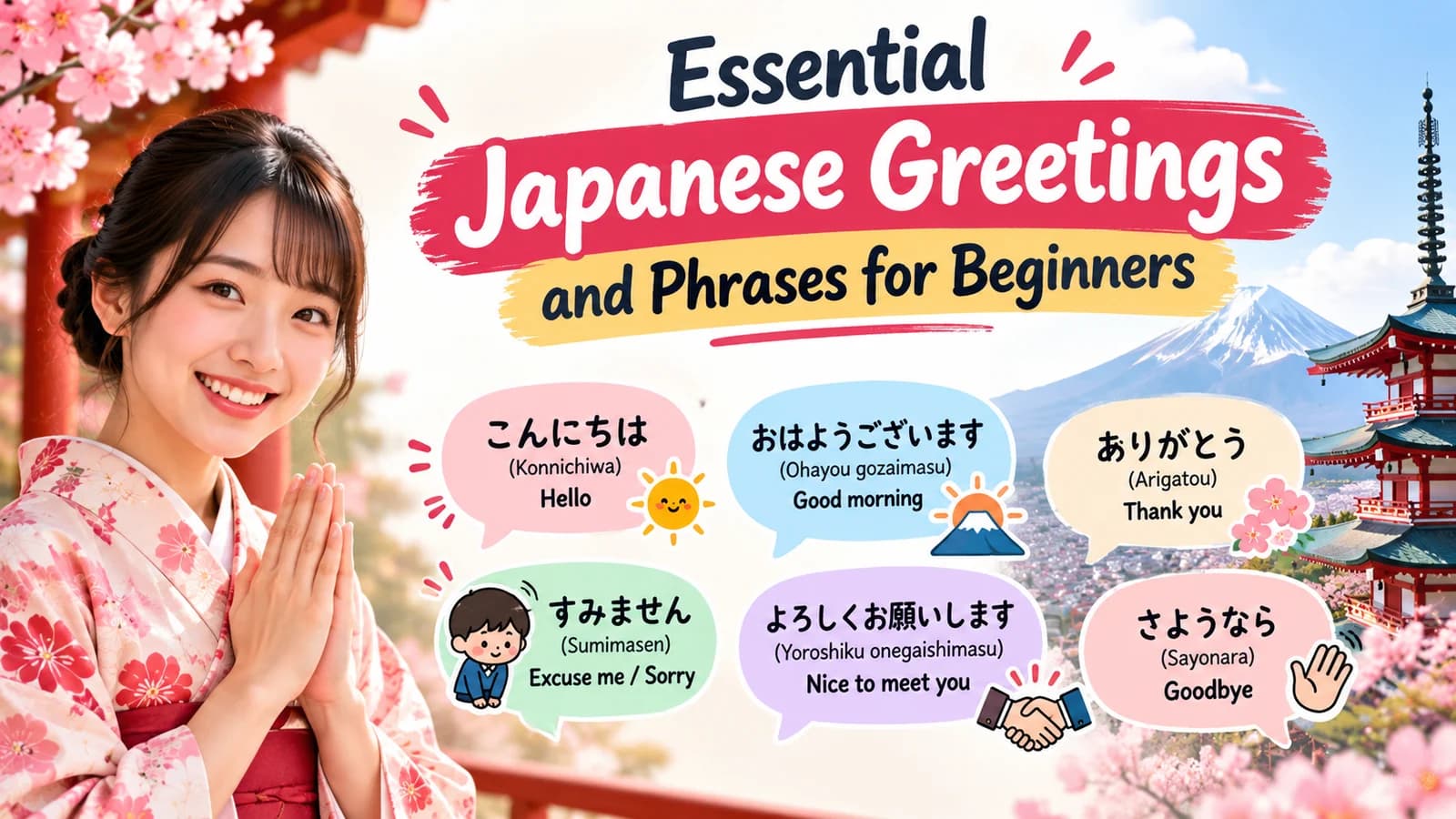
Essential Japanese Greetings and Phrases for Beginners
Published: 2026-10-14 12:01:02
Starting Japanese can feel overwhelming. Three writing systems, new sounds and polite speech levels all arrive at once. The good news is that you do not need to master grammar before you can speak. A handful of Japanese greetings and phrases is enough to start real conversations, impress native speakers and build the confidence to keep learning.
This guide covers the Japanese phrases for beginners that matter most: greetings, thank-yous and apologies, self-introductions, shopping, directions and polite expressions. Every phrase comes with pronunciation and English meaning. We have also added easy conversation examples, common mistakes to avoid and a section for JLPT N5 learners.
Quick tip: Say each phrase out loud as you read. Speaking is the fastest way to remember basic Japanese words and phrases.
Why Should Beginners Learn Basic Japanese Greetings and Phrases?
Greetings are the first thing you use and the first thing people notice. Japanese culture places great value on politeness (礼儀, reigi), so even a simple "Konnichiwa" shows respect and effort. Here is why starting with basic Japanese greetings for beginners works so well:
- You can speak from Day 1. You don't need kanji or grammar rules to say hello, thank you or sorry.
- You build listening confidence. These phrases appear in anime, dramas, YouTube videos and daily life, so you start recognising them everywhere.
- You make a great first impression. Whether you meet a Japanese colleague, a client or a tourist in Delhi, a polite greeting opens doors.
- You prepare for exams. Most greetings and set expressions are part of Japanese language basics for the N5 exam.
- You get ready for travel and work. These are the useful Japanese phrases to learn before travelling to Japan, and they also help if you plan to work with Japanese companies. Read more in our guide on learning Japanese as a complete beginner.
Many learners also ask whether Japanese is hard for Indian speakers. It is easier than you might think, because Japanese word order (subject–object–verb) is similar to Hindi. See our article Is Japanese difficult for Indians? for more.
Common Japanese Greetings for Everyday Conversations
Japanese greetings change with the time of day and the level of politeness. These are the common Japanese greetings you will use most. For a deeper look at formal, casual and polite forms, see our full guide to Japanese greetings.
How to Say Hello and Good Morning in Japanese
If you are wondering how to say hello in Japanese for beginners, start with these two.
| Japanese | Romaji (Pronunciation) | English Meaning | When to Use |
| こんにちは | Konnichiwa (kohn-nee-chee-wah) | Hello / Good afternoon | Late morning to early evening |
| おはようございます | Ohayou gozaimasu (oh-hah-yoh goh-zah-ee-mahs) | Good morning (polite) | Morning, with teachers, seniors, colleagues |
| おはよう | Ohayou | Good morning (casual) | Friends, family, juniors |
Good to know: Konnichiwa is not usually used early in the morning or late at night. In many workplaces, people also say Ohayou gozaimasu for the first greeting of the day, even in the afternoon.
How to Say Good Afternoon and Good Evening in Japanese
| Japanese | Romaji | English Meaning |
| こんにちは | Konnichiwa | Good afternoon |
| こんばんは | Konbanwa | Good evening |
Japanese has no separate word for "good afternoon". Konnichiwa covers both "hello" and "good afternoon". Use Konbanwa after sunset.
How to Say Goodbye in Japanese
| Japanese | Romaji | English Meaning | Tone |
| さようなら | Sayounara | Goodbye | Formal, often final (e.g. teacher to class) |
| じゃあね / またね | Jaa ne / Mata ne | See you / See you later | Casual, friends |
| また明日 | Mata ashita | See you tomorrow | Casual to neutral |
| 失礼します | Shitsurei shimasu | Excuse me for leaving | Formal, workplace |
| お疲れ様でした | Otsukaresama deshita | Thank you for your hard work | Used when leaving work |
Tip: Sayounara sounds quite final. For everyday goodbyes, Mata ne or Mata ashita feel more natural.
How to Say Good Night in Japanese
| Japanese | Romaji | English Meaning | Tone |
| おやすみなさい | Oyasuminasai | Good night (polite) | Parents, seniors, hosts |
| おやすみ | Oyasumi | Good night (casual) | Friends, family, partners |
Use Oyasumi only at bedtime or when parting for the night. It is not the same as Konbanwa, which is a greeting.
Basic Japanese Phrases for Beginners with English Meanings
Now let's build your Japanese phrases with English meaning toolkit. These are the easy Japanese phrases to learn first.
Common Japanese Words and Phrases for Daily Use
These Japanese words for everyday use show up in almost every conversation.
| Japanese | Romaji | English Meaning |
| はい | Hai | Yes |
| いいえ | Iie | No |
| わかりました | Wakarimashita | I understand |
| わかりません | Wakarimasen | I don't understand |
| だいじょうぶです | Daijoubu desu | It's okay / I'm fine |
| ちょっと待ってください | Chotto matte kudasai | Please wait a moment |
| もう一度お願いします | Mou ichido onegaishimasu | One more time, please |
| ゆっくり話してください | Yukkuri hanashite kudasai | Please speak slowly |
| 英語を話せますか | Eigo o hanasemasu ka | Can you speak English? |
| そうですか | Sou desu ka | Is that so? / I see |
For more beginner vocabulary, browse our lists of basic Japanese words for beginners and Japanese vocabulary.
How to Say Thank You and Sorry in Japanese
Knowing how to say thank you and sorry in Japanese is essential because Japanese has several levels of each. You can also read our dedicated article on how to say thank you in Japanese.
Saying thank you
| Japanese | Romaji | Level |
| ありがとう | Arigatou | Casual |
| ありがとうございます | Arigatou gozaimasu | Polite |
| どうもありがとうございます | Doumo arigatou gozaimasu | Very polite |
| ありがとうございました | Arigatou gozaimashita | Polite, for something already done |
Saying sorry
| Japanese | Romaji | Meaning and use |
| ごめん | Gomen | Sorry (casual, close friends) |
| ごめんなさい | Gomennasai | I'm sorry (sincere, everyday) |
| すみません | Sumimasen | Excuse me / Sorry / Thank you for the trouble |
| 申し訳ありません | Moushiwake arimasen | I am very sorry (formal, business) |
How to Say Please and Excuse Me in Japanese
| Japanese | Romaji | English Meaning | Use |
| お願いします | Onegaishimasu | Please (requesting something) | "Water, please." |
| ください | Kudasai | Please give me | After a noun: Kore o kudasai |
| ~てください | ~te kudasai | Please do ~ | Matte kudasai (Please wait) |
| すみません | Sumimasen | Excuse me | Getting attention, passing through a crowd |
| 失礼します | Shitsurei shimasu | Excuse me (formal) | Entering or leaving a room |
How to Introduce Yourself in Japanese
A self-introduction (自己紹介, jikoshoukai) is one of the first things taught in class. Here is the basic pattern, which also answers how to introduce yourself in Japanese:
| Japanese | Romaji | English Meaning |
| はじめまして | Hajimemashite | Nice to meet you (first meeting) |
| わたしは〜です | Watashi wa ~ desu | I am ~ |
| インドから来ました | Indo kara kimashita | I came from India |
| 〜歳です | ~ sai desu | I am ~ years old |
| 学生です / 会社員です | Gakusei desu / Kaishain desu | I am a student / an office worker |
| どうぞよろしくお願いします | Douzo yoroshiku onegaishimasu | Please treat me well |
Example self-introduction:
はじめまして。わたしはアーリヤです。インドから来ました。学生です。どうぞよろしくお願いします。
Hajimemashite. Watashi wa Aarya desu. Indo kara kimashita. Gakusei desu. Douzo yoroshiku onegaishimasu.
"Nice to meet you. I am Aarya. I am from India. I am a student. Please treat me kindly."
Want more examples? Read our full guide on self-introduction in Japanese.
Essential Japanese Phrases for Everyday Conversations
Once you know the basics, these Japanese phrases for everyday conversations will carry you through real situations at home, in class, at work and while travelling.
Japanese Phrases for Meeting Someone for the First Time
| Japanese | Romaji | English Meaning |
| はじめまして | Hajimemashite | Nice to meet you |
| お名前は何ですか | Onamae wa nan desu ka | What is your name? |
| お会いできて嬉しいです | Oaidekite ureshii desu | I'm happy to meet you |
| お元気ですか | Ogenki desu ka | How are you? |
| 元気です。あなたは? | Genki desu. Anata wa? | I'm fine. And you? |
| こちらこそ | Kochira koso | Likewise / The pleasure is mine |
Japanese Phrases for Asking Questions
Questions in Japanese are simple. Add か (ka) at the end of a sentence. Our article on how to ask questions in Japanese goes deeper.
| Japanese | Romaji | English Meaning |
| これは何ですか | Kore wa nan desu ka | What is this? |
| どこですか | Doko desu ka | Where is it? |
| いつですか | Itsu desu ka | When is it? |
| 誰ですか | Dare desu ka | Who is it? |
| どうしてですか | Doushite desu ka | Why? |
| いくらですか | Ikura desu ka | How much is it? |
| 日本語で何と言いますか | Nihongo de nan to iimasu ka | How do you say this in Japanese? |
Japanese Phrases for Shopping and Ordering Food
| Japanese | Romaji | English Meaning |
| これをください | Kore o kudasai | This one, please |
| いくらですか | Ikura desu ka | How much is it? |
| メニューをください | Menyuu o kudasai | Menu, please |
| お水をお願いします | Omizu o onegaishimasu | Water, please |
| いただきます | Itadakimasu | Said before eating (thanks for the meal) |
| おいしいです | Oishii desu | It's delicious |
| お会計をお願いします | Okaikei o onegaishimasu | The bill, please |
| ごちそうさまでした | Gochisousama deshita | Thank you for the meal (said after eating) |
| カードは使えますか | Kaado wa tsukaemasu ka | Can I use a card? |
Cultural note: Itadakimasu and Gochisousama deshita express gratitude to the people who prepared the food. Japanese people say them at nearly every meal.
Japanese Phrases for Asking for Directions
| Japanese | Romaji | English Meaning |
| 駅はどこですか | Eki wa doko desu ka | Where is the station? |
| トイレはどこですか | Toire wa doko desu ka | Where is the toilet? |
| まっすぐ | Massugu | Straight ahead |
| 右 | Migi | Right |
| 左 | Hidari | Left |
| 道に迷いました | Michi ni mayoimashita | I'm lost |
| 助けてください | Tasukete kudasai | Please help me |
Formula to remember: [Place] wa doko desu ka? = "Where is [place]?" Swap in any noun and it works.
Japanese Greetings and Polite Expressions You Should Know
Politeness is built into the Japanese language. Learning Japanese polite expressions early helps you avoid sounding rude without meaning to.
Formal vs Informal Japanese Greetings
| Situation | Formal (polite) | Informal (casual) |
| Good morning | Ohayou gozaimasu | Ohayou |
| Thank you | Arigatou gozaimasu | Arigatou |
| Sorry | Moushiwake arimasen / Sumimasen | Gomen |
| Good night | Oyasuminasai | Oyasumi |
| Goodbye | Shitsurei shimasu / Sayounara | Jaa ne / Mata ne |
| How are you? | Ogenki desu ka | Genki? |
Simple rule: If you are unsure, always use the polite form. Use casual forms only with close friends, family and people younger than you. Tourists and beginners are always safe with polite Japanese.
Common Japanese Honorific Expressions for Beginners
Honorifics (敬語, keigo) are a big topic, but beginners only need a few:
- 〜さん (-san): Added after names for general respect. Use it for everyone you meet: Tanaka-san.
- 〜先生 (-sensei): For teachers, doctors and professionals: Yamada-sensei.
- 〜くん / 〜ちゃん (-kun / -chan): Friendly, used for boys/younger people and girls/children among close contacts.
- お〜 / ご〜 (o- / go-): Polite prefixes, as in o-mizu (water) and go-han (meal).
- 〜です / 〜ます: The polite sentence endings you will use in almost every sentence.
Never use -san with your own name when introducing yourself. For deeper reading, see our guides on Japanese honorifics and the role of keigo in Japanese society.
When to Use Sumimasen, Arigatou, and Onegaishimasu
These three words are the backbone of polite Japanese.
1. Sumimasen (すみません) is the most flexible word in Japanese. It can mean:
- Excuse me: getting a waiter's attention or squeezing past someone on the train.
- I'm sorry: apologising for a small mistake.
- Thank you for the trouble: when someone goes out of their way to help.
2. Arigatou (ありがとう / ありがとうございます)
- Use Arigatou gozaimasu with teachers, seniors and strangers.
- Use Arigatou with friends.
- Use Arigatou gozaimashita when thanking someone for something that has just finished.
3. Onegaishimasu (お願いします)
- Use it when asking for something or for a service: Onegaishimasu ("Please") or Kore o onegaishimasu ("This one, please").
- It is also a polite way to begin a class, a meeting or a game: “Please treat me well.”
Basic Japanese Phrases with Pronunciation and English Translation
Here is a quick-reference list of the most useful Japanese words and phrases with pronunciation. Save or screenshot it as your starter cheat sheet.
| # | Japanese | Romaji | Pronunciation Guide | English Translation |
| 1 | こんにちは | Konnichiwa | kohn-nee-chee-wah | Hello / Good afternoon |
| 2 | おはようございます | Ohayou gozaimasu | oh-hah-yoh goh-zah-ee-mahs | Good morning |
| 3 | こんばんは | Konbanwa | kohn-bahn-wah | Good evening |
| 4 | おやすみなさい | Oyasuminasai | oh-yah-soo-mee-nah-sah-ee | Good night |
| 5 | さようなら | Sayounara | sah-yoh-nah-rah | Goodbye |
| 6 | ありがとうございます | Arigatou gozaimasu | ah-ree-gah-toh goh-zah-ee-mahs | Thank you very much |
| 7 | すみません | Sumimasen | soo-mee-mah-sen | Excuse me / Sorry |
| 8 | ごめんなさい | Gomennasai | goh-men-nah-sah-ee | I'm sorry |
| 9 | お願いします | Onegaishimasu | oh-neh-gah-ee-shee-mahs | Please |
| 10 | はい / いいえ | Hai / Iie | high / ee-eh | Yes / No |
| 11 | わかりません | Wakarimasen | wah-kah-ree-mah-sen | I don't understand |
| 12 | はじめまして | Hajimemashite | hah-jee-meh-mah-shee-teh | Nice to meet you |
| 13 | いくらですか | Ikura desu ka | ee-koo-rah dess kah | How much is it? |
| 14 | トイレはどこですか | Toire wa doko desu ka | toy-reh wah doh-koh dess kah | Where is the toilet? |
| 15 | おいしいです | Oishii desu | oh-ee-shee dess | It's delicious |
Pronunciation tips for beginners:
- Japanese vowels are short and clear: a (ah), i (ee), u (oo), e (eh), o (oh).
- The final "su" in desu and masu is soft, almost silent ("dess", "mahs").
- Every syllable has roughly equal length and stress. Avoid English-style stress.
- A long vowel such as ou in ohayou is held a bit longer, and changes meaning when shortened.
Want to read the scripts behind these phrases? Start with Hiragana, then Katakana and Kanji.
Easy Japanese Conversation Examples for Beginners
Reading phrases is useful, but seeing them in action is better. These Japanese conversation for beginners examples show how phrases fit together.
Simple Japanese Greetings Between Friends
A: おはよう! Ohayou! Good morning!
B: おはよう。元気? Ohayou. Genki? Morning. How are you?
A: 元気だよ。あなたは? Genki da yo. Anata wa? I'm good. And you?
B: 元気。また後でね! Genki. Mata ato de ne! Good. See you later!
A: うん、またね。 Un, mata ne. Yeah, see you.
A Basic Japanese Conversation for Self-Introduction
A: はじめまして。田中です。どうぞよろしくお願いします。 Hajimemashite. Tanaka desu. Douzo yoroshiku onegaishimasu. Nice to meet you. I'm Tanaka. Please treat me kindly.
B: はじめまして。ラヒルです。インドから来ました。 Hajimemashite. Rahul desu. Indo kara kimashita. Nice to meet you. I'm Rahul. I'm from India.
A: そうですか。お仕事は何ですか。 Sou desu ka. Oshigoto wa nan desu ka. Is that so? What do you do?
B: 学生です。日本語を勉強しています。 Gakusei desu. Nihongo o benkyou shite imasu. I'm a student. I'm studying Japanese.
A: すごいですね! Sugoi desu ne! That's great!
Japanese Conversation Practice for Daily Situations
At a restaurant
Staff: いらっしゃいませ。何名様ですか。 Irasshaimase. Nanmei-sama desu ka. Welcome. How many people?
You: 二人です。 Futari desu. Two people.
You: すみません、メニューをお願いします。 Sumimasen, menyuu o onegaishimasu. Excuse me, the menu please.
You: これをください。 Kore o kudasai. This one, please.
You: おいしかったです。ごちそうさまでした。 Oishikatta desu. Gochisousama deshita. It was delicious. Thank you for the meal.
For more patterns, read our guide to simple sentences in Japanese and test yourself with our free Japanese quiz.
Common Mistakes Beginners Make When Using Japanese Greetings
Avoid these errors and you will sound far more natural.
- Using Konnichiwa at any time of day. It is best from late morning to early evening. Switch to Ohayou gozaimasu in the morning and Konbanwa at night.
- Overusing Sayounara. It sounds final, like a long farewell. Use Mata ne, Mata ashita or Shitsurei shimasu instead.
- Mixing casual and polite forms. Saying Arigatou to your teacher or Ohayou to your boss can sound rude. When unsure, add gozaimasu.
- Confusing Sumimasen and Gomennasai. Sumimasen works for "excuse me" and light apologies. Gomennasai is a more personal "I'm sorry".
- Adding -san to your own name. Use -san only for other people.
- Pronouncing desu as "de-su". The u is nearly silent: "dess".
- Ignoring bowing and tone. In Japan, a slight bow, a smile and a calm voice are part of the greeting.
- Translating word-for-word from English. Phrases such as Itadakimasu and Otsukaresama desu have no direct English equivalent, so learn them as set expressions.
- Relying on romaji forever. Romaji is a helpful start, but learning hiragana early makes pronunciation and reading much stronger. Start with our Hiragana guide.
Essential Japanese Words and Phrases for JLPT N5 Beginners
If you plan to take the JLPT N5, the entry-level exam of the Japanese Language Proficiency Test, these Japanese phrases for JLPT N5 will appear in the vocabulary, listening and reading sections. Learn them as set expressions along with basic Japanese vocabulary for JLPT N5.
JLPT N5 greetings and expressions
| Japanese | Romaji | English Meaning |
| おはようございます | Ohayou gozaimasu | Good morning |
| こんにちは | Konnichiwa | Hello |
| こんばんは | Konbanwa | Good evening |
| おやすみなさい | Oyasuminasai | Good night |
| さようなら | Sayounara | Goodbye |
| ありがとうございます | Arigatou gozaimasu | Thank you |
| すみません | Sumimasen | Excuse me / Sorry |
| ごめんなさい | Gomennasai | I'm sorry |
| いただきます | Itadakimasu | Said before eating |
| ごちそうさまでした | Gochisousama deshita | Said after eating |
| いってきます / いってらっしゃい | Ittekimasu / Itterasshai | I'm off / Have a good day |
| ただいま / おかえりなさい | Tadaima / Okaerinasai | I'm home / Welcome home |
| はじめまして | Hajimemashite | Nice to meet you |
| どうぞよろしくお願いします | Douzo yoroshiku onegaishimasu | Pleased to meet you |
N5 study tips
- Learn each greeting with its situation. The listening section tests context, not just meaning.
- Revise numbers, days, time words, family words and basic verbs along with greetings.
- Master hiragana and katakana first, then add the N5 kanji.
- Practise with timed mock tests to get used to the exam style.
Helpful resources to continue:
- JLPT N5 study guide for Indian students
- JLPT N5 kanji list
- JLPT N5 exam pattern
- Everything about the JLPT
- Basic Japanese N5 course at TLS
How to Practise Japanese Greetings and Improve Speaking Skills
Knowing phrases is one thing. Using them smoothly is another. This basic Japanese speaking practice routine works for most beginners:
- Speak aloud every day. Spend 10 minutes saying 10 phrases, with your own voice, at natural speed.
- Use the shadowing method. Play a short audio clip, pause and repeat exactly what you hear, copying rhythm and intonation.
- Learn phrases in situations, not in lists. Imagine entering a shop, meeting a new colleague or ordering food, and run the whole dialogue.
- Record yourself. Compare your voice with a native speaker and fix weak sounds.
- Keep a phrase notebook. Write the phrase, romaji, meaning and a one-line example. Review it every few days.
- Use flashcards and spaced repetition. Revisit difficult phrases at increasing intervals.
- Watch and listen. Japanese dramas, anime and YouTube lessons help you pick up natural speed and tone. Our list of Japanese language videos is a good place to start.
- Find a speaking partner or teacher. A trainer corrects mistakes instantly, which is the biggest advantage of structured learning. Join conversation classes in Japanese to practise regularly.
- Be consistent. Fifteen minutes a day beats a three-hour session once a week.
More ideas are in our post on how to improve Japanese speaking skills fast and our Japanese language learning roadmap.
Learn Basic Japanese with TLS – The Japanese Language School in Delhi
Self-study is a great start, but real progress comes from a structured course with expert trainers, regular speaking practice and exam guidance. That is exactly what TLS – The Japanese Language School offers.
Whether you are a school student, college student, working professional or planning a career or studies in Japan, TLS helps you go from "Konnichiwa" to confident conversations. If you are searching for a Japanese language course in Delhi, a Japanese language institute in Delhi or Japanese classes in Delhi, here is why learners choose TLS:
- Complete level-wise courses: From Basic Japanese N5 to Intermediate N4, Pre-Advance N3, Advance N2 and Super Advance N1. Browse all Japanese language courses.
- Japanese speaking classes in Delhi: Dedicated conversation classes (Kaiwa) help you practise real dialogues from the first week.
- Japanese language course for beginners in Delhi: Zero knowledge needed. You start with hiragana, greetings and simple sentences.
- JLPT-focused training: Syllabus, mock practice and exam strategy built around JLPT requirements.
- Online and offline options: Join classroom batches in Laxmi Nagar or learn through the online Japanese language course.
- Japan visa and study guidance: Support through our Japan visa assistance services for students planning to study or work in Japan.
- Convenient East Delhi location: TLS is a trusted Japanese language institute in Laxmi Nagar, easily reachable from across Delhi NCR. Learn more on our Laxmi Nagar centre page or see our guide to Japanese language courses in Laxmi Nagar.
Looking for Japanese coaching near me? Check our Japanese language course near me page. You can also read about fees for Japanese courses in Delhi before you decide, or learn how to choose a Japanese language institute in Delhi.
📍 Ready to Start? Visit TLS Today
Visit Us 2/81-82, 2nd Floor, Lalita Park, Gali No - 2, Laxmi Nagar, New Delhi - 110092
Call Us 91 87009 56038
Email Us tls@teamlanguages.com
👉 Book Your Free Demo Class | Contact Us | Explore Courses
Frequently Asked Questions About Japanese Greetings and Phrases
What Are the Most Common Japanese Greetings?
The most common Japanese greetings are Ohayou gozaimasu (good morning), Konnichiwa (hello / good afternoon), Konbanwa (good evening), Oyasuminasai (good night) and Sayounara (goodbye). Casual versions include Ohayou, Oyasumi and Mata ne. Always use the polite forms with teachers, seniors and strangers.
How Do Beginners Say Hello in Japanese?
Beginners say hello with Konnichiwa (こんにちは). Use Ohayou gozaimasu in the morning and Konbanwa in the evening. If you are meeting someone for the first time, add Hajimemashite ("Nice to meet you") and Douzo yoroshiku onegaishimasu ("Please treat me well").
What Are the Most Useful Japanese Phrases for Daily Life?
The most useful Japanese phrases for daily life are Arigatou gozaimasu (thank you), Sumimasen (excuse me / sorry), Onegaishimasu (please), Kore o kudasai (this one, please), Ikura desu ka (how much is it?), Doko desu ka (where is it?), Wakarimasen (I don't understand) and Daijoubu desu (I'm okay).
How Do You Introduce Yourself in Japanese?
Use this pattern: Hajimemashite. Watashi wa [name] desu. [Country] kara kimashita. Douzo yoroshiku onegaishimasu. For example: Hajimemashite. Watashi wa Rahul desu. Indo kara kimashita. Douzo yoroshiku onegaishimasu. You can add your age, job or what you are studying.
Is Japanese Difficult to Learn for Beginners?
Japanese has a new writing system, but spoken Japanese is quite beginner-friendly. Pronunciation is simple, there are only five vowel sounds and there are no tones or grammatical gender. Indian learners also benefit from a subject–object–verb word order similar to Hindi. With regular practice and a good teacher, most beginners can hold simple conversations within a few months. Read more in Is Japanese difficult for Indians?
Which Japanese Phrases Should I Learn First for JLPT N5?
Start with greetings (Ohayou gozaimasu, Konnichiwa, Konbanwa, Oyasuminasai, Sayounara), politeness words (Arigatou gozaimasu, Sumimasen, Gomennasai, Onegaishimasu), everyday set phrases (Itadakimasu, Gochisousama deshita, Ittekimasu, Tadaima) and self-introduction (Hajimemashite, Watashi wa ~ desu). Then add numbers, time, family words and basic verbs. Our JLPT N5 study guide lays out a step-by-step plan.
Final Thoughts
Learning Japanese greetings and phrases is the easiest, most rewarding first step in your language journey. Start with five phrases today, such as Konnichiwa, Arigatou gozaimasu, Sumimasen, Onegaishimasu and Hajimemashite. Add five more every few days, and practise them out loud. Within a few weeks, you will be greeting, thanking and introducing yourself in Japanese with confidence.
If you want expert guidance, speaking practice and JLPT preparation, join TLS – The Japanese Language School in Laxmi Nagar, Delhi, and take your Japanese from beginner to fluent.
📞 Call: 91 87009 56038 | ✉️ Email: tls@teamlanguages.com
Related Reading
- Japanese Greetings Explained
- How to Say Thank You in Japanese
- Self-Introduction in Japanese
- Basic Japanese Words for Beginners
- JLPT N5 Study Guide for Indian Students
- Japanese Language Course in Delhi
- Japanese Language Institute in Delhi
- Japanese Classes in Delhi