
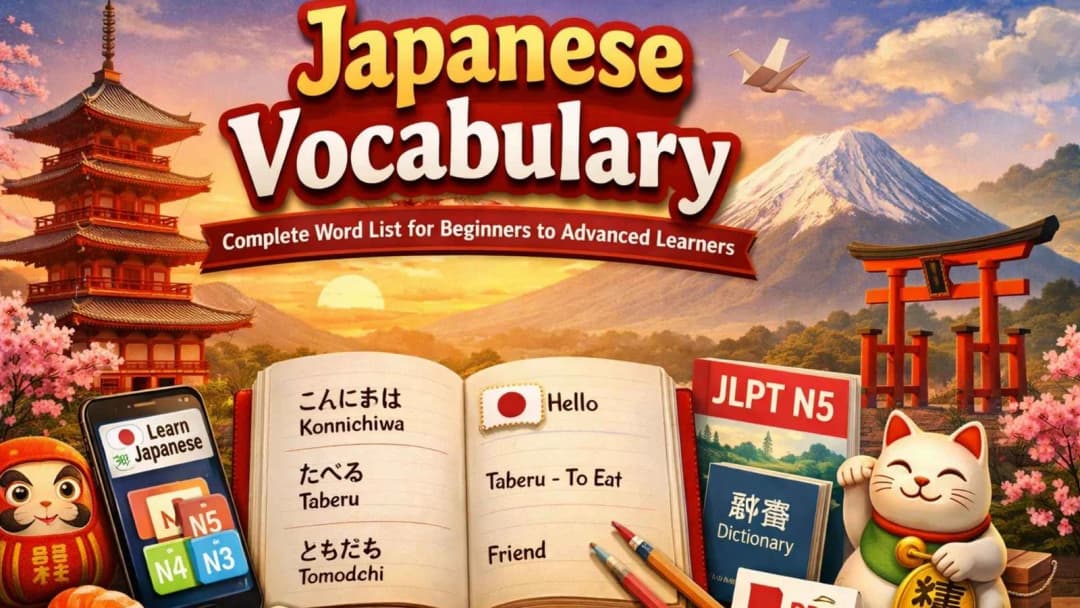
Japanese Vocabulary: Complete Word List for Beginners to Advanced Learners
Published: 2026-01-29 05:52:45
Learning Japanese Vocabulary is the most important part of learning the Japanese language. Vocabulary means words, and without knowing enough words, you cannot speak, read, write, or understand Japanese properly. Even if you know grammar, communication is not possible without vocabulary.
Whether you are learning for daily conversation, JLPT exams, study in Japan, or job opportunities, strong Japanese vocabulary will help you at every stage. In this article, you will learn about Japanese vocabulary for beginners, Japanese vocabulary N5, how to use Japanese words A to Z, how to study using a Japanese vocabulary book, how to practice with Japanese vocabulary PDF, and how a Japanese vocabulary app can help in daily revision.
For serious learners, professional guidance from TLS – The Japanese Language School plays an important role in building strong vocabulary with correct usage and pronunciation.
Why Is Japanese Vocabulary So Important?
Japanese vocabulary helps you:
- Make correct sentences
- Understand spoken Japanese
- Read books, signs, and online content
- Clear JLPT exams
- Speak confidently in real situations
Instead of only memorizing words, you should learn Japanese vocabulary words with meaning and how they are used in sentences.
Students looking for offline classes can also explore a Japanese language course near West Delhi to improve vocabulary through classroom practice and guided learning.
Japanese Vocabulary for Beginners: Start with Daily Use Words
If you are new to Japanese, start with simple and commonly used words. This is the best way to build confidence.
Read More-: https://youtu.be/JTmJmWLsgKE?si=1D-7MP3MKl-DpcaR
Basic Japanese Vocabulary Words with Meaning
| Japanese | Romaji | Meaning |
| こんにちは | Konnichiwa | Hello |
| おはよう | Ohayou | Good morning |
| ありがとう | Arigatou | Thank you |
| はい | Hai | Yes |
| いいえ | Iie | No |
| 水 | Mizu | Water |
| 食べる | Taberu | To eat |
| 行く | Iku | To go |
| 来る | Kuru | To come |
| 友達 | Tomodachi | Friend |
Simple Japanese Sentences for Beginners
- 私は学生です。
Watashi wa gakusei desu.
I am a student. - 水を飲みます。
Mizu o nomimasu.
I drink water. - 学校へ行きます。
Gakkou e ikimasu.
I go to school.
At TLS – The Japanese Language School, beginners are trained with daily conversation vocabulary along with speaking practice so students can use words naturally.
Learners planning to study in Japan should also check how much money is required for Japan student visa so they can prepare both academically and financially.
Japanese Vocabulary N5 for JLPT Beginners
JLPT N5 is the first official level of Japanese language exams. Japanese vocabulary N5 focuses on basic everyday words.
What You Learn in N5 Vocabulary
Students usually learn around 800 to 1000 words, including:
- Family
- School
- Food
- Travel
- Time and dates
- Basic verbs and adjectives
Learners preparing for exams should stay updated with the JLPT December result date announcement to plan their next level of vocabulary and exam preparation.
Sample N5 Vocabulary Table
| Japanese | Romaji | Meaning |
| 家族 | Kazoku | Family |
| 先生 | Sensei | Teacher |
| 電車 | Densha | Train |
| 店 | Mise | Shop |
| 大きい | Ookii | Big |
| 小さい | Chiisai | Small |
| 見る | Miru | To see |
| 聞く | Kiku | To listen |
Example N5 Sentences
- 電車で会社へ行きます。
Densha de kaisha e ikimasu.
I go to the office by train. - 先生の話を聞きます。
Sensei no hanashi o kikimasu.
I listen to the teacher.
Strong N5 vocabulary is very important before moving to higher JLPT levels.
Read More -: https://youtube.com/shorts/uX-KMTXoM_w?si=E2JOA2xlETNhh062
Learning Japanese Words A to Z for Practice
Many students like to learn Japanese words A to Z using romaji lists. This method helps in quick revision and organized practice.
Example A to Z Style Vocabulary
| Letter | Word | Japanese | Meaning |
| A | Arigatou | ありがとう | Thank you |
| B | Benkyou | 勉強 | Study |
| C | Chotto | ちょっと | A little |
| D | Doko | どこ | Where |
| E | Eki | 駅 | Station |
| K | Kirei | きれい | Beautiful |
| M | Mikan | みかん | Orange |
| S | Suki | 好き | Like |
A to Z lists are good for memorization, but you should also study topic-wise vocabulary and sentence usage.
Students who want structured study material and practice sheets can also explore helpful learning tools available on the Japanese language learning resources page for better vocabulary building.
Choosing the Right Japanese Vocabulary Book
A good Japanese vocabulary book helps you learn faster and in a structured way.
What a Good Vocabulary Book Should Have
- Word meaning with examples
- JLPT level-wise vocabulary
- Pronunciation support
- Practice exercises
Many JLPT vocabulary books also include mock tests and revision sections.
At TLS – The Japanese Language School, students receive proper vocabulary material prepared according to JLPT patterns and real conversation needs.
If you are comparing options, you can check the list of institutes offering Japanese language courses in Delhi to choose the right place for structured vocabulary and JLPT training.
Using Japanese Vocabulary PDF for Easy Revision
Many learners prefer digital study material like Japanese vocabulary PDF because it is easy to carry and revise.
Benefits of Japanese Vocabulary Words PDF
- Study on mobile or laptop
- Printable for offline practice
- Easy to revise while traveling
- Topic-wise and level-wise lists
You can find Japanese vocabulary words PDF for:
- JLPT N5 to N1
- Daily use conversation
- Business Japanese
- Travel Japanese
Combining books with PDFs helps in faster revision and better memory.
After improving Japanese vocabulary and clearing JLPT, many students are curious about job prospects, so reading about salary after JLPT N2 in India and Japan can help in career planning.
Learning with Japanese Vocabulary App
A Japanese vocabulary app is very useful for daily practice.
Features of Good Vocabulary Apps
- Flashcards
- Spaced repetition
- Audio pronunciation
- Daily reminders
- Quizzes
How Apps Help in Vocabulary Learning
Apps help you revise old words and learn new words every day. This improves long-term memory and keeps learning continuous even on busy days.
But apps should be used along with:
- Speaking practice
- Writing practice
- Grammar study
Professional classes like those at TLS combine classroom learning with digital practice.
To understand how vocabulary connects with traditions and expressions, reading about Japanese language and culture can help you learn words in proper cultural context.
Advanced Japanese Vocabulary for Higher Levels
At advanced levels like N3, N2, and N1, vocabulary becomes more complex.
Types of Advanced Vocabulary
- Business words
- Formal expressions
- News and academic terms
- Idioms and fixed phrases
Example Advanced Vocabulary
| Japanese | Romaji | Meaning |
| 経済 | Keizai | Economy |
| 会議 | Kaigi | Meeting |
| 連絡 | Renraku | Contact |
| 重要 | Juuyou | Important |
| 改善 | Kaizen | Improvement |
Example Sentence
- 会議で重要な話をします。
Kaigi de juuyou na hanashi o shimasu.
We discuss important matters in the meeting.
Advanced vocabulary needs regular reading and listening practice.
To improve reading skills and learn new words in a fun way, students can practice with motivational Japanese quotes with meaning which are useful for daily vocabulary revision.
Smart Methods to Improve Japanese Vocabulary Faster
Learning Japanese vocabulary becomes easier when you use the right study techniques instead of only memorizing word lists. Practice new words in full sentences, revise them regularly using spaced repetition, and try to use them while speaking or writing every day.
Best Learning Techniques
- Learn words with sentences
- Revise using spaced repetition
- Speak daily using new words
- Write short paragraphs
- Listen to native Japanese audio
Daily Study Plan
- Learn 10 new words
- Revise 30 old words
- Make 5 sentences
- Listen to Japanese audio
Consistency is more important than long study hours.
Learning festival-related words becomes easier when you explore articles on Japanese New Year traditions and practice seasonal vocabulary used in celebrations.
Why Study at TLS – The Japanese Language School
Self-study is good, but professional training gives faster results. TLS – The Japanese Language School provides structured courses for beginners to advanced learners.
Benefits of TLS
- JLPT focused vocabulary training
- Speaking and listening practice
- Experienced Japanese language trainers
- Online and classroom options
- Regular tests and feedback
Students learn vocabulary in context, not just as word lists. This helps in real conversation and exam success.
Those who prefer personalized learning can also choose a Japanese tutor online to improve vocabulary, pronunciation, and speaking confidence from home.
Common Mistakes Students Make in Vocabulary Learning
- Only memorizing without usage
- Not revising regularly
- Ignoring pronunciation
- Learning too many words at once
- Avoiding speaking practice
Avoid these mistakes to improve faster.
To speak politely and correctly, students should also study Japanese honorifics and polite forms which are important for respectful communication.
Frequently Asked Questions
1. How many Japanese vocabulary words do I need for the N5 level?
To pass the JLPT N5, which is the basic beginner level, you typically need to master around 800 core vocabulary words. This list focuses on everyday essentials like greetings, family members, basic actions, and common objects. Mastering these allows you to handle simple, daily conversations and read basic sentences written in hiragana or katakana.
2. Is it better to learn Japanese vocabulary with or without Kanji?
While beginners start with hiragana and katakana, you should ideally learn Kanji alongside your vocabulary as early as possible. Kanji provides "visual hooks" that help differentiate between homonyms (words that sound the same) and make it easier to understand complex words later on. At TLS (The Japanese Language School), we integrate basic Kanji from the start to build a stronger long term foundation.
3. What is the most effective way to memorize new Japanese words?
The most effective method is Spaced Repetition System (SRS) combined with contextual learning. Instead of memorizing isolated lists, try to use new words in sentences or associate them with vivid mental images. Using a Japanese vocabulary app like Anki or Memrise can help automate this review process so you do not forget what you have learned.
4. How many new Japanese vocabulary words should I learn per day?
A sustainable goal for most beginners is 5 to 10 new words per day. While it is tempting to cram 50 words at once, your brain needs time to move those words from short term to long term memory. Consistency is far more important than intensity, so aim for a small number of words that you can practice and use daily.
5. Can I learn Japanese vocabulary just by watching anime or movies?
Anime can be a great supplement for hearing natural intonation and slang, but it is rarely enough on its own for systematic learning. Many words used in anime are overly dramatic or specific to certain genres and may not be appropriate for real life or professional situations. It is best to use anime to reinforce the Japanese vocabulary words with meaning you have already studied in a structured course.
Beginners can follow a step-by-step Japanese language learning roadmap to build vocabulary and grammar in the right sequence.
6. Why does some Japanese vocabulary have different meanings in different contexts?
Japanese is a highly contextual language where a single word can shift meaning based on the speaker's relationship with the listener. For example, verbs and pronouns change significantly depending on whether you are using polite or casual speech. This is why studying at a specialized center like TLS is beneficial, as teachers explain these subtle cultural nuances.
7. Should I focus on learning Romaji or Hiragana first?
You should move away from Romaji as quickly as possible and focus entirely on Hiragana and Katakana. Romaji can actually hinder your pronunciation and make it harder to transition to reading real Japanese materials. Once you can read the native scripts, your ability to absorb new Japanese vocabulary will increase exponentially.
8. What are "Katakana words" and why are they important?
Katakana is used for loanwords from other languages, like terebi (television) or konpyuuta (computer). Even though they sound like English, the pronunciation follows Japanese phonetic rules, so you must learn them as distinct Japanese vocabulary words. They are essential for modern life in Japan and are frequently used in advertisements and menus.
9. How can I practice my Japanese vocabulary if I don't live in Japan?
You can create an immersion environment by labeling items in your house with their Japanese names, following Japanese social media accounts, or joining language exchange groups. Enrolling in a school like The Japanese Language School also gives you a dedicated space to practice speaking with experts. This active recall is what turns passive knowledge into active fluency.
10. What should I do if I keep forgetting the words I just learned?
Forgetting is a natural part of the learning process, often called the "forgetting curve." To overcome this, use "Active Recall" by testing yourself without looking at the answers and write the words out by hand to build muscle memory. If you feel stuck, reaching out for professional guidance can help you identify better study habits tailored to your learning style.
Students planning higher studies should read about popular Japanese scholarships for Indian students where strong vocabulary and JLPT scores are very helpful.
Conclusion
Strong Japanese Vocabulary is the key to becoming confident in Japanese. From Japanese vocabulary for beginners to advanced JLPT levels, learning words with meaning and sentence usage is very important.
Using tools like a Japanese vocabulary book, Japanese vocabulary PDF, Japanese words A to Z lists, Japanese vocabulary N5 preparation material, and daily practice with a Japanese vocabulary app helps build a strong learning system.
For proper guidance and structured learning, TLS – The Japanese Language School offers professional Japanese language training that supports exam preparation and real-life communication.
With regular practice and the right guidance, mastering Japanese vocabulary is fully achievable.
While preparing for JLPT N5, it is also important to practice kanji, so learners should refer to the JLPT N5 kanji list along with vocabulary for complete exam preparation.
Contact TLS-The Japanese Language School Today
If you want to learn Japanese with proper guidance and structured study plans, contact TLS – The Japanese Language School now.
Call or WhatsApp: 91 8700956038
Address: 2/81-82, Ground Floor, Lalita Park, Laxmi Nagar, New Delhi – 110092
Email: tls@teamlanguages.com
Start your Japanese learning journey today and build strong vocabulary for exams, careers, and real communication.