

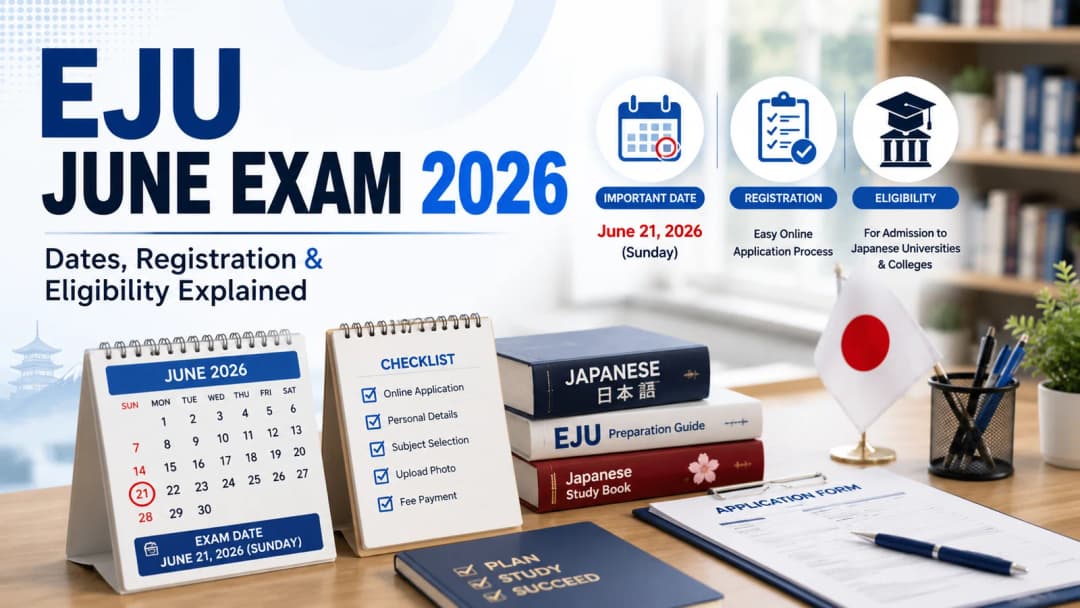
EJU June Exam 2026: Dates, Registration, and Eligibility Explained
Published: 2026-05-06 07:33:32
Are you dreaming of studying at a Japanese university? Then the Examination for Japanese University Admission for International Students (EJU) is your gateway. Whether you're aiming for an undergraduate degree, a postgraduate program, a junior college, or a professional training college in Japan, the EJU June 2026 exam is the first major milestone on your journey.
This comprehensive guide covers everything you need to know — EJU exam dates 2026, registration windows, eligibility requirements, exam structure, scholarship opportunities, and step-by-step application instructions, especially for students applying from India through MOSAI in New Delhi.
Planning for the EJU? Don’t miss the complete timeline—check the EJU exam date 2026 guide to stay updated with both June and November sessions.
What Is the EJU? A Quick Overview
The EJU (Examination for Japanese University Admission for International Students) is conducted by the Japan Student Services Organization (JASSO), headquartered in Tokyo, Japan. It is the standardized entrance examination used by Japanese universities, junior colleges, graduate schools, and special training colleges to assess international applicants.
The exam evaluates two core competencies:
- Japanese Language Proficiency — This section is conducted entirely in Japanese and measures a student's ability to understand academic Japanese at the university level.
- Basic Academic Abilities — This section tests knowledge of Mathematics, Science (Physics, Chemistry, Biology), and Social Science (Japan and the World) at the higher secondary level. Examinees can choose either Japanese or English as the medium for this part.
The EJU is held twice a year — in June (1st Session) and November (2nd Session). For students eager to begin their Japanese academic journey, the June sitting is particularly important.
Understanding the EJU exam registration process for Indian students is essential to avoid mistakes during application.
EJU June 2026 Exam: Key Dates at a Glance
Here is a complete timeline for the 2026 EJU 1st Session (June), as officially published by JASSO:
| Event | Date |
| Application Period (Japan) | February 16 – March 12, 2026 (by 5:00 p.m. JST) |
| Application Period (Outside Japan) | February 16 – March 12, 2026 |
| Last Date to Apply (India/MOSAI) | March 12, 2026 (by 5:00 p.m.) |
| Examination Voucher Mailing (Japan) | May 22, 2026 (tentative) |
| Examination Date | June 21, 2026 (Sunday) |
| Score Report Announcement | July 28, 2026 (0 a.m. JST, tentative) |
Mark June 21, 2026 on your calendar — that's the big day. Score reports will be released on July 28, 2026, giving you the results you need for university admission applications.
For reference, the 2026 EJU 2nd Session (November) has its own separate timeline: applications open July 6 and close July 30, 2026, with the exam on November 8, 2026, and results announced on December 15, 2026.
Understanding the complete EJU exam registration process is essential before applying to avoid common mistakes.
Who Is Eligible to Take the EJU June 2026 Exam?
The EJU has a broad and inclusive eligibility policy designed to welcome aspiring students from across the world.
Minimum Qualification: You must have completed or be currently enrolled in Class 11th or higher. This means students who have finished their higher secondary (10 1) education or are currently in Class 12 are eligible to appear.
Target Applicants: The exam is intended for individuals who wish to enroll in:
- Undergraduate programs at Japanese universities
- Graduate schools (postgraduate programs) in Japan
- Junior colleges in Japan
- Special training colleges (technical/vocational courses) in Japan
In essence, if you have a genuine intention to pursue higher education in Japan and meet the basic academic qualification, you are welcome to take the EJU. There is no upper age limit, and the exam is open to international students regardless of nationality.
Check the complete EJU exam date 2026 to stay updated with both June and November session schedules.
EJU in India: MOSAI and the Role of the Embassy of Japan
For students based in India, the EJU is conducted in New Delhi by MOSAI (Modern Scholars Academic Institute), on behalf of the Japan Student Services Organization (JASSO) head office, Tokyo, Japan, under the supervision of the Embassy of Japan, New Delhi.
MOSAI serves as the official EJU Overseas Representative for India. The test center for the June 2026 exam is New Delhi, making it accessible to students from across the country.
India-Specific Application Details:
- Online Registration Opens: February 16, 2026
- Last Date to Apply: March 12, 2026 (5:00 p.m.)
- Examination Fee: ₹1,350 (payable online via credit/debit card or net banking)
- Test Center: New Delhi
Check the latest EJU 2026 guidelines announced to understand important updates in syllabus, fees, and exam structure.
EJU Exam Structure: What Does the Test Look Like?
The EJU is a one-day examination divided into two parts:
Part 1: Japanese as a Foreign Language (日本語)
This section evaluates your Japanese language proficiency. The medium of examination is Japanese only. It includes components such as reading comprehension, listening, and writing (essay composition). This is the section where your Japanese language training will be most directly tested.
Part 2: Basic Academic Abilities
This section tests your subject-specific knowledge in:
- Mathematics (Course 1 and Course 2)
- Science — choose from Physics, Chemistry, and Biology
- Japan and the World (Social Science)
You may choose either Japanese or English as the medium for this section, which gives non-native Japanese speakers the flexibility to demonstrate their subject knowledge without a language barrier.
Check the official EJU exam schedule 2026 to stay updated with application deadlines and exam dates.
Scholarships: Study in Japan and Get Paid to Learn
One of the most exciting aspects of the EJU is the scholarship opportunity it opens up. Students who achieve a top rank score in the EJU examination are considered for selection for a scholarship that provides approximately ¥52,000 per month (roughly equivalent to INR 28,000–30,000 per month at current exchange rates).
This scholarship significantly reduces the financial burden of studying abroad in Japan and makes a world-class education accessible to talented students from India and other countries. If you are a high achiever aiming for the best Japanese universities, excelling in the EJU can literally pay off.
Step-by-Step Online Application Process (India/MOSAI)
Applying for the EJU June 2026 exam in India is done entirely online through MOSAI's portal. Follow these steps carefully:
Step 1: Prepare Your Documents and Payment Method
Before you open the application form, get these ready:
- Passport-size photograph scanned in JPG/JPEG format, sized between 100 KB to 200 KB, with a dimension ratio of 4 (length) × 3 (width)
- A payment method — credit card, debit card, or net banking credentials
Also download and read the EJU Bulletin (EJU_Bulletin June受験案内2026.pdf) available on the MOSAI website. This document contains all detailed instructions, subject syllabuses, and course information.
Get complete support with the Japan visa assistance for students to ensure a smooth and hassle-free application process.
Step 2: Sign Up and Verify Your Email
Visit the MOSAI application portal and create an account. After registration, you will receive a confirmation email — check your inbox (and spam folder) and click the verification link to activate your account.
Step 3: Fill Out the Application Form and Pay the Fee
Log in to your verified account, carefully fill in the application form, and submit the examination fee of ₹1,350 using your chosen payment method. Upon successful payment, you will see a Transaction Number on your completed application form. This Transaction Number is proof of your successful registration — without it, your application will not be considered.
Step 4: Save Your Confirmation
Take a printout of your completed application form and store it safely. You will also receive a confirmation email at the address you provided. Keep both for future reference.
Important: Corrections to a submitted form are extremely difficult and must be requested by email to mosai.india@gmail.com before March 12, 2026. No changes will be allowed after the deadline.
What Happens After You Apply?
Once you have submitted your application and paid the fee, here's what to expect:
- Examination Voucher: Your admit card/examination voucher will be mailed/communicated to you through the overseas representative (MOSAI). Details of the mailing process outside Japan are coordinated by the overseas representative in each country.
- Exam Day: Show up at the designated test center in New Delhi on June 21, 2026 (Sunday) with your examination voucher and a valid photo ID.
- Score Report: Results will be announced on July 28, 2026. You will receive your score report, which you can then submit to Japanese universities as part of your admission application.
Get complete support with the Japan visa application assistance to ensure a smooth and error-free submission.
EJU vs. JLPT: Understanding the Difference
A common question among students preparing to study in Japan is the difference between the EJU and the Japanese Language Proficiency Test (JLPT). Here's a quick distinction:
- JLPT measures general Japanese language ability across 5 levels (N5–N1) and is a certification exam. It does not test academic subjects.
- EJU is specifically designed for university admission. It tests Japanese language proficiency in an academic context AND evaluates subject knowledge. Most Japanese universities require EJU scores (not JLPT) for international admissions.
If your goal is to enroll in a Japanese university, you need the EJU. While JLPT is valuable for language certification and visa/employment purposes, EJU is the academic gateway.
Tips to Prepare for EJU June 2026
Scoring well in the EJU requires focused, strategic preparation:
- Build strong Japanese language foundations — Aim for at least JLPT N2 level proficiency to comfortably handle the Japanese language section.
- Practice past papers — JASSO publishes past EJU papers (from 2011 to 2021) on their official website. These are invaluable for understanding the exam pattern and question types.
- Choose your science subjects wisely — You don't have to take all three sciences. Select the subjects that align with your intended university major.
- Decide your medium for Part 2 — If your Japanese is not yet strong, opting for English as the medium for Basic Academic Abilities can significantly improve your score.
- Enroll in a structured Japanese language program well in advance to ensure your proficiency is exam-ready.
Understanding the Japan COE (Certificate of Eligibility) process is the first step toward a successful student visa application.
Prepare with TLS — The Japanese Language School, New Delhi
If you are serious about cracking the EJU June 2026 exam, professional language coaching makes a transformative difference. TLS — The Japanese Language School in Laxmi Nagar, New Delhi, is a trusted name for students aspiring to study in Japan.
TLS offers structured Japanese language courses that prepare you not just for conversational fluency but for the rigorous academic Japanese tested in the EJU. Their experienced faculty understands the demands of the EJU examination and can guide you from beginner level all the way to exam readiness.
Visit TLS — The Japanese Language School:
- 📍 Address: 2/81-82, 2nd Floor, Lalita Park, Gali No. 2, Laxmi Nagar, New Delhi – 110092
- 📞 Phone: 91 8700956038
- 📧 Email: tls@teamlanguages.com
Whether you are a complete beginner or someone looking to sharpen their advanced Japanese skills, TLS has a course designed for you. Don't wait — the EJU exam window is short, and preparation takes time.
Frequently Asked Questions (FAQs)
Q: Is the EJU exam available outside Japan?
Yes. The EJU is conducted in multiple countries through overseas representatives. In India, it is conducted in New Delhi by MOSAI under the supervision of the Embassy of Japan.
Q: Can I take the EJU if I haven't finished Class 12 yet?
Yes. You are eligible if you are currently enrolled in Class 11 or higher.
Q: How many times can I take the EJU?
There is no limit. You can appear in both the June and November sessions each year and use your best score for university applications.
Q: Is the EJU score valid for multiple years?
EJU scores are generally valid for a limited period (typically 2 years), but individual universities may have their own policies regarding score validity.
Q: What subjects should I choose for the EJU?
Your subject selection should match the requirements of your target universities and your intended field of study. Check the admission requirements of your preferred Japanese universities carefully.
Final Thoughts: Don't Miss the EJU June 2026 Window
The EJU June 2026 exam on June 21, 2026 is a critical opportunity for international students — especially those in India — to take a definitive step toward studying in Japan. With applications closing on March 12, 2026, and preparation time already running short, now is the moment to act.
From confirming your eligibility and gathering documents to enrolling in a Japanese language course at TLS and submitting your online application through MOSAI — every step you take today brings you closer to a life-changing educational experience in Japan.
Start your preparation, apply on time, and aim high. Japan's world-class universities are waiting.
For official EJU schedule information, visit JASSO's official website. For India-specific registration details, visit MOSAI.